You hear people say “looking forward to it” all the time. It shows excitement about something that will happen in the future. Simple. Friendly. Very common.
But here’s the problem. When you use the same phrase again and again, your writing and speech can sound flat. In business emails, it can feel lazy. In essays, it can feel basic. In daily talk, it may not match your real emotion.
Word choice shapes tone. It shows respect, warmth, confidence, or formality. One small change can make you sound more polite, more professional, or more excited.
For example:
- Formal: I look forward to your response.
- Informal: Can’t wait to hear from you!
Same idea. Very different feel.
Learning alternatives helps you speak clearly, write better emails, and sound natural in every situation.
What Does “Looking Forward to It” Mean?
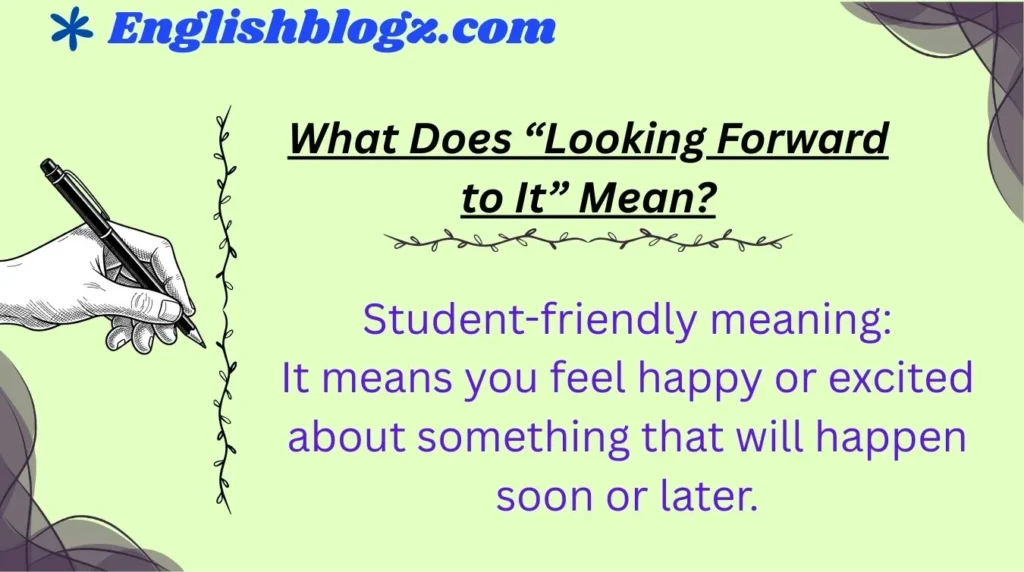
Student-friendly meaning:
It means you feel happy or excited about something that will happen soon or later.
Grammar form:
It is a verb phrase.
“Looking” works as a gerund (verb + ing acting like a noun).
Close synonyms:
- excited about
- eager for
- happy to wait for
Opposite tone ideas:
- not interested in
- dreading
- not excited about
Example sentences:
- I’m looking forward to the trip next week.
- She’s looking forward to meeting the team.
When to Use “Looking Forward to It”
Spoken English
Great for daily talk with friends, family, or coworkers. Sounds warm and natural.
Business English
Okay in polite emails, but better with structure:
I look forward to discussing this with you.
Emails and Messages
Safe and friendly closing line in most situations.
Social Media
Works fine in comments and posts when talking about plans or events.
Academic Writing
Not strong enough. Academic tone prefers neutral phrases like anticipate or expect.
Professional Meetings
Acceptable, but confident alternatives can sound stronger and clearer.
Is “Looking Forward to It” Polite or Professional?
This phrase is polite and friendly. It is not rude at all.
But professionalism depends on context.
Tone levels:
- Soft: friendly chats, casual emails
- Neutral: general work messages
- Professional: formal emails, meetings, client talk
Etiquette tip:
It’s fine for coworkers and clients you know.
Avoid it in very formal corporate letters or legal writing. Choose a stronger, cleaner phrase there.
Pros and Cons of Using “Looking Forward to It”
✔ Pros:
- Easy to understand
- Sounds positive and kind
- Works in many situations
- Good for beginners
✘ Cons:
- Overused
- Sounds weak in formal writing
- Not strong enough for serious business tone
- Repeats too often in emails
Quick Alternatives List (For Fast Use)
If you’re in a hurry, try these one-line swaps:
- Can’t wait for it
- Eager to hear back
- Excited about it
- Happy to discuss
- Keen to see the results
- Anticipating your reply
- I welcome the opportunity
- Delighted to join
- Ready for what’s next
- Hope to connect soon
- Looking ahead to it
- Glad to be part of this
- Awaiting your response
- Thrilled about it
- Interested to learn more
Strong Alternatives You Can Use Right Away
I can’t wait
Meaning:
I feel very excited about what will happen.
Explanation:
This shows strong emotion and real excitement. It sounds friendly and personal.
Grammar Note:
Idiomatic verb phrase.
Example Sentence:
I can’t wait to see you this weekend.
Best Use:
Text messages, casual talk, friendly emails.
Worst Use:
Formal business or academic writing.
Tone:
Friendly, energetic.
Level:
Beginner.
Similarity Score:
9/10.
Replaceability Tip:
Use when excitement matters more than politeness.
I’m eager to
Meaning:
I strongly want something to happen.
Explanation:
This sounds serious and positive. It works well in work and study settings.
Grammar Note:
Adjective + infinitive verb.
Example Sentence:
I’m eager to start the project.
Best Use:
Emails, meetings, academic talk.
Worst Use:
Very casual chat where it may sound stiff.
Tone:
Professional, motivated.
Level:
Intermediate.
Similarity Score:
8/10.
Replaceability Tip:
Choose this when you want to sound driven and focused.
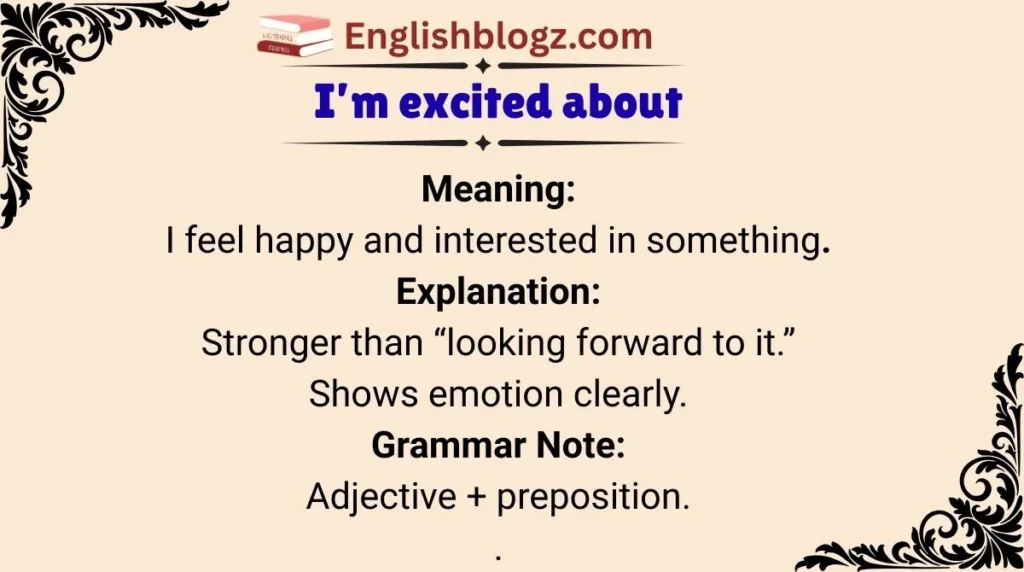
I’m excited about
Meaning:
I feel happy and interested in something.
Explanation:
Stronger than “looking forward to it.” Shows emotion clearly.
Grammar Note:
Adjective + preposition.
Example Sentence:
I’m excited about the new role.
Best Use:
Work chats, social posts, emails.
Worst Use:
Very serious business deals.
Tone:
Positive, open.
Level:
Beginner.
Similarity Score:
9/10.
Replaceability Tip:
Use when you want to show real feeling, not just politeness.
I look forward to hearing from you
Meaning:
I expect and welcome your reply.
Explanation:
A polite email closing. Very common in business English.
Grammar Note:
Fixed formal phrase.
Example Sentence:
I look forward to hearing from you soon.
Best Use:
Professional emails.
Worst Use:
Text messages with friends.
Tone:
Professional, polite.
Level:
Beginner.
Similarity Score:
10/10.
Replaceability Tip:
Perfect when you expect a response.
I welcome the opportunity
Meaning:
I am happy to accept this chance.
Explanation:
Sounds confident and respectful. Great for interviews and formal emails.
Grammar Note:
Formal verb phrase.
Example Sentence:
I welcome the opportunity to discuss this further.
Best Use:
Job emails, proposals, meetings.
Worst Use:
Casual talk.
Tone:
Formal, confident.
Level:
Advanced.
Similarity Score:
7/10.
Replaceability Tip:
Use when you want to sound serious and thankful.
I’m keen to
Meaning:
I am very interested in doing something.
Explanation:
Common in UK English. Sounds friendly but focused.
Grammar Note:
Adjective + infinitive.
Example Sentence:
I’m keen to learn more about the role.
Best Use:
Work talk, interviews, friendly emails.
Worst Use:
Very formal documents.
Tone:
Positive, professional-friendly.
Level:
Intermediate.
Similarity Score:
8/10.
Replaceability Tip:
Great when interest matters more than emotion.
I anticipate
Meaning:
I expect something to happen.
Explanation:
Neutral and calm. No strong emotion.
Grammar Note:
Formal verb.
Example Sentence:
We anticipate a positive response.
Best Use:
Reports, formal writing.
Worst Use:
Personal messages.
Tone:
Neutral, formal.
Level:
Advanced.
Similarity Score:
5/10.
Replaceability Tip:
Use when emotion is not needed.
I’m delighted to
Meaning:
I feel very pleased to do something.
Explanation:
Polite and warm. Often used in formal friendly emails.
Grammar Note:
Adjective + infinitive.
Example Sentence:
I’m delighted to join the team.
Best Use:
Professional emails, announcements.
Worst Use:
Casual texting.
Tone:
Polite, happy.
Level:
Intermediate.
Similarity Score:
8/10.
Replaceability Tip:
Use when gratitude and happiness matter.
I’m happy to
Meaning:
I agree and feel good about it.
Explanation:
Soft and helpful tone. Shows cooperation.
Grammar Note:
Adjective + infinitive.
Example Sentence:
I’m happy to help with the task.
Best Use:
Work emails, teamwork.
Worst Use:
When you want to show excitement.
Tone:
Soft, friendly.
Level:
Beginner.
Similarity Score:
6/10.
Replaceability Tip:
Use when offering support, not excitement.
I’m thrilled about
Meaning:
I feel very excited and joyful.
Explanation:
Strong emotion. Best for happy news.
Grammar Note:
Adjective + preposition.
Example Sentence:
I’m thrilled about the promotion.
Best Use:
Celebrations, announcements.
Worst Use:
Formal business plans.
Tone:
Strong, emotional.
Level:
Intermediate.
Similarity Score:
8/10.
Replaceability Tip:
Use when something truly excites you.
I’m interested in
Meaning:
I want to learn or take part.
Explanation:
Neutral and polite. No strong emotion.
Grammar Note:
Adjective + preposition.
Example Sentence:
I’m interested in the training program.
Best Use:
Professional inquiries, emails.
Worst Use:
Emotional or personal moments.
Tone:
Neutral, polite.
Level:
Beginner.
Similarity Score:
5/10.
Replaceability Tip:
Use when curiosity matters, not excitement.
I hope to
Meaning:
I wish for something to happen.
Explanation:
Soft and polite. Shows desire, not certainty.
Grammar Note:
Verb + infinitive.
Example Sentence:
I hope to meet you soon.
Best Use:
Friendly emails, polite talk.
Worst Use:
Strong commitments.
Tone:
Soft, hopeful.
Level:
Beginner.
Similarity Score:
6/10.
Replaceability Tip:
Use when outcome is not sure.
I look ahead to
Meaning:
I think positively about the future event.
Explanation:
Similar to the original but slightly more formal.
Grammar Note:
Formal verb phrase.
Example Sentence:
We look ahead to working with you.
Best Use:
Business emails, letters.
Worst Use:
Casual chat.
Tone:
Professional.
Level:
Intermediate.
Similarity Score:
9/10.
Replaceability Tip:
Use when you want a polished tone.
I’m ready for
Meaning:
I feel prepared and positive.
Explanation:
Shows confidence more than excitement.
Grammar Note:
Adjective + preposition.
Example Sentence:
I’m ready for the next step.
Best Use:
Motivational talk, interviews.
Worst Use:
When you want to sound polite.
Tone:
Strong, confident.
Level:
Intermediate.
Similarity Score:
5/10.
Replaceability Tip:
Use when confidence matters more than feeling.
I’m glad to
Meaning:
I feel pleased to do something.
Explanation:
Friendly and polite. Light emotion.
Grammar Note:
Adjective + infinitive.
Example Sentence:
I’m glad to be here today.
Best Use:
Meetings, polite talk.
Worst Use:
Formal contracts or reports.
Tone:
Warm, polite.
Level:
Beginner.
Similarity Score:
7/10.
Replaceability Tip:
Use when politeness matters more than excitement.
Mini Dialogue Examples
Formal conversation:
A: We will review your application next week.
B: Thank you. I look forward to hearing from you.
Informal chat:
A: Movie night tomorrow!
B: Nice! I can’t wait.
Business email style:
Thank you for the update. I’m eager to discuss the next steps during our meeting.
Mistakes to Avoid
- Using casual phrases in formal emails.
- Writing “looking forward to it” without saying what “it” is.
- Overusing the same phrase in every message.
- Mixing strong emotion with serious business tone.
- Using slang in professional settings.
- Forgetting grammar after “to” (it must be a noun or -ing).
- Sounding unsure when confidence is needed.
Cultural and Tone Tips
In US English, the phrase feels friendly and safe. It’s common in emails and talks.
In UK English, people often say “keen to” instead. It sounds natural and polite.
In casual social English, short phrases like “can’t wait” feel more real and warm.
Native speakers notice tone fast. Too formal sounds cold. Too casual sounds careless.
Matching the moment matters more than perfect grammar.
Quick Comparison of Strong Options
| Phrase | Tone | Best Context | Professional Level | Example |
|---|---|---|---|---|
| I’m eager to | Professional | Work emails | High | I’m eager to begin |
| I can’t wait | Friendly | Friends | Low | Can’t wait to go |
| I welcome the opportunity | Formal | Interviews | Very high | I welcome the chance |
| I’m delighted to | Polite | Announcements | High | Delighted to join |
| I’m interested in | Neutral | Inquiries | Medium | Interested in details |
| I look ahead to | Professional | Business letters | High | Look ahead to working |
| I’m thrilled about | Emotional | Happy news | Medium | Thrilled about it |
FAQs
Is “looking forward to it” rude?
No. It is polite and friendly in most cases.
Is it okay to use in emails?
Yes, especially in normal business emails. Avoid it in very formal letters.
What is the most formal alternative?
“I welcome the opportunity” and “I anticipate” are very formal.
What is the most polite alternative?
“I’m delighted to” and “I look forward to hearing from you.”
What should beginners use?
“I’m happy to” and “I’m excited about” are easy and safe.
Can I use slang instead?
Only with friends. Never in professional writing.
Conclusion
Words shape how people see you. Small changes make big differences. When you replace “looking forward to it” with stronger, clearer options, your message becomes sharper and more natural.
You sound confident in meetings, polite in emails, and friendly in daily talk. That builds trust and better communication. Practice these phrases in real life.
Try them in texts, emails, and conversations. Soon, they will feel natural. Strong language opens doors. Use it wisely.

“Jacob Harper makes English learning simple and fun. He shares tips to help everyone improve confidently.”