You’ve probably said “don’t get me wrong” many times. It’s a handy phrase. You use it when you want to correct a possible misunderstanding or soften a strong opinion.
However, using the same phrase again and again can sound dull, casual, or even defensive in serious settings.
Word choice shapes tone. Tone shapes trust. In emails, meetings, essays, and daily talk, small changes in wording can make you sound calm, clear, and professional. Strong alternatives help you explain ideas without sounding harsh or awkward.
For example:
Informal: Don’t get me wrong, I like the idea.
Formal: To be clear, I support the idea.
Same message. Better fit for work. Better impact.
Let’s break down what the phrase means and explore smarter ways to say it in every situation.
What Does “Don’t Get Me Wrong” Mean?
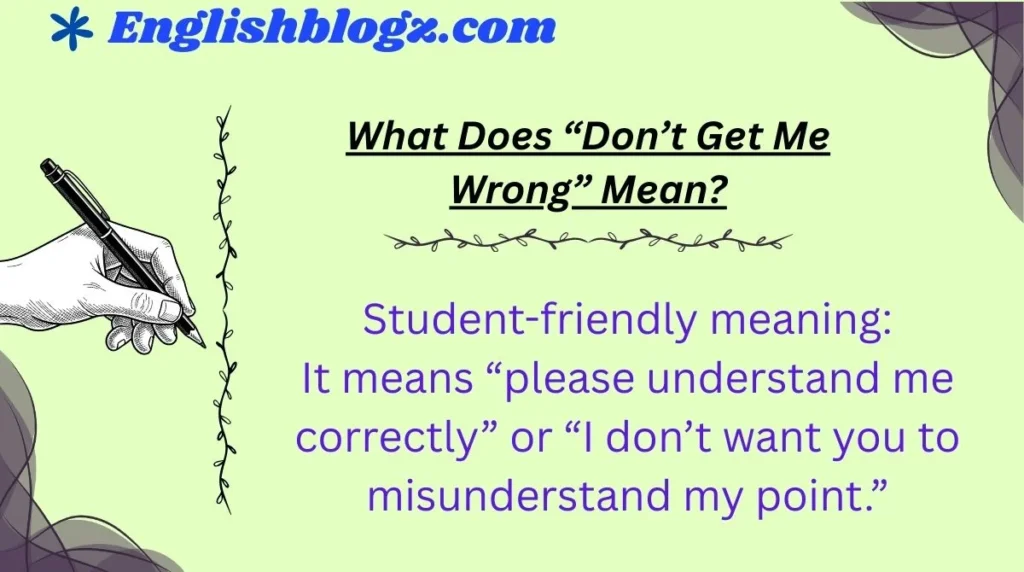
Student-friendly meaning:
It means “please understand me correctly” or “I don’t want you to misunderstand my point.”
You use it before or after a statement that could sound negative, strong, or confusing.
Grammar form:
It’s an idiomatic expression. You can’t change the words much without losing the meaning.
Similar ideas:
- To be clear
- Let me clarify
- Just to clarify
Opposite tone:
- I mean exactly what I said
- No explanation needed
Examples:
- Don’t get me wrong, I respect her, but I disagree.
- I enjoy the job. Don’t get me wrong. It’s just very tiring.
When to Use “Don’t Get Me Wrong”
Spoken English
Great for quick explanations in casual talk. It sounds natural in friendly chats.
Business English
Okay in meetings, but softer or clearer phrases work better in formal talks.
Emails / Messages
Not ideal for serious emails. It can sound emotional or defensive.
Social Media
Very common. People use it to avoid backlash or clarify opinions.
Academic Writing
Avoid it. Use formal transitions like “to clarify” or “it is important to note.”
Professional Meetings
Use when speaking, but pair it with calm body language and neutral tone.
Is “Don’t Get Me Wrong” Polite or Professional?
This phrase sits in the middle of the tone scale.
- Polite: Yes, if said calmly
- Neutral: Often
- Strong: Can sound firm if stressed
- Soft: Not very
- Formal: No
- Informal: Yes
Etiquette tip:
Better for speech than writing. Avoid it in corporate emails or client messages. Choose clearer, calmer wording instead.
Pros & Cons of Using “Don’t Get Me Wrong”
✔ Pros:
- Quick and easy to say
- Sounds natural in conversation
- Helps prevent misunderstanding
- Softens criticism
✘ Cons:
- Sounds casual
- Can feel defensive
- Not suitable for formal writing
- Overused by many speakers
Quick Alternatives List (For Fast Use)
- To be clear
- Let me clarify
- Just to be clear
- I don’t mean to suggest
- That’s not to say
- Please understand
- I’m not saying that
- For the record
- Let’s be clear about this
- I want to make this clear
- Not that I disagree, but
- I should clarify
- This isn’t to imply
- Allow me to explain
- Before you misunderstand
Now let’s go deeper with the best alternatives and how to use them right.
Powerful Alternatives to “Don’t Get Me Wrong”
To be clear
Meaning:
I want to explain this clearly.
Explanation:
This phrase signals clarity and honesty. It sounds calm and confident. Great for professional settings.
Grammar Note:
Formal transition phrase.
Example Sentence:
To be clear, I support the plan, but the timeline needs work.
Best Use:
Workplace, emails, presentations.
Worst Use:
Very casual chats where it may sound stiff.
Tone:
Professional, neutral.
Level:
Beginner.
Similarity Score:
8/10
Replaceability Tip:
Use when you want to correct confusion without sounding emotional.
Let me clarify
Meaning:
I will explain again in a better way.
Explanation:
This works well when someone already misunderstood you. It keeps things calm and focused.
Grammar Note:
Verb phrase.
Example Sentence:
Let me clarify what I meant by that comment.
Best Use:
Meetings, emails, teaching.
Worst Use:
Arguments where emotions are high.
Tone:
Professional, calm.
Level:
Beginner.
Similarity Score:
9/10
Replaceability Tip:
Perfect when you need to fix confusion quickly.
That’s not to say
Meaning:
This does not mean the opposite is true.
Explanation:
You use this to balance two ideas. It sounds thoughtful and formal.
Grammar Note:
Formal linking phrase.
Example Sentence:
The project is delayed. That’s not to say it won’t succeed.
Best Use:
Reports, formal talks, essays.
Worst Use:
Casual texting.
Tone:
Formal, neutral.
Level:
Advanced.
Similarity Score:
7/10
Replaceability Tip:
Use when adding balance to a strong statement.
I don’t mean to suggest
Meaning:
I’m not trying to say something negative or wrong.
Explanation:
This phrase protects relationships. It shows respect and care.
Grammar Note:
Verb phrase.
Example Sentence:
I don’t mean to suggest your idea is bad.
Best Use:
Feedback, teamwork, emails.
Worst Use:
Very casual talk.
Tone:
Polite, soft.
Level:
Intermediate.
Similarity Score:
9/10
Replaceability Tip:
Use when you worry your words may sound critical.
For the record
Meaning:
I want to state this clearly and officially.
Explanation:
This phrase adds firmness. It works when you want no confusion.
Grammar Note:
Idiomatic phrase.
Example Sentence:
For the record, I did support the proposal.
Best Use:
Meetings, formal discussions.
Worst Use:
Friendly chats.
Tone:
Strong, professional.
Level:
Intermediate.
Similarity Score:
6/10
Replaceability Tip:
Use when you want to be very clear and firm.
Just to clarify
Meaning:
I want to explain something small or simple.
Explanation:
Softer than “let me clarify.” Sounds polite and friendly.
Grammar Note:
Softening phrase.
Example Sentence:
Just to clarify, the deadline is Friday.
Best Use:
Emails, team chats.
Worst Use:
Formal legal writing.
Tone:
Friendly, neutral.
Level:
Beginner.
Similarity Score:
8/10
Replaceability Tip:
Great for small corrections.
This isn’t to imply
Meaning:
I’m not suggesting something negative.
Explanation:
Useful when your words could sound judgmental.
Grammar Note:
Formal phrase.
Example Sentence:
This isn’t to imply that anyone failed.
Best Use:
Reports, presentations.
Worst Use:
Text messages.
Tone:
Formal, careful.
Level:
Advanced.
Similarity Score:
7/10
Replaceability Tip:
Use when protecting others from blame.
I’m not saying that
Meaning:
I don’t mean that extreme idea.
Explanation:
Direct and simple. Works in spoken English.
Grammar Note:
Verb phrase.
Example Sentence:
I’m not saying that you’re wrong.
Best Use:
Conversations, debates.
Worst Use:
Formal writing.
Tone:
Neutral, casual.
Level:
Beginner.
Similarity Score:
9/10
Replaceability Tip:
Use when correcting misunderstandings in speech.
Allow me to explain
Meaning:
Please let me give more details.
Explanation:
Very polite and respectful. Sounds confident and calm.
Grammar Note:
Formal request phrase.
Example Sentence:
Allow me to explain the full process.
Best Use:
Presentations, formal talks.
Worst Use:
Casual chat.
Tone:
Formal, professional.
Level:
Advanced.
Similarity Score:
6/10
Replaceability Tip:
Use when speaking to older people or clients.
Before you misunderstand
Meaning:
Let me stop confusion early.
Explanation:
You use this before sharing a sensitive point.
Grammar Note:
Introductory clause.
Example Sentence:
Before you misunderstand, this isn’t a complaint.
Best Use:
Serious conversations.
Worst Use:
Formal writing.
Tone:
Careful, friendly.
Level:
Intermediate.
Similarity Score:
8/10
Replaceability Tip:
Good when talking about sensitive topics.
Let’s be clear about this
Meaning:
I want strong clarity on this point.
Explanation:
Sounds firm. Best when setting rules or expectations.
Grammar Note:
Imperative phrase.
Example Sentence:
Let’s be clear about this: deadlines matter.
Best Use:
Leadership, meetings.
Worst Use:
Soft personal talks.
Tone:
Strong, professional.
Level:
Intermediate.
Similarity Score:
6/10
Replaceability Tip:
Use when setting boundaries.
I want to make this clear
Meaning:
This point is very important.
Explanation:
Direct but polite. Good for serious topics.
Grammar Note:
Verb phrase.
Example Sentence:
I want to make this clear. We support your growth.
Best Use:
Feedback sessions, emails.
Worst Use:
Jokes or casual chat.
Tone:
Serious, professional.
Level:
Beginner.
Similarity Score:
7/10
Replaceability Tip:
Use when stressing key points.
Not that I disagree, but
Meaning:
I partly agree, but I have concerns.
Explanation:
Softens disagreement. Keeps conversations friendly.
Grammar Note:
Conversational phrase.
Example Sentence:
Not that I disagree, but we should check the budget.
Best Use:
Team talks, casual work chats.
Worst Use:
Formal reports.
Tone:
Friendly, soft.
Level:
Intermediate.
Similarity Score:
7/10
Replaceability Tip:
Use when disagreeing politely.
I should clarify
Meaning:
I need to explain better.
Explanation:
Sounds responsible and polite.
Grammar Note:
Verb phrase.
Example Sentence:
I should clarify what I meant earlier.
Best Use:
Emails, follow-up talks.
Worst Use:
Heated arguments.
Tone:
Polite, neutral.
Level:
Beginner.
Similarity Score:
9/10
Replaceability Tip:
Great for fixing past confusion.
Please understand
Meaning:
I want you to see my point.
Explanation:
Adds emotional tone. Use carefully.
Grammar Note:
Polite request phrase.
Example Sentence:
Please understand, this decision was not easy.
Best Use:
Personal messages, apologies.
Worst Use:
Formal reports.
Tone:
Emotional, soft.
Level:
Beginner.
Similarity Score:
6/10
Replaceability Tip:
Use when feelings are involved.
Mini Dialogue Examples
Formal Conversation
Manager: The schedule must change.
Employee: To be clear, I support the change. I just need more notice.
Informal Conversation
Friend: So you hate your job?
You: I’m not saying that. I just need a break.
Business Email Style
Let me clarify my earlier message. I agree with the proposal, but I suggest a longer review period.
Mistakes to Avoid
- Using casual phrases in formal emails
- Sounding defensive instead of calm
- Repeating the same phrase too often
- Mixing strong tone with soft wording
- Using slang in professional settings
- Over-explaining simple points
- Using emotional words in business writing
Cultural & Tone Tips
In US English, people prefer clear and direct language. Phrases like “to be clear” or “let me clarify” sound natural and respectful.
In UK English, speakers often soften statements. Phrases like “that’s not to say” feel polite and balanced.
In casual social English, short phrases work best. “I’m not saying that” or “just to be clear” sound friendly and natural.
Tone always matters more than the words alone. Calm voice plus clear words equals trust.
Comparison Table: Best Alternatives
| Phrase | Tone | Best Context | Professional Level | Example |
|---|---|---|---|---|
| To be clear | Neutral | Meetings | High | To be clear, I agree with you. |
| Let me clarify | Calm | Emails | High | Let me clarify the process. |
| I’m not saying that | Casual | Talk | Medium | I’m not saying that you failed. |
| That’s not to say | Formal | Writing | High | That’s not to say it won’t work. |
| Just to clarify | Friendly | Team chat | Medium | Just to clarify, Friday is the due date. |
| Allow me to explain | Formal | Presentations | High | Allow me to explain the results. |
FAQs
Is “don’t get me wrong” rude?
No, but it can sound defensive. Tone matters.
Is it okay in emails?
It’s better to use clearer, more formal phrases in emails.
What is the most formal alternative?
“Allow me to explain” or “that’s not to say.”
What is the most polite alternative?
“I don’t mean to suggest” sounds very respectful.
What should beginners use?
Try “to be clear” or “let me clarify.” They’re simple and safe.
Can I use it in academic writing?
No. Use formal transitions instead.
Conclusion
Strong communication depends on smart word choice. “Don’t get me wrong” works in casual talk, but it doesn’t fit every setting.
When you switch to clearer and calmer phrases, you sound more confident, more professional, and more fluent.
These alternatives help you explain ideas without sounding rude, emotional, or unclear. They also help you match your tone to the moment, whether you’re writing an email, giving feedback, or chatting with friends.
Practice a few phrases each week. Use them in real conversations. Soon, clear and natural English will feel easy and automatic.

“Jacob Harper makes English learning simple and fun. He shares tips to help everyone improve confidently.”