Last updated on July 14th, 2026 at 08:28 am
The phrase “even though” is a common connector in English that introduces contrast or an unexpected result. For instance, “Even though it rained, we went hiking.”
It shows that one action or fact happened despite another. While useful, overusing “even though” can make writing and speech repetitive.
Learning alternatives allows English learners and professionals to express the same idea more naturally and flexibly.
Choosing the right synonym also impacts tone. In formal emails, essays, or presentations, some alternatives sound more polished than the casual “though” used in conversation. For example:
- Formal: “Although the project was delayed, the team met the deadline.”
- Informal: “Even though it rained, we still went out.”
By varying expressions, you not only improve clarity but also adapt your language for business, social media, academic writing, and daily conversations.
Using alternatives strategically helps convey professionalism, friendliness, or emphasis depending on the situation.
What Does “Even Though” Mean?
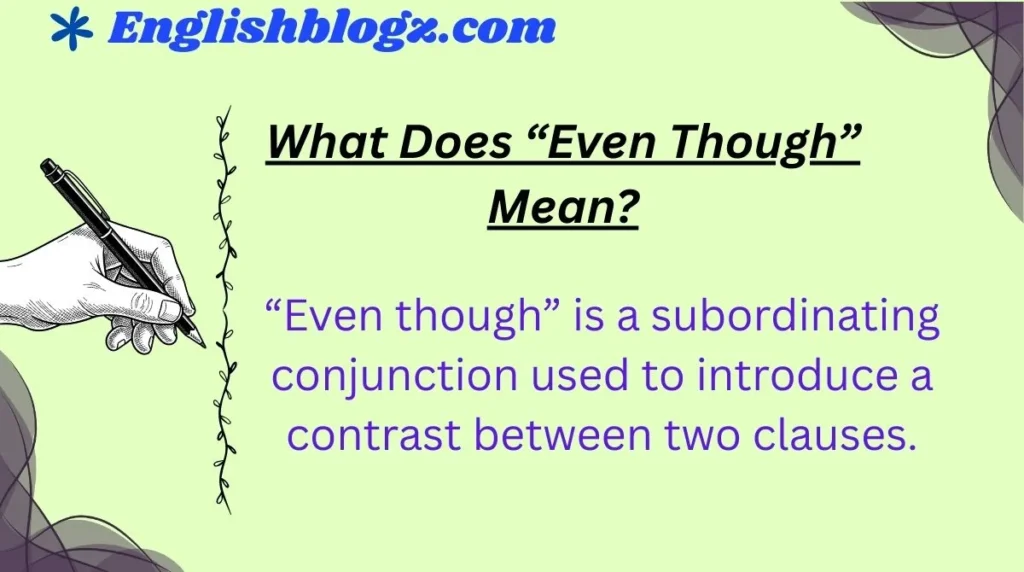
“Even though” is a subordinating conjunction used to introduce a contrast between two clauses.
- Grammar Form: Conjunction
- Definition for Students: It shows that something happens or is true despite another fact or situation.
- Synonyms: Although, though, despite the fact that, in spite of the fact that
- Opposite Tone Words: Because, since, due to (these indicate reason rather than contrast)
Examples:
- Even though he was tired, he finished his homework.
- She stayed calm even though everyone was panicking.
When to Use “Even Though”
Spoken English: Perfect for casual conversation and storytelling.
Business English: Works, but alternatives like “although” sound more professional.
Emails / Messages: Acceptable for informal internal emails; use alternatives for client-facing messages.
Social Media: Very common in captions or posts.
Academic Writing: Prefer “although” or “despite the fact that” for formal tone.
Professional Meetings: Can be used in speech, but written reports should lean toward formal equivalents.
Is “Even Though” Polite or Professional?
Tone Levels:
- Polite: Neutral; rarely rude.
- Neutral: Safe in most contexts.
- Strong: Adds emphasis but can seem casual.
- Soft: Gentle contrast in conversation.
Formal vs Informal:
- Formal: Use “although” or “despite the fact that.”
- Informal: “Even though” works naturally in speech.
Etiquette Tip: Avoid “even though” in client emails or formal reports. Prefer “although” to maintain professionalism.
Pros & Cons of Using “Even Though”
✔ Pros:
- Easy to understand
- Flexible in spoken and written English
- Emphasizes contrast naturally
✘ Cons:
- Overused in writing
- May sound casual in professional documents
- Limited variety for advanced writing
Quick Alternatives List (One-Line Phrases Only)
- Although
- Though
- Even if
- In spite of the fact that
- Despite the fact that
- While
- Whereas
- Notwithstanding
- Yet
- Albeit
- Regardless of
- Be that as it may
- Still
- Though it may be
- For all that
MAIN BODY: 15 Alternatives
Although
Meaning: Introduces contrast between two ideas.
Explanation: Polished, professional, works in essays and formal writing.
Grammar Note: Conjunction
Example Sentence: Although it was raining, the event continued.
Best Use: Academic, formal writing, emails
Worst Use: Casual texting (may sound stiff)
Tone: Formal
Level: Intermediate
Similarity Score: 10/10
Replaceability Tip: Use when writing formally instead of “even though.”
Though
Meaning: Informal contrast; can appear mid-sentence.
Explanation: Casual and natural in speech.
Grammar Note: Conjunction
Example Sentence: She kept smiling, though she was nervous.
Best Use: Conversations, social media
Worst Use: Formal reports
Tone: Friendly
Level: Beginner
Similarity Score: 9/10
Replaceability Tip: Best for everyday speech or casual writing.
Even if
Meaning: Expresses hypothetical contrast.
Explanation: Focuses on potential situations rather than facts.
Grammar Note: Conjunction
Example Sentence: Even if it snows, we will travel tomorrow.
Best Use: Conversations, informal emails
Worst Use: Academic writing
Tone: Neutral
Level: Intermediate
Similarity Score: 8/10
Replaceability Tip: Use when emphasizing possibilities, not confirmed facts.
In spite of the fact that
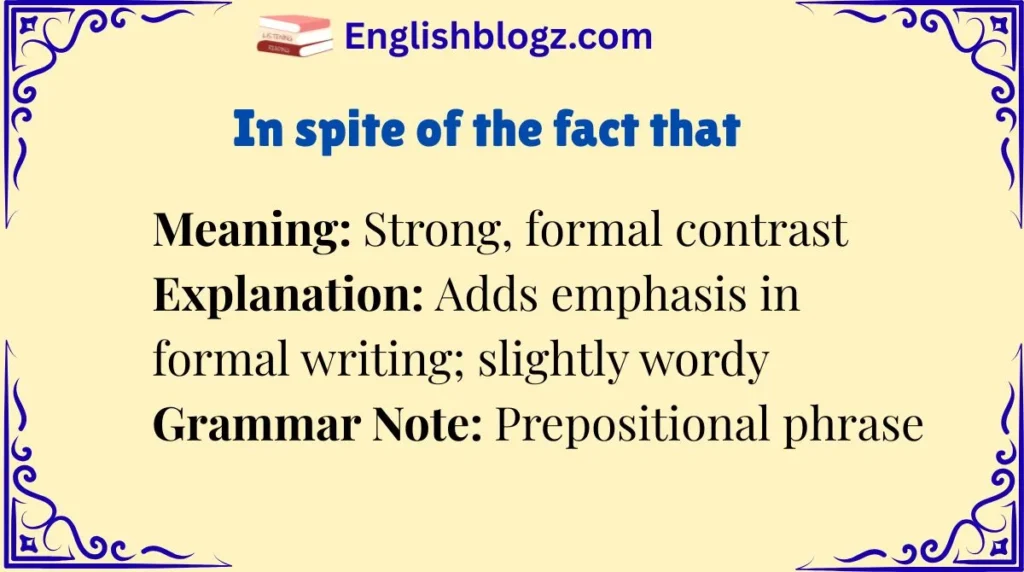
Meaning: Strong, formal contrast
Explanation: Adds emphasis in formal writing; slightly wordy
Grammar Note: Prepositional phrase
Example Sentence: In spite of the fact that he was sick, he attended the meeting.
Best Use: Academic, professional writing
Worst Use: Text messages or casual speech
Tone: Formal
Level: Advanced
Similarity Score: 10/10
Replaceability Tip: Use when clarity and formality are needed.
Despite the fact that
Meaning: Highlights contrast formally
Explanation: Strong formal tone, concise alternative to “in spite of the fact that”
Grammar Note: Prepositional phrase
Example Sentence: Despite the fact that sales were down, profits increased.
Best Use: Reports, essays, emails
Worst Use: Informal speech
Tone: Formal
Level: Advanced
Similarity Score: 10/10
Replaceability Tip: Use in professional contexts for a polished sound.
While
Meaning: Shows contrast, sometimes simultaneous actions
Explanation: Can be formal or neutral depending on context
Grammar Note: Conjunction
Example Sentence: While I enjoy coffee, I prefer tea in the morning.
Best Use: Academic, spoken English
Worst Use: Strongly casual tone may confuse
Tone: Neutral/Formal
Level: Intermediate
Similarity Score: 9/10
Replaceability Tip: Good for simultaneous contrasting actions.
Whereas
Meaning: Formal contrast between two statements
Explanation: Highlights difference rather than unexpected outcome
Grammar Note: Conjunction
Example Sentence: He likes tea, whereas I prefer coffee.
Best Use: Professional reports, essays
Worst Use: Casual conversation
Tone: Formal
Level: Advanced
Similarity Score: 9/10
Replaceability Tip: Use in academic or professional comparisons.
Notwithstanding
Meaning: Formal, emphasizes contrast
Explanation: Old-fashioned, strong professional tone
Grammar Note: Preposition/conjunction
Example Sentence: Notwithstanding his busy schedule, he attended the meeting.
Best Use: Legal, corporate writing
Worst Use: Casual conversation
Tone: Formal/Professional
Level: Advanced
Similarity Score: 9/10
Replaceability Tip: Use in formal or legal contexts.
Yet
Meaning: Short, casual contrast
Explanation: Works mid-sentence; can be formal if structured correctly
Grammar Note: Conjunction
Example Sentence: He was tired, yet he continued working.
Best Use: Conversations, semi-formal writing
Worst Use: Overuse can sound simplistic
Tone: Neutral/Formal
Level: Beginner/Intermediate
Similarity Score: 8/10
Replaceability Tip: Use for simple contrast in both casual and formal settings.
Albeit
Meaning: Introduces a concession in a formal tone
Explanation: Elegant, slightly literary
Grammar Note: Conjunction
Example Sentence: The journey was long, albeit enjoyable.
Best Use: Essays, professional writing
Worst Use: Casual texting
Tone: Formal
Level: Advanced
Similarity Score: 9/10
Replaceability Tip: Use for sophisticated written contrast.
Regardless of
Meaning: Ignores opposing factor
Explanation: Focuses on outcome rather than contrast
Grammar Note: Preposition
Example Sentence: Regardless of the weather, the event continued.
Best Use: Professional emails, announcements
Worst Use: Overly casual contexts
Tone: Neutral/Formal
Level: Intermediate
Similarity Score: 8/10
Replaceability Tip: Use for emphasis on action or outcome.
Be that as it may
Meaning: Polite acknowledgment before contrast
Explanation: Often used in speeches and formal writing
Grammar Note: Idiom
Example Sentence: Be that as it may, we need to focus on the results.
Best Use: Professional meetings, formal essays
Worst Use: Casual conversation
Tone: Formal/Neutral
Level: Advanced
Similarity Score: 9/10
Replaceability Tip: Use for polite concession.
Still
Meaning: Simple contrast or concession
Explanation: Emphasizes continuation despite contrast
Grammar Note: Adverb
Example Sentence: He was tired. Still, he finished the report.
Best Use: Spoken English, informal writing
Worst Use: Formal reports without context
Tone: Neutral/Friendly
Level: Beginner
Similarity Score: 8/10
Replaceability Tip: Use for simple emphasis.
Though it may be
Meaning: Soft, polite contrast
Explanation: Adds humility or caution to a statement
Grammar Note: Conjunction + modal
Example Sentence: Though it may be difficult, we will succeed.
Best Use: Formal speech, professional emails
Worst Use: Very casual conversation
Tone: Formal/Soft
Level: Advanced
Similarity Score: 9/10
Replaceability Tip: Use when expressing polite acknowledgment.
For all that
Meaning: Despite everything mentioned
Explanation: Neutral, slightly literary
Grammar Note: Idiom
Example Sentence: He failed many tests. For all that, he kept trying.
Best Use: Storytelling, essays
Worst Use: Corporate emails
Tone: Neutral/Formal
Level: Intermediate
Similarity Score: 8/10
Replaceability Tip: Use in narratives or reflective writing.
Mini Dialogue Examples
Formal Dialogue:
A: “Although the report was late, the manager praised your work.”
B: “Thank you, I prioritized quality over speed.”
Informal Dialogue:
A: “Even though it’s raining, want to play football?”
B: “Sure! Rain never stops us.”
Business Email-Style:
Subject: Project Update
“Despite the fact that we faced delays, the team completed the project on schedule. Great job, everyone.”
Mistakes to Avoid
- Using “even though” in very formal reports.
- Confusing although and even if.
- Starting a sentence incorrectly: “Even though, he was late…” (wrong comma use).
- Overusing the phrase repetitively.
- Using casual alternatives in legal documents.
- Mixing despite with that incorrectly: “Despite that he was tired” (incorrect).
- Misjudging tone: “even though” can sound casual in high-level essays.
Cultural & Tone Tips
- UK English: “Although” is slightly more formal and preferred in writing.
- US English: “Even though” is very common in conversation.
- Casual Social English: “Though” and “even though” dominate everyday speech.
- Tone Awareness: Using more formal alternatives signals professionalism in business emails and academic writing.
Comparison Table: Best Alternatives
| Phrase | Tone | Best Context | Professional Level | Example |
|---|---|---|---|---|
| Although | Formal | Essays, emails | High | Although it rained, we went out. |
| Though | Friendly | Conversation, posts | Low | She smiled, though she was tired. |
| Despite the fact that | Formal | Reports, essays | High | Despite the fact that sales were down, profits rose. |
| In spite of the fact that | Formal | Academic writing | High | In spite of the fact that he was sick, he attended. |
| Whereas | Formal | Comparisons, reports | High | He likes tea, whereas I prefer coffee. |
| Albeit | Formal/Literary | Essays, formal writing | High | The task was difficult, albeit rewarding. |
| Even if | Neutral | Hypothetical scenarios | Medium | Even if it snows, we’ll travel. |
FAQs
Is “even though” rude?
No, it is neutral and rarely rude. Tone depends on context.
Is it okay in emails?
Yes, but better for informal internal emails. Use although for clients.
What is the most formal alternative?
In spite of the fact that or despite the fact that.
What is the most polite alternative?
Though it may be adds softness and politeness.
What should beginners use?
Although and though are simple, versatile choices.
Can “even though” be used in academic writing?
Yes, but although or despite often sound more formal and polished.
Conclusion
Mastering alternatives to “even though” enriches your English. It allows you to adapt your tone for casual conversation, professional emails, academic essays, or social media posts.
Using phrases like although, despite, albeit, or whereas improves clarity, reduces repetition, and makes you sound confident and fluent.
Practice using these alternatives in real conversations and writing to develop natural, strong, and versatile English skills.

“Jacob Harper makes English learning simple and fun. He shares tips to help everyone improve confidently.”