You’ve probably used etc. many times. It’s short. It’s easy. It means “and other similar things.”
However, overusing etc. can make your writing sound lazy, unclear, or unprofessional—especially in emails, reports, and academic work.
Choosing better alternatives helps you sound clearer, smarter, and more confident. Word choice affects tone. It changes how polite, formal, or serious your message feels.
In business writing, the right phrase builds trust. In daily conversation, it makes you sound natural. In essays, it shows strong language control.
Quick contrast example:
- Informal: Bring notebooks, pens, etc.
- More professional: Bring notebooks, pens, and other necessary materials.
Small changes like this raise the quality of your English instantly.
What Does “Etc.” Mean?
Etc. comes from the Latin phrase et cetera.
It means “and other similar things” or “and so on.”
Grammar form:
Abbreviation / discourse marker (not a full sentence part)
Similar meanings:
- and so on
- and more
- and others
Opposite tone (more specific):
- namely
- specifically
- exactly
Example sentences:
- We sell shoes, bags, etc.
- The report covers finance, marketing, etc.
When to Use “Etc.”
Spoken English
Used often in casual speech when details are obvious.
Business English
Acceptable in speech, risky in writing.
Emails / Messages
Okay in internal or friendly emails. Avoid in formal ones.
Social Media
Very common and natural.
Academic Writing
Usually discouraged. Be specific instead.
Professional Meetings
Fine when speaking, not ideal in documents or slides.
Is “Etc.” Polite or Professional?
Tone levels:
- Polite: Neutral
- Formality: Low
- Clarity: Medium to low
Formal vs Informal
- Informal: Perfectly fine
- Formal: Often too vague
Etiquette tip:
Use etc. in conversation.
Avoid it in corporate emails, reports, and proposals.
Pros & Cons of Using “Etc.”
✔ Pros:
- Saves time
- Sounds natural in speech
- Easy for beginners
✘ Cons:
- Feels vague
- Sounds lazy in writing
- Weakens professional tone
Quick Alternatives List (Fast Help)
- and so on
- and others
- among others
- including but not limited to
- and similar items
- and additional items
- and related matters
- and more
- and the like
- and other relevant factors
Strong Alternatives to “Etc.”
And So On
Meaning:
And other similar things.
Explanation:
This is the closest spoken alternative. It sounds natural and friendly.
Grammar Note:
Phrase / discourse marker
Example Sentence:
We talked about pricing, delivery times, and so on.
Best Use:
Conversation, informal emails
Worst Use:
Legal or academic writing
Tone:
Neutral, friendly
Level:
Beginner
Similarity Score:
9/10
Replaceability Tip:
Use when you want a spoken feel without using etc.
And Others
Meaning:
Additional people or things.
Explanation:
Clearer than etc. and works well with people or items.
Grammar Note:
Noun phrase
Example Sentence:
She invited Sarah, Ali, and others.
Best Use:
Emails, workplace talk
Worst Use:
Highly formal documents
Tone:
Neutral
Level:
Beginner
Similarity Score:
8/10
Replaceability Tip:
Great when listing people.
Among Others
Meaning:
Part of a larger group.
Explanation:
Adds a polished, professional tone.
Grammar Note:
Prepositional phrase
Example Sentence:
The project covers cost reduction, automation, among others.
Best Use:
Reports, presentations
Worst Use:
Casual texting
Tone:
Professional
Level:
Intermediate
Similarity Score:
7/10
Replaceability Tip:
Choose this for business or academic writing.
Including but Not Limited To
Meaning:
The list is only partial.
Explanation:
Very formal. Often used in contracts and policies.
Grammar Note:
Formal phrase
Example Sentence:
The benefits include health insurance, bonuses, and paid leave, including but not limited to these.
Best Use:
Legal, corporate writing
Worst Use:
Daily conversation
Tone:
Very formal
Level:
Advanced
Similarity Score:
6/10
Replaceability Tip:
Use when precision matters legally.
And Similar Items
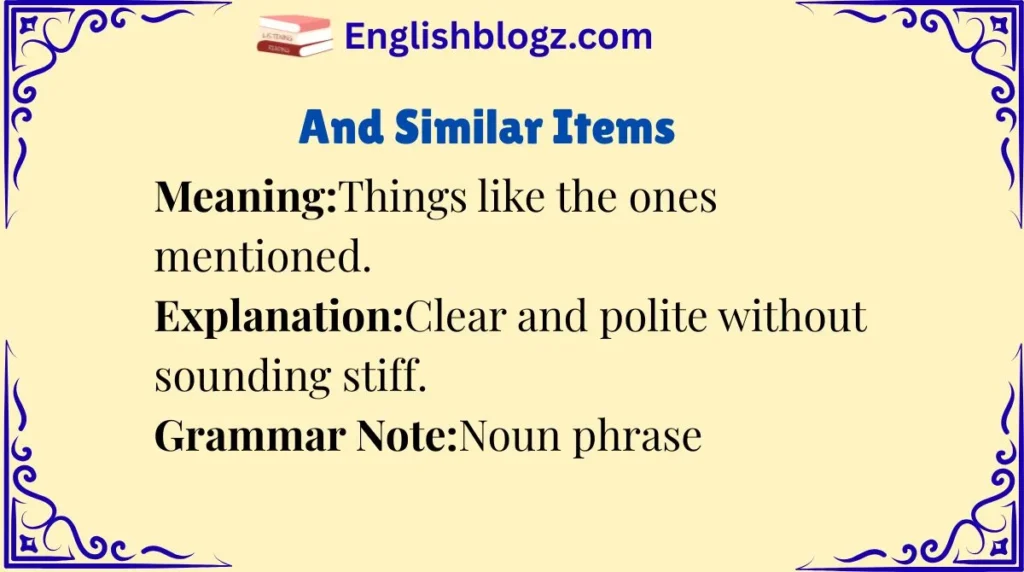
Meaning:
Things like the ones mentioned.
Explanation:
Clear and polite without sounding stiff.
Grammar Note:
Noun phrase
Example Sentence:
Please bring ID cards, documents, and similar items.
Best Use:
Emails, instructions
Worst Use:
Creative writing
Tone:
Professional, soft
Level:
Intermediate
Similarity Score:
8/10
Replaceability Tip:
Good balance between clarity and tone.
And the Like
Meaning:
Things of the same type.
Explanation:
Sounds slightly old-fashioned but still correct.
Grammar Note:
Idiomatic phrase
Example Sentence:
They discussed budgets, timelines, and the like.
Best Use:
Formal speech, writing
Worst Use:
Very casual chat
Tone:
Formal-neutral
Level:
Intermediate
Similarity Score:
7/10
Replaceability Tip:
Useful in presentations.
And More
Meaning:
Additional things exist.
Explanation:
Short, modern, and informal.
Grammar Note:
Phrase
Example Sentence:
The app offers tracking, alerts, and more.
Best Use:
Marketing, social media
Worst Use:
Academic writing
Tone:
Casual
Level:
Beginner
Similarity Score:
6/10
Replaceability Tip:
Perfect for promotional language.
And Additional Items
Meaning:
Extra things beyond the list.
Explanation:
Sounds organized and professional.
Grammar Note:
Noun phrase
Example Sentence:
The package includes tools, manuals, and additional items.
Best Use:
Business writing
Worst Use:
Text messages
Tone:
Professional
Level:
Intermediate
Similarity Score:
7/10
Replaceability Tip:
Use when clarity matters.
And Related Matters
Meaning:
Connected topics or issues.
Explanation:
Abstract and formal.
Grammar Note:
Formal phrase
Example Sentence:
The meeting covered compliance, safety, and related matters.
Best Use:
Reports, meetings
Worst Use:
Casual speech
Tone:
Formal
Level:
Advanced
Similarity Score:
6/10
Replaceability Tip:
Best for serious topics.
And Other Relevant Factors
Meaning:
Other important elements.
Explanation:
Precise and analytical.
Grammar Note:
Formal noun phrase
Example Sentence:
We considered cost, time, and other relevant factors.
Best Use:
Academic, professional writing
Worst Use:
Informal talk
Tone:
Professional, strong
Level:
Advanced
Similarity Score:
6/10
Replaceability Tip:
Ideal for analysis and reports.
Mini Dialogue Examples
Formal conversation
Manager: “The report covers risks, timelines, and other relevant factors.”
Informal conversation
Friend: “We need snacks, drinks, and stuff like that.”
Business email style
The proposal includes pricing details, delivery terms, and additional items for review.
Common Mistakes to Avoid
- Using etc. in formal emails
- Ending sentences with etc. too often
- Using etc. after “such as”
- Using it in academic essays
- Mixing etc. with formal phrases
- Being unclear about what’s included
Cultural & Tone Tips
US English
Very common in speech. Avoid in formal writing.
UK English
Slightly more accepted in writing, still informal.
Casual Social English
Perfectly natural. No issues at all.
Native speakers feel etc. is quick but vague. Professionals prefer clarity.
Comparison Table
| Phrase | Tone | Best Context | Professional Level | Example |
|---|---|---|---|---|
| And so on | Friendly | Speech | Low | Plans, goals, and so on |
| Among others | Neutral | Reports | Medium | Costs, delays, among others |
| Including but not limited to | Formal | Legal | High | Benefits include… |
| And similar items | Soft | Emails | Medium | Files and similar items |
| And the like | Formal | Presentations | Medium | Budgets and the like |
| And more | Casual | Marketing | Low | Features and more |
FAQs
Is “etc.” rude?
No. It’s informal, not rude.
Is it okay in emails?
Yes, in casual or internal emails.
What is the most formal alternative?
Including but not limited to
What is the most polite option?
And similar items
What should beginners use?
And so on or and others
Can I use “etc.” in essays?
It’s better to avoid it.
Conclusion
Using only etc. limits your English. Strong alternatives give you control over tone, clarity, and professionalism.
They help you sound confident in emails, meetings, essays, and daily conversation. Small word changes create big results.
Practice replacing etc. with clearer phrases. Listen to how native speakers adjust tone. Over time, your English will sound more natural, polished, and effective.
Language grows when you use it with purpose.

“Jacob Harper makes English learning simple and fun. He shares tips to help everyone improve confidently.”