The phrase “That works for me” is a simple yet powerful way to express agreement or acceptance.
It signals that a suggestion, plan, or idea is suitable, convenient, or acceptable to you.
While widely used, relying on the same expression repeatedly can make your language sound repetitive or informal, especially in professional or academic settings.
Using alternative expressions can improve clarity, convey the right tone, and show your versatility in English.
For instance, saying “That suits me perfectly” sounds more formal than “Cool, that’s fine with me”, which feels casual.
Choosing the right phrase matters in emails, workplace discussions, or casual chats.
By expanding your vocabulary with varied alternatives, you can express agreement confidently, sounding natural in different contexts—be it a corporate meeting, a text message, or an academic paper.
What Does “That Works for Me” Mean?
Definition: The phrase means you agree with a plan, idea, or suggestion. It expresses convenience, acceptance, or approval.
Grammar Form: Idiomatic phrase, often used in casual and professional conversation.
Synonyms:
- “That’s fine” (neutral)
- “Perfect” (informal, enthusiastic)
- “That suits me” (formal)
Opposites:
- “That won’t work”
- “I can’t agree”
- “That’s inconvenient”
Examples:
- “Meeting at 3 PM works for me.”
- “If we start the project next Monday, that works for me.”
When to Use “That Works for Me”
Spoken English: Perfect for conversations with friends, colleagues, or classmates.
Business English: Ideal for confirming meetings or deadlines informally.
Emails / Messages: Can be used, but consider more formal alternatives in corporate communication.
Social Media: Suitable for casual replies to suggestions or plans.
Academic Writing: Rarely used; prefer formal phrases like “That is acceptable” or “That arrangement is suitable.”
Professional Meetings: Works in informal discussions; for formal settings, consider alternatives like “That schedule is acceptable” or “I am agreeable to that.”
Is “That Works for Me” Polite or Professional?
- Tone Level: Neutral, friendly, casual.
- Polite: Yes, shows willingness to cooperate.
- Formal: Mildly informal; better suited for casual professional interactions.
Etiquette Tip: In formal emails or high-level meetings, use phrases like “That is suitable for me” or “I agree with that plan” to sound polished.
Pros & Cons of Using “That Works for Me”
✔ Pros:
- Easy to say and understand
- Polite and cooperative
- Fits most casual situations
✘ Cons:
- Slightly informal for corporate emails
- Can sound repetitive if overused
- Lacks nuance in expressing strong approval or enthusiasm
Quick Alternatives List
- That suits me
- That’s fine with me
- Sounds good
- Perfect
- I’m good with that
- That’s acceptable
- Works perfectly
- That’s agreeable
- I’m on board
- That fits my schedule
- That’s convenient
- I approve
- That’s ideal
- I can manage that
- That’s doable
- I’m okay with that
- Fine by me
- That’s all right
18 Alternatives to “That Works for Me”
1. That suits me
Meaning: The plan or idea fits your schedule or preference.
Explanation: More formal than “That works for me.” Often used in professional or polite contexts.
Grammar Note: Verb phrase
Example Sentence: “Your suggested timeline suits me well.”
Best Use: Formal meetings, emails, polite conversation
Worst Use: Slang-heavy informal chats
Tone: Polite, formal
Level: Intermediate
Similarity Score: 9
Replaceability Tip: Use in professional or polite situations instead of casual speech.
2. That’s fine with me
Meaning: Acceptable; no objections.
Explanation: Neutral tone, safe for almost all situations.
Grammar Note: Adjective phrase
Example Sentence: “If we meet on Thursday, that’s fine with me.”
Best Use: Spoken English, emails
Worst Use: Very formal documents
Tone: Neutral
Level: Beginner
Similarity Score: 10
Replaceability Tip: Great for learners; safe in most contexts.
3. Sounds good
Meaning: Indicates agreement or approval.
Explanation: Casual, friendly, and enthusiastic.
Grammar Note: Idiomatic expression
Example Sentence: “We can start at 10 AM. Sounds good!”
Best Use: Informal chats, social media, team discussions
Worst Use: Formal emails or official correspondence
Tone: Friendly, casual
Level: Beginner
Similarity Score: 8
Replaceability Tip: Use with peers or informal groups.
4. Perfect
Meaning: Fully acceptable or ideal.
Explanation: Shows enthusiasm; more positive than just “works for me.”
Grammar Note: Adjective
Example Sentence: “You want to review the draft tomorrow? Perfect.”
Best Use: Informal and semi-formal contexts
Worst Use: Overused in formal writing
Tone: Friendly, enthusiastic
Level: Beginner
Similarity Score: 9
Replaceability Tip: Use when you want to show strong approval.
5. I’m good with that
Meaning: I agree or have no objections.
Explanation: Informal, conversational tone.
Grammar Note: Idiomatic phrase
Example Sentence: “We’ll handle the task on Friday. I’m good with that.”
Best Use: Spoken English, casual emails
Worst Use: Formal meetings or academic writing
Tone: Casual, friendly
Level: Beginner
Similarity Score: 8
Replaceability Tip: Perfect for informal agreement.
6. That’s acceptable
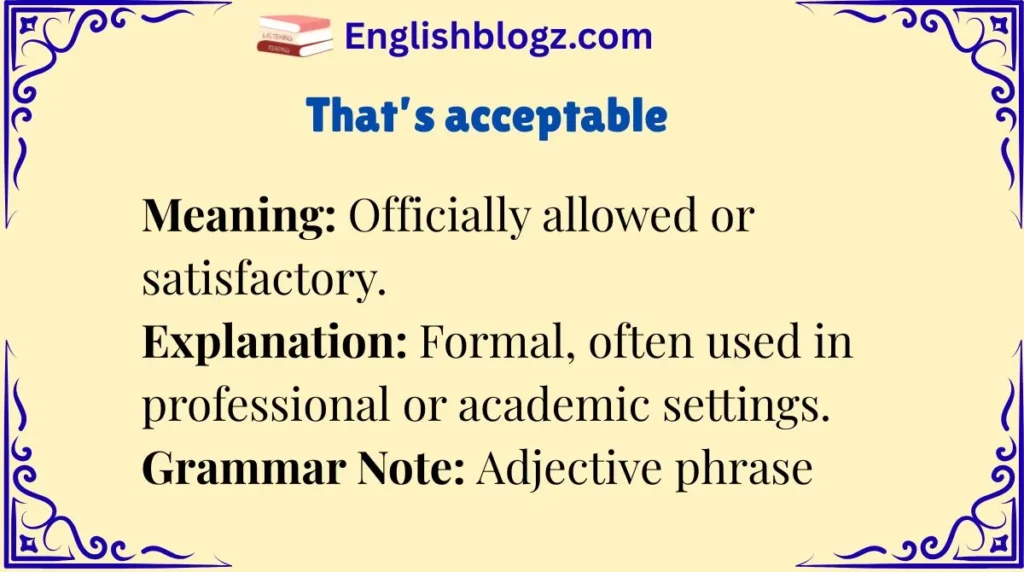
Meaning: Officially allowed or satisfactory.
Explanation: Formal, often used in professional or academic settings.
Grammar Note: Adjective phrase
Example Sentence: “Your proposal for rescheduling is acceptable.”
Best Use: Workplace, academic contexts, formal emails
Worst Use: Slang-heavy or informal conversations
Tone: Formal, professional
Level: Intermediate
Similarity Score: 9
Replaceability Tip: Ideal in professional communication.
7. Works perfectly
Meaning: Fits exactly; no issues.
Explanation: Stronger version of “works for me,” conveys confidence and satisfaction.
Grammar Note: Idiom / adverb phrase
Example Sentence: “The new software update works perfectly on my system.”
Best Use: Emails, spoken English, informal workplace chats
Worst Use: Very formal academic papers
Tone: Neutral to enthusiastic
Level: Intermediate
Similarity Score: 10
Replaceability Tip: Use to express precise satisfaction.
8. That’s agreeable
Meaning: Acceptable and consented to.
Explanation: Polite, formal expression; less common but elegant.
Grammar Note: Adjective phrase
Example Sentence: “Your schedule proposal is agreeable to me.”
Best Use: Business meetings, emails
Worst Use: Informal chats
Tone: Formal, polite
Level: Advanced
Similarity Score: 9
Replaceability Tip: Perfect for high-level professional contexts.
9. I’m on board
Meaning: I agree; I will participate.
Explanation: Suggests commitment as well as agreement.
Grammar Note: Idiom / phrasal
Example Sentence: “We’re launching the new campaign next week. I’m on board.”
Best Use: Workplace, team projects, casual professional talks
Worst Use: Formal academic writing
Tone: Friendly, professional
Level: Intermediate
Similarity Score: 8
Replaceability Tip: Use when you want to show active participation.
10. That fits my schedule
Meaning: Convenient timing; no conflicts.
Explanation: Emphasizes suitability in terms of time.
Grammar Note: Verb phrase
Example Sentence: “Meeting at 2 PM fits my schedule perfectly.”
Best Use: Business emails, spoken English
Worst Use: Overly casual chats
Tone: Neutral, professional
Level: Intermediate
Similarity Score: 10
Replaceability Tip: Use in scheduling or planning situations.
11. That’s convenient
Meaning: Easy or suitable for your needs.
Explanation: Focus on practicality, polite but neutral.
Grammar Note: Adjective
Example Sentence: “Your suggested time is convenient for me.”
Best Use: Emails, meetings, polite conversation
Worst Use: Slang-heavy text messages
Tone: Polite, formal
Level: Intermediate
Similarity Score: 9
Replaceability Tip: Great for polite professional interactions.
12. I approve
Meaning: Official consent or acceptance.
Explanation: Strong, formal; often used in authoritative contexts.
Grammar Note: Verb phrase
Example Sentence: “I’ve reviewed the document, and I approve the changes.”
Best Use: Corporate approvals, official documents
Worst Use: Informal chats
Tone: Formal, strong
Level: Advanced
Similarity Score: 9
Replaceability Tip: Use for formal or managerial approval.
13. That’s ideal
Meaning: Perfectly suitable.
Explanation: Expresses strong satisfaction; formal and positive.
Grammar Note: Adjective phrase
Example Sentence: “Scheduling the workshop for Monday is ideal.”
Best Use: Professional and academic contexts
Worst Use: Casual slang conversations
Tone: Formal, positive
Level: Intermediate
Similarity Score: 9
Replaceability Tip: Use when emphasizing suitability.
14. I can manage that
Meaning: Able to handle or agree to the plan.
Explanation: Suggests capability as well as acceptance.
Grammar Note: Verb phrase
Example Sentence: “I can manage the extra workload next week.”
Best Use: Workplace, professional conversation
Worst Use: Informal social chat (sounds stiff)
Tone: Neutral, professional
Level: Intermediate
Similarity Score: 8
Replaceability Tip: Use for agreement plus responsibility.
15. That’s doable
Meaning: Feasible or possible.
Explanation: Informal, practical; conveys willingness.
Grammar Note: Adjective phrase / idiom
Example Sentence: “Finishing the project by Friday is doable.”
Best Use: Workplace chats, informal emails
Worst Use: Highly formal documents
Tone: Casual, friendly
Level: Beginner
Similarity Score: 8
Replaceability Tip: Use for practical agreement.
16. I’m okay with that
Meaning: Acceptable; no objections.
Explanation: Neutral, often used casually.
Grammar Note: Idiomatic phrase
Example Sentence: “If we meet at 11, I’m okay with that.”
Best Use: Spoken English, casual emails
Worst Use: Formal writing
Tone: Neutral, casual
Level: Beginner
Similarity Score: 9
Replaceability Tip: Safe in most informal contexts.
17. Fine by me
Meaning: Agreed; no objections.
Explanation: Informal and conversational.
Grammar Note: Idiomatic phrase
Example Sentence: “If you want to start at noon, that’s fine by me.”
Best Use: Friends, colleagues, casual conversation
Worst Use: Corporate emails
Tone: Friendly, casual
Level: Beginner
Similarity Score: 8
Replaceability Tip: Use in relaxed situations.
18. That’s all right
Meaning: Acceptable, satisfactory.
Explanation: Slightly understated approval; polite.
Grammar Note: Adjective phrase
Example Sentence: “Meeting on Wednesday is all right for me.”
Best Use: Polite conversation, emails
Worst Use: Situations needing strong agreement
Tone: Polite, neutral
Level: Beginner
Similarity Score: 8
Replaceability Tip: Use for casual but polite acceptance.
Mini Dialogue Examples
Formal Dialogue:
- A: “We could schedule the client call for Thursday at 3 PM.”
- B: “Thursday suits me perfectly.”
Informal Dialogue:
- A: “Pizza night tomorrow?”
- B: “Sounds good to me!”
Business Email Example:
- Subject: Meeting Confirmation
- Hi Sarah,
- Your proposed time for the project update works perfectly for me. See you at 2 PM.
- Best,
- John
Mistakes to Avoid
- Overusing “That works for me” in formal emails.
- Using casual phrases like “Cool” in corporate settings.
- Confusing “I approve” with casual agreement—it’s formal.
- Misplacing idioms like “I’m on board” in academic writing.
- Saying “That’s fine by me” to clients—it may sound too casual.
- Overloading sentences with multiple alternatives; one is enough.
- Using “That’s all right” when you want to express strong enthusiasm.
Cultural & Tone Tips
- UK English: “That suits me” is polite; casual phrases like “Sounds good” are common among peers.
- US English: “I’m good with that” and “Sounds good” are widely accepted in informal professional contexts.
- Casual Social English: “Perfect” and “Fine by me” are natural, friendly, and show positive engagement.
- Tone matters: choose formal phrases for corporate emails, neutral for colleagues, and informal for friends.
Comparison Table of Best Alternatives
| Phrase | Tone | Best Context | Professional Level | Example |
|---|---|---|---|---|
| That suits me | Polite | Meetings, emails | Formal | “That suits me well.” |
| Sounds good | Friendly | Informal chats, teams | Casual | “Sounds good!” |
| I’m on board | Professional | Workplace, projects | Intermediate | “I’m on board with the plan.” |
| That’s acceptable | Formal | Emails, approvals | Formal | “Your proposal is acceptable.” |
| Works perfectly | Neutral | Workplace, spoken English | Intermediate | “The tool works perfectly.” |
FAQs
Is “That works for me” rude?
No, it’s polite and neutral in most situations.
Is it okay in emails?
Yes, but prefer formal alternatives in corporate emails.
What is the most formal alternative?
“That is acceptable” or “That suits me.”
What is the most polite alternative?
“That suits me” or “That’s agreeable.”
What should beginners use?
“That’s fine with me” or “Sounds good” are safe options.
Can it be used in academic writing?
Rarely. Use formal phrases like “That arrangement is suitable.”
Conclusion
Using alternatives to “That works for me” enhances clarity, tone, and professionalism.
Whether in emails, meetings, or casual conversations, the right expression helps convey agreement naturally and appropriately.
Learning varied phrases allows English learners and professionals to communicate with confidence and fluency.
Practice these alternatives in real conversations to sound polished, friendly, and adaptable across contexts.

“Jacob Harper makes English learning simple and fun. He shares tips to help everyone improve confidently.”