The phrase “thank you for your participation” is a polite way to show appreciation when someone joins an activity, meeting, event, discussion, or task.
You’ll hear it in classrooms, offices, surveys, webinars, workshops, and even online communities.
However, using the same phrase again and again can sound dull, robotic, or overly generic. Word choice matters.
It shapes your tone, shows professionalism, and helps your message feel more human. In business emails, the wrong phrase can sound cold. In casual conversation, it can feel stiff.
That’s why learning alternatives is so powerful. Varied language improves clarity, builds better relationships, and makes you sound fluent and confident.
Formal:
“Thank you for your valuable contribution to the discussion.”
Informal:
“Thanks for joining in!”
Both express gratitude, but the tone feels very different.
What Does “Thank You for Your Participation” Mean?
Student-friendly definition:
It means you are grateful that someone took part in an activity, event, or discussion.
Grammar form:
A polite fixed phrase (expression of gratitude).
Not an idiom. Not slang. Common in formal and neutral contexts.
Similar meanings (same tone):
- Thanks for taking part
- Thank you for being involved
Opposite tone (no appreciation):
- No acknowledgment
- Silence after participation
Example sentences:
- Thank you for your participation in today’s workshop.
- We appreciate your participation in this survey.
When to Use “Thank You for Your Participation”
Spoken English
Used after meetings, presentations, or group discussions.
Business English
Common in conferences, training sessions, corporate events.
Emails and messages
Often placed at the end of formal or semi-formal emails.
Social media
Used by brands thanking users for polls or live sessions.
Academic writing
Seen in research surveys, questionnaires, and acknowledgments.
Professional meetings
Used by managers, hosts, moderators, and speakers.
Is “Thank You for Your Participation” Polite or Professional?
Yes, it is polite and professional. But it is also neutral and generic.
Tone levels explained:
- Polite: Yes
- Neutral: Very
- Strong: No (low emotional warmth)
- Soft: Slightly
- Formal: Yes
- Informal: No
Etiquette tip:
Great for formal settings. Avoid overusing it in personal emails or friendly chats. It can feel distant in close relationships.
Pros & Cons of Using “Thank You for Your Participation”
✔ Pros:
- Safe and polite
- Universally understood
- Suitable for formal settings
- No risk of sounding rude
✘ Cons:
- Sounds generic
- Lacks warmth
- Overused in corporate language
- Feels impersonal in casual contexts
Quick Alternatives List (For Busy Readers)
- Thanks for taking part
- We appreciate your involvement
- Thank you for joining us
- Thanks for contributing
- We’re grateful for your input
- Thanks for being part of it
- Thank you for your time
- Much appreciated
- Thanks for your support
- We value your participation
- Thanks for engaging with us
- Appreciate you joining
- Thank you for your contribution
Main Alternatives Explained in Detail
Thanks for Taking Part
Meaning:
A casual way to say thank you for participating.
Explanation:
This phrase feels lighter and more conversational. It removes the stiffness of the original phrase while keeping the meaning clear.
Grammar note:
Verb phrase (phrasal verb).
Example sentence:
Thanks for taking part in today’s discussion.
Best use:
Informal meetings, spoken English, friendly emails.
Worst use:
Very formal corporate or legal documents.
Tone:
Friendly, neutral.
Level:
Beginner.
Similarity score:
9/10.
Replaceability tip:
Use this when you want to sound polite but human.
We Appreciate Your Participation
Meaning:
We are thankful for your involvement.
Explanation:
This adds warmth and sincerity. “Appreciate” feels more personal than “thank you” alone.
Grammar note:
Formal appreciation phrase.
Example sentence:
We appreciate your participation in the training program.
Best use:
Workplace, emails, professional settings.
Worst use:
Casual text messages.
Tone:
Professional, warm.
Level:
Intermediate.
Similarity score:
10/10.
Replaceability tip:
Choose this when you want polite and professional warmth.
Thank You for Joining Us
Meaning:
Thanks for being present or attending.
Explanation:
Focuses more on presence than contribution. Very welcoming.
Grammar note:
Verb phrase.
Example sentence:
Thank you for joining us for today’s webinar.
Best use:
Events, webinars, meetings.
Worst use:
Academic research papers.
Tone:
Friendly, polite.
Level:
Beginner.
Similarity score:
8/10.
Replaceability tip:
Perfect when attendance matters more than action.
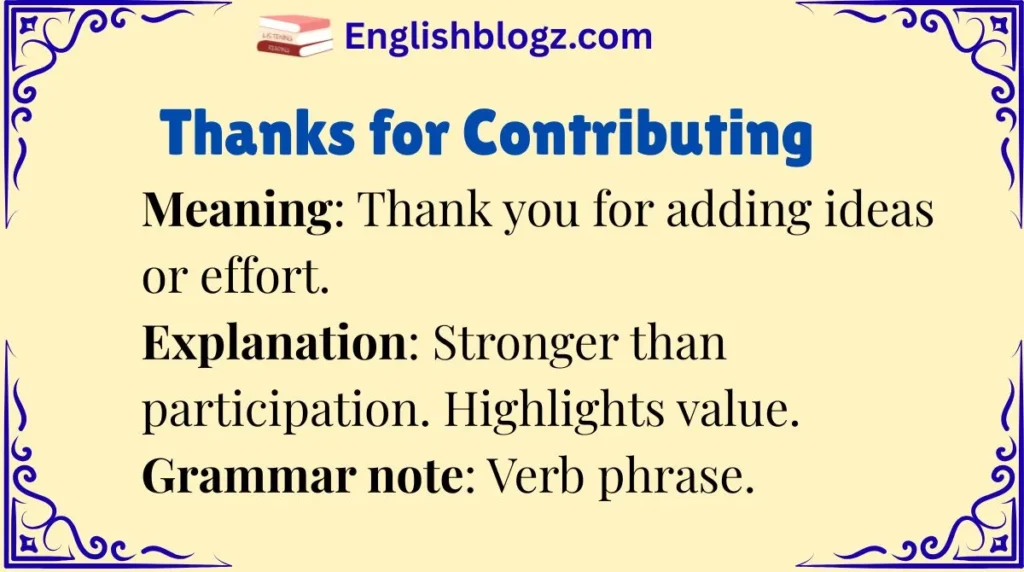
Thanks for Contributing
Meaning:
Thank you for adding ideas or effort.
Explanation:
Stronger than participation. Highlights value.
Grammar note:
Verb phrase.
Example sentence:
Thanks for contributing your ideas during the meeting.
Best use:
Team discussions, feedback sessions.
Worst use:
When someone only attended silently.
Tone:
Professional, positive.
Level:
Intermediate.
Similarity score:
7/10.
Replaceability tip:
Use when input or ideas matter.
We’re Grateful for Your Involvement
Meaning:
We truly value your participation.
Explanation:
Emotionally warmer and more sincere. Sounds respectful.
Grammar note:
Formal appreciation phrase.
Example sentence:
We’re grateful for your involvement in the project.
Best use:
Formal emails, professional letters.
Worst use:
Quick chats or texts.
Tone:
Formal, warm.
Level:
Advanced.
Similarity score:
9/10.
Replaceability tip:
Use for high-respect situations.
Thanks for Being Part of It
Meaning:
Thanks for joining the experience.
Explanation:
Very relaxed and human. Builds connection.
Grammar note:
Casual phrase.
Example sentence:
Thanks for being part of it—we loved your energy.
Best use:
Casual groups, social media, spoken English.
Worst use:
Corporate or academic writing.
Tone:
Friendly, informal.
Level:
Beginner.
Similarity score:
6/10.
Replaceability tip:
Use when warmth matters more than formality.
Thank You for Your Time
Meaning:
Thanks for the time you gave.
Explanation:
Often used when participation required effort or attendance.
Grammar note:
Formal polite phrase.
Example sentence:
Thank you for your time and attention.
Best use:
Emails, interviews, surveys.
Worst use:
Fun or casual contexts.
Tone:
Formal, respectful.
Level:
Beginner.
Similarity score:
7/10.
Replaceability tip:
Choose this when time is the main contribution.
Much Appreciated
Meaning:
Thank you very much.
Explanation:
Short, polite, slightly formal.
Grammar note:
Elliptical phrase.
Example sentence:
Your feedback is much appreciated.
Best use:
Emails, notes.
Worst use:
Long formal documents alone.
Tone:
Neutral, polite.
Level:
Intermediate.
Similarity score:
6/10.
Replaceability tip:
Great for brief appreciation.
Thanks for Your Support
Meaning:
Thank you for helping or backing us.
Explanation:
Focuses on encouragement and help.
Grammar note:
Noun phrase.
Example sentence:
Thanks for your support during the event.
Best use:
Teams, communities, brands.
Worst use:
Pure attendance-only situations.
Tone:
Warm, positive.
Level:
Beginner.
Similarity score:
6/10.
Replaceability tip:
Use when help mattered.
We Value Your Participation
Meaning:
Your involvement matters to us.
Explanation:
Professional and respectful. Highlights importance.
Grammar note:
Formal business phrase.
Example sentence:
We value your participation in this initiative.
Best use:
Corporate emails, reports.
Worst use:
Casual conversation.
Tone:
Professional, strong.
Level:
Advanced.
Similarity score:
9/10.
Replaceability tip:
Use when emphasizing importance.
Thanks for Engaging With Us
Meaning:
Thanks for interacting.
Explanation:
Modern and common in digital spaces.
Grammar note:
Verb phrase.
Example sentence:
Thanks for engaging with us on social media.
Best use:
Online platforms, marketing.
Worst use:
Academic writing.
Tone:
Friendly, modern.
Level:
Intermediate.
Similarity score:
6/10.
Replaceability tip:
Best for online interaction.
Appreciate You Joining
Meaning:
Casual thanks for attending.
Explanation:
Very conversational and warm.
Grammar note:
Casual spoken phrase.
Example sentence:
Appreciate you joining today.
Best use:
Spoken English, informal emails.
Worst use:
Formal letters.
Tone:
Friendly.
Level:
Beginner.
Similarity score:
5/10.
Replaceability tip:
Use in relaxed settings.
Thank You for Your Contribution
Meaning:
Thanks for what you added.
Explanation:
More formal and specific than participation.
Grammar note:
Formal noun phrase.
Example sentence:
Thank you for your contribution to the project.
Best use:
Workplace, academic contexts.
Worst use:
Very casual chats.
Tone:
Professional, respectful.
Level:
Intermediate.
Similarity score:
8/10.
Replaceability tip:
Use when effort or ideas matter.
Mini Dialogue Examples
Formal conversation
Manager: Thank you for your contribution to today’s meeting.
Employee: I appreciate the opportunity.
Informal conversation
Host: Thanks for taking part!
Guest: Happy to join!
Business email example
We appreciate your participation in the survey. Your feedback helps us improve our services.
Common Mistakes Learners Make
- Using very formal phrases in casual chats
- Repeating the same phrase too often
- Thanking participation when no action happened
- Mixing informal tone in corporate emails
- Forgetting context (event vs effort)
- Sounding robotic or copy-paste
- Using slang in academic writing
Cultural & Tone Tips
US English:
Prefers warmer, friendlier alternatives.
UK English:
More neutral and polite expressions are common.
Casual social English:
Short phrases feel more natural.
Native speakers notice tone quickly. Choose warmth or formality based on relationship, not habit.
Comparison Table of Best Alternatives
| Phrase | Tone | Best Context | Professional Level | Example |
|---|---|---|---|---|
| We appreciate your participation | Professional | Emails | High | We appreciate your participation today |
| Thanks for taking part | Friendly | Spoken | Medium | Thanks for taking part |
| Thank you for joining us | Polite | Events | Medium | Thank you for joining us |
| Thank you for your contribution | Formal | Work | High | Thank you for your contribution |
| Thanks for being part of it | Casual | Social | Low | Thanks for being part of it |
FAQs
Is “thank you for your participation” rude?
No. It’s polite but neutral.
Is it okay in emails?
Yes, especially formal or professional ones.
What is the most formal alternative?
We appreciate your participation or We value your participation.
What is the most polite alternative?
We’re grateful for your involvement.
What should beginners use?
Thanks for taking part or Thank you for joining us.
Can I use it in academic writing?
Yes, but alternatives like thank you for your contribution sound better.
Conclusion
Words shape how people feel. Using only “thank you for your participation” can sound safe but forgettable.
Learning alternatives gives you control over tone, warmth, and professionalism. It helps you sound natural, confident, and fluent in real-life English.
Whether you’re writing emails, speaking at meetings, or chatting online, the right phrase builds better connections.
Practice these expressions in daily conversation. The more you vary your language, the more natural your English becomes.

“Jacob Harper makes English learning simple and fun. He shares tips to help everyone improve confidently.”