Saying “thank you for your insight” is more than polite—it shows respect for someone’s knowledge and effort.
This phrase is often used in conversations, emails, and meetings to acknowledge guidance, advice, or ideas.
But using the same expression repeatedly can sound dull or robotic. Choosing the right alternative can help you sound natural, professional, and confident.
Alternatives matter because they adjust your tone for different situations.
For example, in a formal meeting, “I appreciate your perspective” may sound more polished than a simple “thanks.” In casual chats, “That’s really helpful, thanks!” feels friendly and genuine.
Word choice can impact clarity, tone, and professionalism.
By learning varied expressions, you can improve your communication in business, academia, social media, and everyday conversations.
What Does “Thank You for Your Insight” Mean?
At its core, “thank you for your insight” expresses gratitude for someone’s knowledge, perspective, or advice.
- Grammar: It’s a polite interjection combined with a noun phrase.
- Synonyms: “Thanks for your input,” “I appreciate your advice.”
- Opposites: Dismissive phrases like “Whatever you think” or ignoring feedback.
Example Sentences:
- Formal: Thank you for your insight during today’s strategy meeting.
- Informal: Thanks for your insight, that really cleared things up!
When to Use “Thank You for Your Insight”
Spoken English: Useful in conversations, debates, or when receiving advice.
Business English: Ideal in meetings, presentations, or project discussions.
Emails / Messages: Polite closure for professional correspondence.
Social Media: Shows respect when responding to comments or posts.
Academic Writing: Acknowledges contributions or guidance from peers or instructors.
Professional Meetings: Enhances rapport and shows engagement with colleagues’ ideas.
Is “Thank You for Your Insight” Polite or Professional?
This phrase is polite, professional, and formal. It communicates respect and thoughtfulness.
- Tone Levels:
- Polite ✔
- Neutral ✔
- Strong ✘
- Soft ✔
- Formal ✔
- Informal ✘
Etiquette Tip: Best used in workplaces, formal emails, and professional discussions. Avoid using it casually in friendly text chats—it may sound stiff.
Pros & Cons of Using “Thank You for Your Insight”
✔ Pros:
- Shows respect and appreciation
- Professional and polished
- Suitable in business and academic settings
✘ Cons:
- Can sound repetitive if overused
- Slightly formal for casual chats
- Doesn’t convey strong enthusiasm
Quick Alternatives List (One-Line Phrases Only)
- I appreciate your perspective.
- Thanks for your advice.
- Grateful for your input.
- I value your opinion.
- Much obliged for your thoughts.
- Your guidance is appreciated.
- Thanks for sharing your knowledge.
- I’m thankful for your feedback.
- Appreciate your viewpoint.
- Your suggestion helps a lot.
- I’m grateful for your guidance.
- Thank you for your recommendation.
- Thanks for your expertise.
- I respect your advice.
- Many thanks for your insight.
- Appreciate the clarification.
- Thanks for helping me see this clearly.
- Your input is invaluable.
18 Alternatives (Expanded Guide)
I Appreciate Your Perspective
Meaning: Shows gratitude for someone’s viewpoint.
Explanation: Polite, professional, and slightly formal; great for business discussions.
Grammar Note: Formal phrase
Example Sentence: I appreciate your perspective on the project timeline.
Best Use: Formal / Workplace / Email
Worst Use: Casual chats with friends
Tone: Professional
Level: Intermediate
Similarity Score: 9
Replaceability Tip: Use when thanking a colleague for thoughtful advice.
Thanks for Your Advice
Meaning: Expresses gratitude for suggestions.
Explanation: Friendly yet professional; informal enough for close colleagues.
Grammar Note: Verb phrase
Example Sentence: Thanks for your advice on handling client questions.
Best Use: Informal / Email / Workplace
Worst Use: Highly formal letters
Tone: Neutral
Level: Beginner
Similarity Score: 10
Replaceability Tip: Perfect for quick workplace chats.
Grateful for Your Input
Meaning: A polite acknowledgment of someone’s help or feedback.
Explanation: Slightly formal; emphasizes thankfulness.
Grammar Note: Adjective phrase
Example Sentence: I’m grateful for your input during our team review.
Best Use: Professional / Email / Academic
Worst Use: Casual social chats
Tone: Formal
Level: Intermediate
Similarity Score: 9
Replaceability Tip: Good for professional emails and reports.
I Value Your Opinion
Meaning: Shows respect for another person’s judgment.
Explanation: Expresses both gratitude and recognition of expertise.
Grammar Note: Verb phrase
Example Sentence: I value your opinion on this marketing strategy.
Best Use: Workplace / Email / Meetings
Worst Use: Text messages with friends
Tone: Professional / Friendly
Level: Intermediate
Similarity Score: 8
Replaceability Tip: Use when you want to highlight respect.
Much Obliged for Your Thoughts
Meaning: Formal expression of thanks.
Explanation: Slightly old-fashioned; adds a polite, refined tone.
Grammar Note: Formal phrase
Example Sentence: Much obliged for your thoughts on the proposal.
Best Use: Formal letters / Academic emails
Worst Use: Casual spoken English
Tone: Formal
Level: Advanced
Similarity Score: 8
Replaceability Tip: Use in professional correspondence with high respect.
Your Guidance Is Appreciated
Meaning: Acknowledges advice or mentorship.
Explanation: Polite and professional; often used with mentors or supervisors.
Grammar Note: Passive structure
Example Sentence: Your guidance is appreciated as I navigate this project.
Best Use: Workplace / Email / Academic
Worst Use: Informal social media
Tone: Professional / Soft
Level: Intermediate
Similarity Score: 9
Replaceability Tip: Use for advice that significantly impacts work or study.
Thanks for Sharing Your Knowledge
Meaning: Gratitude for information or teaching.
Explanation: Friendly and approachable; suitable for colleagues and instructors.
Grammar Note: Verb phrase
Example Sentence: Thanks for sharing your knowledge about SEO best practices.
Best Use: Informal / Email / Social Media
Worst Use: Highly formal letters
Tone: Friendly
Level: Beginner
Similarity Score: 9
Replaceability Tip: Use when the focus is on learning from someone.
I’m Thankful for Your Feedback
Meaning: Expresses appreciation for constructive comments.
Explanation: Polite and slightly formal; common in academic and professional contexts.
Grammar Note: Verb phrase
Example Sentence: I’m thankful for your feedback on my report.
Best Use: Academic / Workplace / Email
Worst Use: Casual texting
Tone: Polite / Formal
Level: Intermediate
Similarity Score: 9
Replaceability Tip: Choose when feedback improves your work.
Appreciate Your Viewpoint
Meaning: Recognition of someone’s perspective.
Explanation: Concise and polite; good for workplace discussions.
Grammar Note: Verb phrase
Example Sentence: Appreciate your viewpoint on this issue.
Best Use: Workplace / Email / Meetings
Worst Use: Texting friends
Tone: Professional / Neutral
Level: Intermediate
Similarity Score: 8
Replaceability Tip: Use for brief acknowledgment in professional chat.
Your Suggestion Helps a Lot
Meaning: Highlights usefulness of advice.
Explanation: Friendly, informal, yet professional in tone.
Grammar Note: Verb phrase
Example Sentence: Your suggestion helps a lot with our planning.
Best Use: Informal workplace / Text / Email
Worst Use: Formal letters
Tone: Friendly
Level: Beginner
Similarity Score: 7
Replaceability Tip: Choose when advice makes a practical impact.
I’m Grateful for Your Guidance
Meaning: Polite acknowledgment of mentorship or advice.
Explanation: Formal and respectful; emphasizes gratitude and support.
Grammar Note: Verb phrase
Example Sentence: I’m grateful for your guidance throughout this project.
Best Use: Workplace / Academic / Email
Worst Use: Casual chat
Tone: Formal
Level: Intermediate
Similarity Score: 9
Replaceability Tip: Use with supervisors, mentors, or senior colleagues.
Thank You for Your Recommendation
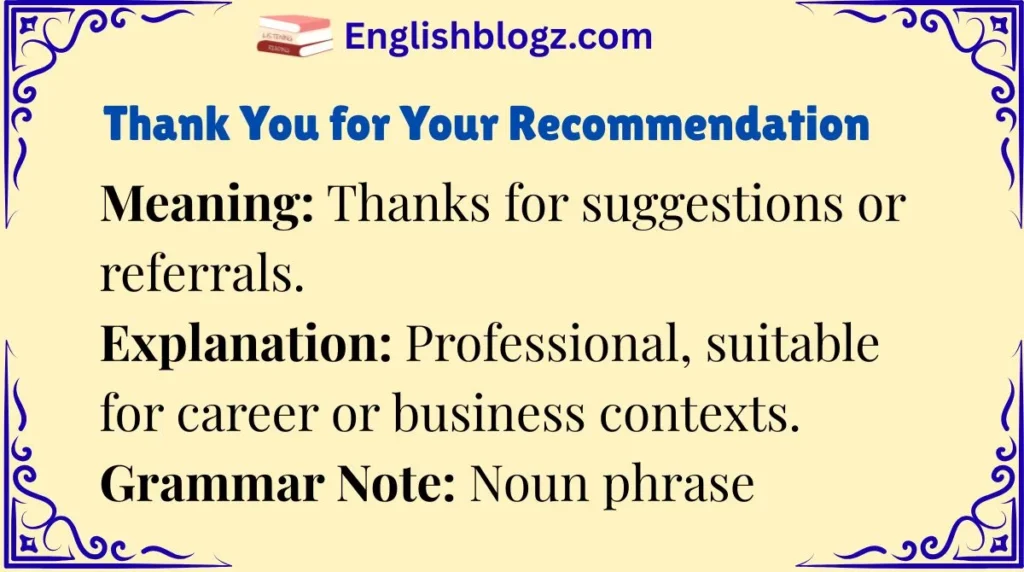
Meaning: Thanks for suggestions or referrals.
Explanation: Professional, suitable for career or business contexts.
Grammar Note: Noun phrase
Example Sentence: Thank you for your recommendation for the new candidate.
Best Use: Workplace / Email / Professional letters
Worst Use: Casual social media
Tone: Professional
Level: Beginner
Similarity Score: 10
Replaceability Tip: Use when acknowledging professional advice or reference.
Thanks for Your Expertise
Meaning: Appreciation for specialized knowledge.
Explanation: Polite and professional; emphasizes respect for skills.
Grammar Note: Noun phrase
Example Sentence: Thanks for your expertise in resolving the technical issue.
Best Use: Workplace / Email / Academic
Worst Use: Casual conversations
Tone: Professional
Level: Intermediate
Similarity Score: 9
Replaceability Tip: Use when knowledge significantly helps.
I Respect Your Advice
Meaning: Shows gratitude while acknowledging authority or experience.
Explanation: Formal and serious tone; conveys deep appreciation.
Grammar Note: Verb phrase
Example Sentence: I respect your advice on managing this situation.
Best Use: Workplace / Email / Academic
Worst Use: Informal chats
Tone: Formal / Professional
Level: Intermediate
Similarity Score: 8
Replaceability Tip: Choose when advice is important or critical.
Many Thanks for Your Insight
Meaning: Friendly, slightly formal way to express thanks.
Explanation: Suitable for emails, letters, or formal chats.
Grammar Note: Noun phrase
Example Sentence: Many thanks for your insight on the quarterly report.
Best Use: Email / Professional correspondence
Worst Use: Casual texts
Tone: Formal / Friendly
Level: Beginner
Similarity Score: 10
Replaceability Tip: Use as a direct replacement for the original phrase.
Appreciate the Clarification
Meaning: Thanks for explaining or clearing doubts.
Explanation: Polite, professional, and concise; useful in email threads.
Grammar Note: Verb phrase
Example Sentence: Appreciate the clarification on the project requirements.
Best Use: Email / Workplace / Academic
Worst Use: Social conversations
Tone: Professional / Neutral
Level: Intermediate
Similarity Score: 8
Replaceability Tip: Use when someone resolves confusion.
Thanks for Helping Me See This Clearly
Meaning: Shows gratitude for making things understandable.
Explanation: Friendly, slightly informal; emphasizes personal impact.
Grammar Note: Verb phrase
Example Sentence: Thanks for helping me see this clearly; now I understand the process.
Best Use: Informal / Workplace / Text
Worst Use: Formal letters
Tone: Friendly / Professional
Level: Intermediate
Similarity Score: 8
Replaceability Tip: Use in collaborative settings.
Your Input Is Invaluable
Meaning: Strongly acknowledges someone’s contribution.
Explanation: Formal, professional; communicates high appreciation.
Grammar Note: Adjective phrase
Example Sentence: Your input is invaluable in shaping our strategy.
Best Use: Email / Workplace / Academic
Worst Use: Casual texting
Tone: Professional / Formal
Level: Advanced
Similarity Score: 9
Replaceability Tip: Use when input has major importance.
Mini Dialogue Examples
Formal Dialogue:
- A: I’ve prepared the quarterly report. What do you think?
- B: Thank you for your insight. I think the projections are accurate.
Informal Dialogue:
- A: Here’s my suggestion for the social media post.
- B: Thanks for your advice! That makes sense.
Business Email Example:
Subject: Feedback on Marketing Proposal
Hi Sarah,
I’m grateful for your guidance on the proposal. Your suggestions helped refine our strategy.
Best regards,
Tom
Mistakes to Avoid
- Using “thank you for your insight” too casually.
- Repeating the same phrase in every email or meeting.
- Misplacing formal alternatives in informal chats.
- Ignoring tone differences between UK and US English.
- Overusing old-fashioned expressions like “much obliged” in casual contexts.
- Confusing “advice” with “insight” (they are related but not identical).
- Forgetting to personalize: make it specific to the advice received.
Cultural & Tone Tips
- UK English: Slightly more formal and understated; “I appreciate your perspective” is common.
- US English: More direct and warm; “Thanks for your advice” fits well.
- Casual Social English: Overly formal phrases can sound stiff; friendly expressions work better.
- Tone: Always match your gratitude to the situation. Too much formality may feel distant; too casual may seem careless.
Comparison Table (Best 6 Alternatives)
| Phrase | Tone | Best Context | Professional Level | Example |
|---|---|---|---|---|
| I appreciate your perspective | Formal | Workplace, Email | Intermediate | I appreciate your perspective on the project. |
| Thanks for your advice | Friendly | Informal, Email | Beginner | Thanks for your advice on handling client calls. |
| Grateful for your input | Polite | Academic, Email | Intermediate | Grateful for your input during our review. |
| Your guidance is appreciated | Formal | Workplace, Mentorship | Intermediate | Your guidance is appreciated as I navigate this project. |
| I value your opinion | Neutral | Meetings, Workplace | Intermediate | I value your opinion on this marketing strategy. |
| Your input is invaluable | Strong | Email, Workplace | Advanced | Your input is invaluable in shaping our strategy. |
FAQs
Is “thank you for your insight” rude?
No, it is always polite and professional.
Is it okay in emails?
Yes, perfect for professional or academic emails.
What is the most formal alternative?
“Your input is invaluable” or “Much obliged for your thoughts.”
What is the most polite alternative?
“I appreciate your perspective” is soft and polite.
What should beginners use?
“Thanks for your advice” or “Thanks for your insight” works well.
Can it be used in casual chats?
Better to use simpler, friendly phrases like “Thanks for your advice” in casual contexts.
Conclusion
Using varied expressions for “thank you for your insight” improves clarity, professionalism, and fluency.
Word choice helps you adapt to different situations—formal meetings, casual chats, academic emails, or business correspondence.
Practicing alternatives allows you to express gratitude naturally, sound confident, and build stronger professional and social relationships.

“Jacob Harper makes English learning simple and fun. He shares tips to help everyone improve confidently.”