Saying “thank you for your assistance in this matter” is a polite way to show appreciation when someone helps you with a task or problem.
It is widely used in formal emails, professional meetings, and written communication. However, relying on the same phrase repeatedly can make your writing or speech sound mechanical or dull.
Choosing alternative expressions allows you to convey gratitude naturally while matching the tone to the situation.
For instance, in a formal email, you might write: “Thank you for your assistance in this matter.” In a casual chat, the same sentiment could be expressed as:
“Thanks a lot for your help!” This small shift changes the tone from formal and professional to friendly and approachable.
Using varied language improves clarity, professionalism, and emotional impact in business, academic, and everyday communication.
What Does “Thank You for Your Assistance in This Matter” Mean?
At its core, this phrase expresses gratitude toward someone who has helped you with a specific issue or task. It is formal, polite, and commonly used in professional writing.
- Grammar form: Phrase / polite expression
- Synonyms: Thank you for your support, I appreciate your help, Many thanks for your assistance
- Opposites (less polite or casual): No worries, It’s nothing, Don’t mention it
Example sentences:
- Thank you for your assistance in this matter; your guidance has been invaluable.
- I appreciate your help in resolving this issue quickly.
When to Use “Thank You for Your Assistance in This Matter”
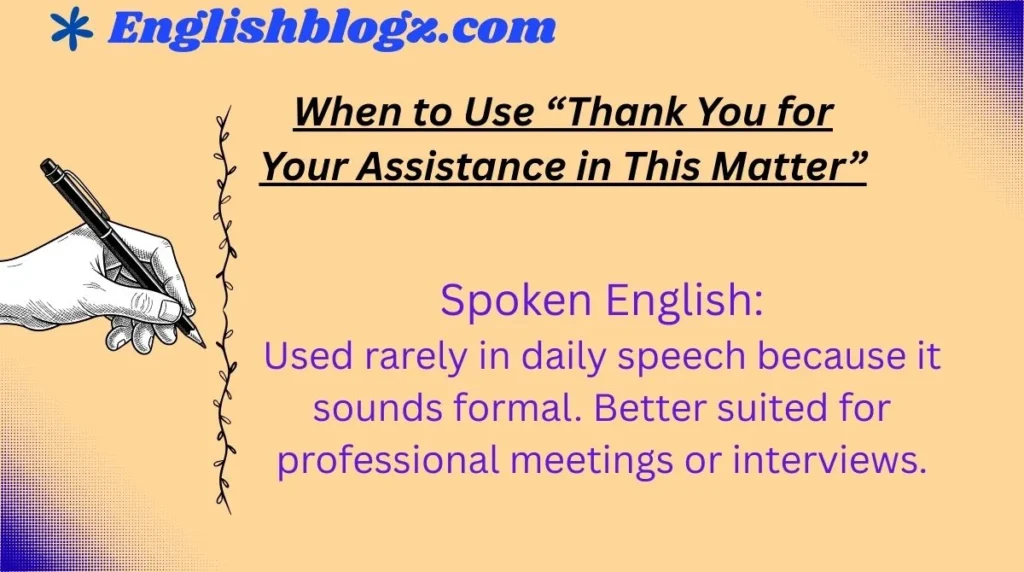
Spoken English:
Used rarely in daily speech because it sounds formal. Better suited for professional meetings or interviews.
Business English:
Common in emails, reports, and client communications. It communicates respect and professionalism.
Emails / Messages:
Ideal for formal emails to colleagues, managers, or clients. Sets a polite tone without sounding too casual.
Social Media:
Less common on platforms like Twitter or Instagram. Informal alternatives like “Thanks for the help!” work better.
Academic Writing:
Used in acknowledgments, references, or professional correspondence.
Professional Meetings:
Works well when concluding discussions, assigning tasks, or following up on assistance received.
Is “Thank You for Your Assistance in This Matter” Polite or Professional?
The phrase is polite, formal, and professional.
Tone Levels:
- Polite ✔
- Neutral ✔
- Strong ✘
- Soft ✔
Formal vs Informal:
- Formal ✅
- Informal ❌
Etiquette Tip:
- Best for workplace emails, client communications, and formal requests.
- Avoid using in casual chat; it may sound stiff or unnatural.
Pros & Cons of Using “Thank You for Your Assistance in This Matter”
✔ Pros:
- Clearly expresses gratitude
- Maintains professionalism
- Suitable for business and academic contexts
- Easy for non-native speakers to use correctly
✘ Cons:
- Can sound stiff or repetitive
- Less natural in casual conversation
- May feel overly formal in friendly exchanges
Quick Alternatives List (One-Line Phrases Only)
- Thanks for your help
- I appreciate your assistance
- Many thanks for your support
- Grateful for your guidance
- I’m thankful for your help
- Thank you kindly
- Much obliged
- I appreciate your time and effort
- Thanks a ton
- Sincere thanks for your support
- Thanks for your cooperation
- I’m grateful for your help
- Appreciate your input
- Thanks for taking the time
- Heartfelt thanks
- Thanks for your attention
- Thank you for your prompt assistance
- Thanks for your understanding
- I’m thankful for your assistance
- Thanks a million
- Deepest thanks
- Thanks for pitching in
- I’m indebted to you
- Cheers for your help
- Thank you ever so much
- Many thanks for your valuable assistance
- Thanks for being there
- Appreciated beyond words
- Thanks for lending a hand
- Much appreciation
08 Alternatives in Detail
1. Thanks for Your Help
Meaning: Simple gratitude for assistance
Explanation: Friendly and informal; used for colleagues, friends, or casual emails
Grammar Note: Phrase / informal
Example Sentence: Thanks for your help with the report.
Best Use: Informal / workplace / text
Worst Use: Formal business letters
Tone: Friendly
Level: Beginner
Similarity Score: 9
Replaceability Tip: Use for casual situations instead of the full formal phrase
2. I Appreciate Your Assistance
Meaning: Shows gratitude with slight formality
Explanation: More professional than “thanks for your help”; polite and respectful
Grammar Note: Verb phrase / formal
Example Sentence: I appreciate your assistance in resolving this matter.
Best Use: Emails / meetings / workplace
Worst Use: Slang or casual chat
Tone: Professional
Level: Intermediate
Similarity Score: 10
Replaceability Tip: Ideal for workplace emails
3. Many Thanks for Your Support
Meaning: Expresses gratitude for ongoing help
Explanation: Friendly yet polite; shows recognition of support over time
Grammar Note: Noun phrase / semi-formal
Example Sentence: Many thanks for your support throughout the project.
Best Use: Email / professional / social acknowledgment
Worst Use: Casual text to close friend
Tone: Professional / Friendly
Level: Intermediate
Similarity Score: 9
Replaceability Tip: Use to emphasize appreciation for continuous support
4. Grateful for Your Guidance
Meaning: Expresses appreciation for advice or direction
Explanation: Highlights mentorship or advice rather than simple help
Grammar Note: Adjective + noun phrase
Example Sentence: I am grateful for your guidance during this process.
Best Use: Formal email / academic / professional meetings
Worst Use: Casual text or social media
Tone: Formal / Respectful
Level: Advanced
Similarity Score: 8
Replaceability Tip: Use for mentorship or advice situations
5. I’m Thankful for Your Help
Meaning: Shows genuine gratitude
Explanation: Slightly less formal than “thank you for your assistance”
Grammar Note: Verb phrase / neutral
Example Sentence: I’m thankful for your help with the client presentation.
Best Use: Workplace / informal email / conversations
Worst Use: Academic acknowledgments
Tone: Friendly / Neutral
Level: Beginner
Similarity Score: 9
Replaceability Tip: Use in semi-formal situations
6. Thank You Kindly
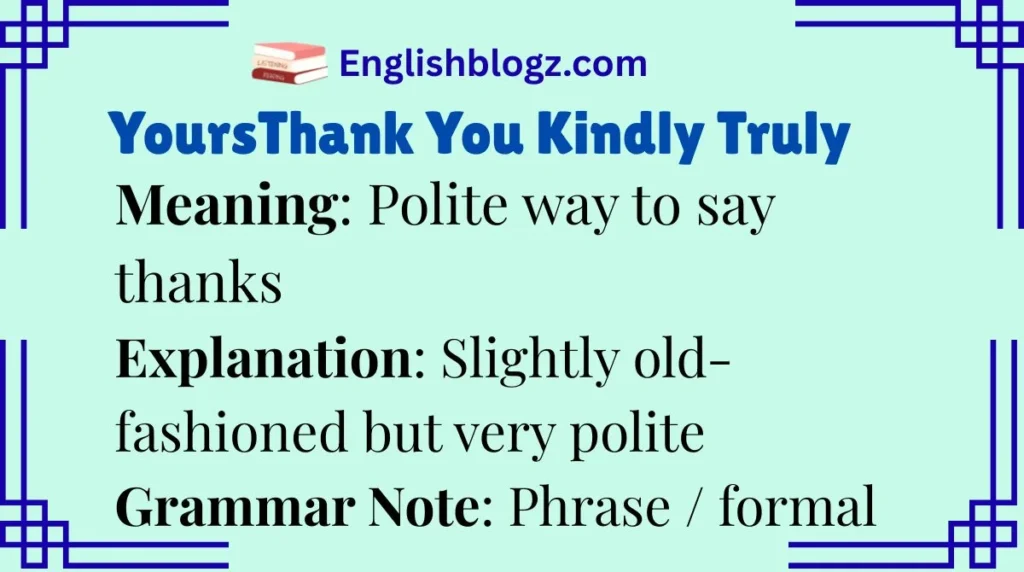
Meaning: Polite way to say thanks
Explanation: Slightly old-fashioned but very polite
Grammar Note: Phrase / formal
Example Sentence: Thank you kindly for your prompt response.
Best Use: Formal letters / professional emails
Worst Use: Casual chat
Tone: Formal
Level: Intermediate
Similarity Score: 10
Replaceability Tip: Adds warmth in formal communication
7. Much Obliged
Meaning: Expresses deep gratitude
Explanation: British English; formal, polite, slightly literary
Grammar Note: Idiom / formal
Example Sentence: Much obliged for your assistance in this matter.
Best Use: UK business correspondence / formal letters
Worst Use: Casual US English
Tone: Formal / Polite
Level: Advanced
Similarity Score: 8
Replaceability Tip: Use for high-level formal correspondence
8. I Appreciate Your Time and Effort
Meaning: Thanks for both help and commitment
Explanation: Shows awareness of effort beyond simple help
Grammar Note: Verb phrase / formal
Example Sentence: I appreciate your time and effort in reviewing the report.
Best Use: Workplace / emails / professional meetings
Worst Use: Casual text to friend
Tone: Professional
Level: Intermediate
Similarity Score: 9
Replaceability Tip: Highlights effort as well as assistance
Mini Dialogue Examples
Formal Dialogue:
- A: Could you review this proposal?
- B: Certainly.
- A: Thank you for your assistance in this matter; your feedback is invaluable.
Informal Dialogue:
- A: Can you help me finish this task?
- B: Sure!
- A: Thanks a lot for your help!
Business Email Example:
- Dear Mr. Smith,
- Thank you for your assistance in this matter. Your input has helped us meet our deadline successfully.
- Best regards,
- Jane Doe
Mistakes to Avoid
- Using the phrase in casual chat (sounds too formal)
- Overusing the same phrase in multiple emails
- Confusing synonyms with informal slang
- Forgetting to adjust tone based on context
- Ignoring cultural differences in politeness
- Using overly complex alternatives in simple emails
- Placing the phrase at the wrong position in a sentence
Cultural & Tone Tips
- UK English: “Much obliged” or “Thank you kindly” are polite and common
- US English: “Thanks for your help” is more natural, casual; “I appreciate your assistance” is professional
- Casual social English: Simple “Thanks!” or “Thanks a ton!” is preferred
- Professional tone: Maintain clarity, brevity, and respect
Comparison Table of Top Alternatives
| Phrase | Tone | Best Context | Professional Level | Example |
|---|---|---|---|---|
| I Appreciate Your Assistance | Professional | Email / Meetings | High | I appreciate your assistance in this matter. |
| Thanks for Your Help | Friendly | Informal / Work Chat | Medium | Thanks for your help with the report. |
| Many Thanks for Your Support | Friendly / Professional | Email / Social | Medium | Many thanks for your support throughout the project. |
| Grateful for Your Guidance | Formal | Mentorship / Academic | High | I am grateful for your guidance. |
| Thank You Kindly | Formal | Letters / Emails | High | Thank you kindly for your prompt response. |
FAQs
Is “Thank You for Your Assistance in This Matter” rude?
No, it is polite and professional.
Is it okay to use in emails?
Yes, it is ideal for formal and professional emails.
What is the most formal alternative?
“Much obliged” or “I appreciate your assistance” are highly formal.
What is the most polite alternative?
“Thank you kindly” is very polite and respectful.
What should beginners use?
“Thanks for your help” or “I appreciate your help” are simple and effective.
Can it be used in casual chat?
Not recommended; it sounds stiff and overly formal.
Conclusion
Using varied ways to say “thank you for your assistance in this matter” improves communication, builds professionalism, and makes your writing or speech more engaging.
Alternatives allow you to match tone, context, and cultural expectations while maintaining politeness.
Practicing these expressions in emails, conversations, and meetings enhances clarity and fluency, helping you sound natural and confident in English.

“Jacob Harper makes English learning simple and fun. He shares tips to help everyone improve confidently.”