Other Ways to Say Thank You for the Information
While simple and effective, relying on it repeatedly can make your language sound repetitive, formal, or even stiff.
Choosing the right alternative can change your tone, reflect professionalism, or make your communication feel friendlier.
In business emails, saying “thank you for the information” works perfectly, but in casual chat with friends, it may feel awkward.
For example, in a formal email: “Thank you for the information. I will review it and get back to you.”
In casual conversation: “Got it, thanks!” Both convey gratitude, but the tone and context differ.
Learning alternatives helps English learners, professionals, and students adapt their expressions for emails, reports, meetings, and social interactions.
Using varied phrases improves clarity, builds rapport, and makes your communication more engaging.
By expanding your vocabulary, you ensure your appreciation feels natural, appropriate, and context-sensitive.
What Does “Thank You for the Information” Mean?
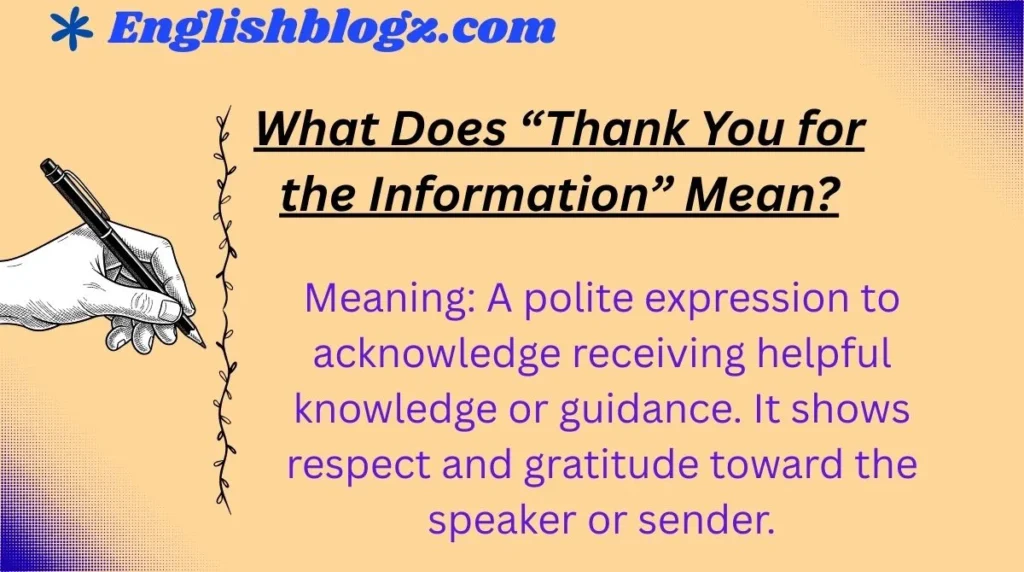
Meaning: A polite expression to acknowledge receiving helpful knowledge or guidance. It shows respect and gratitude toward the speaker or sender.
Grammar Form: Full sentence (interjection phrase) – contains the verb “thank” and the object “information.”
Synonyms: Thanks for the info, I appreciate the details, Grateful for the update
Opposites: Ignoring information, dismissive response
Examples:
- Thank you for the information. It clarified my doubts completely.
- I appreciate the details you shared; they are very helpful.
When to Use “Thank You for the Information”
Spoken English: Ideal in conversations with teachers, mentors, or colleagues when receiving guidance.
Business English: Suitable for emails, reports, and official meetings.
Emails / Messages: Works in both professional emails and text messages but can be made friendlier with alternatives.
Social Media: Formal versions are less common; casual phrases are better.
Academic Writing: Rarely used in research papers but can appear in acknowledgments.
Professional Meetings: Use to show respect and gratitude for shared updates or reports.
Is “Thank You for the Information” Polite or Professional?
This phrase is polite, neutral, and widely accepted in professional contexts. It communicates appreciation without exaggeration or informal slang.
Tone Levels:
- Polite ✔
- Neutral ✔
- Strong ✘
- Soft ✔
- Formal ✔
- Informal ✘
Etiquette Tip: Best for workplace emails, official letters, and formal meetings. Avoid using it in casual chats with friends, where a simpler “thanks” feels more natural.
Pros & Cons of Using “Thank You for the Information”
✔ Pros:
- Polite and professional
- Easy to remember and use
- Appropriate in most formal contexts
✘ Cons:
- Can sound repetitive
- May feel stiff in casual conversation
- Limited emotional nuance
Quick Alternatives List (One-Line Phrases)
- Thanks for the info
- Appreciate the information
- Grateful for the details
- Much obliged
- Thanks for letting me know
- I appreciate your help
- Thank you for your input
- Many thanks for the update
- Thanks a lot for the info
- Thank you for sharing
- I’m grateful for your insight
- Thanks for filling me in
- Appreciate your guidance
- Thanks for the heads-up
- Thanks for keeping me posted
- Thank you for the clarification
- Thanks for your assistance
- Grateful for the update
- Many thanks for your support
- Thank you for the feedback
- Thanks for the explanation
- I value the information
- Much appreciated
- Thanks for letting me be informed
- Appreciate your update
- Thank you kindly for the info
- Thanks for your time
- I appreciate your effort
- Thanks for informing me
08 Alternatives
1. Thanks for the info
Meaning: Short, casual acknowledgment of received information.
Explanation: Friendly and widely used in informal settings. Conveys gratitude without being formal.
Grammar Note: Informal phrase
Example Sentence: Thanks for the info. I’ll check it out.
Best Use: Text messages, casual emails, social media
Worst Use: Corporate letters or academic papers
Tone: Friendly
Level: Beginner
Similarity Score: 9/10
Replaceability Tip: Use in casual conversations where formal tone is unnecessary
2. Appreciate the information
Meaning: Expresses gratitude politely
Explanation: Slightly more formal than “thanks for the info.” Often used in emails or professional chat.
Grammar Note: Verb phrase
Example Sentence: I appreciate the information you sent about the project timeline.
Best Use: Professional emails, workplace messages
Worst Use: Casual chat with friends
Tone: Polite, Professional
Level: Intermediate
Similarity Score: 8/10
Replaceability Tip: Use when addressing colleagues or managers
3. Grateful for the details
Meaning: Shows deeper gratitude for shared information
Explanation: Conveys sincerity and appreciation for effort in providing information
Grammar Note: Adjective phrase
Example Sentence: I am grateful for the details you provided on the meeting agenda.
Best Use: Formal emails, professional discussions
Worst Use: Informal texting
Tone: Formal, Sincere
Level: Advanced
Similarity Score: 8/10
Replaceability Tip: Use when emphasizing appreciation
4. Much obliged
Meaning: Formal, slightly old-fashioned way to say thanks
Explanation: Conveys strong gratitude; common in professional or traditional contexts
Grammar Note: Idiom
Example Sentence: Much obliged for the information regarding the new policy.
Best Use: Formal emails, letters
Worst Use: Casual chats
Tone: Formal
Level: Advanced
Similarity Score: 7/10
Replaceability Tip: Use for polite, professional communication
5. Thanks for letting me know
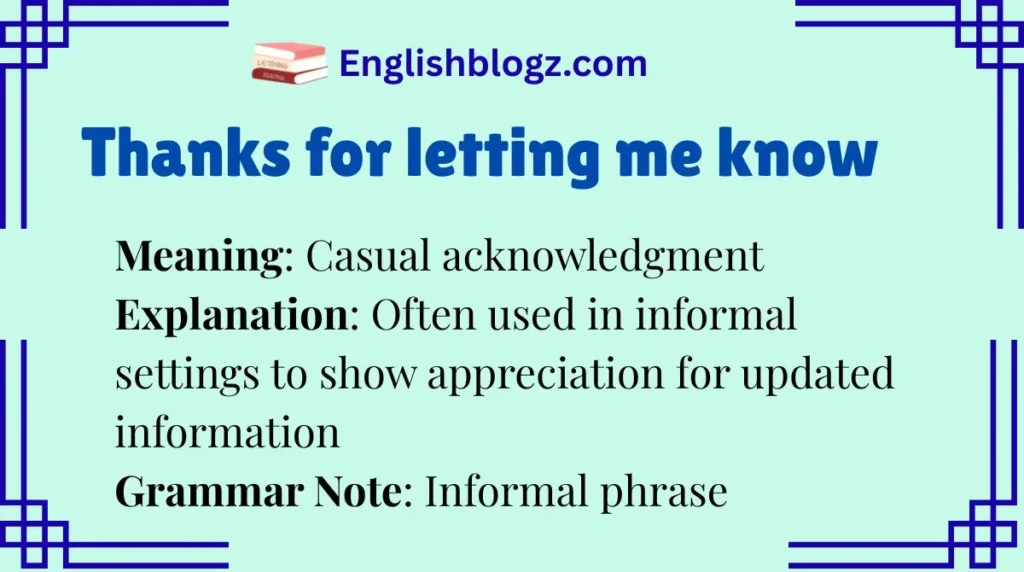
Meaning: Casual acknowledgment
Explanation: Often used in informal settings to show appreciation for updated information
Grammar Note: Informal phrase
Example Sentence: Thanks for letting me know about the schedule change.
Best Use: Informal conversation, messaging
Worst Use: Academic writing
Tone: Friendly
Level: Beginner
Similarity Score: 9/10
Replaceability Tip: Perfect for everyday communication
6. I appreciate your help
Meaning: Expresses gratitude for assistance or information
Explanation: Can be used formally or semi-formally
Grammar Note: Verb phrase
Example Sentence: I appreciate your help in sending the data on time.
Best Use: Emails, workplace conversation
Worst Use: Overly casual texting
Tone: Polite, Professional
Level: Intermediate
Similarity Score: 8/10
Replaceability Tip: Use when showing professional gratitude
7. Thank you for your input
Meaning: Polite recognition of someone’s advice or feedback
Explanation: Slightly formal; useful in meetings or email responses
Grammar Note: Noun phrase
Example Sentence: Thank you for your input on the marketing proposal.
Best Use: Professional meetings, emails
Worst Use: Informal texts
Tone: Formal
Level: Intermediate
Similarity Score: 9/10
Replaceability Tip: Use when acknowledging advice
8. Many thanks for the update
Meaning: Expresses gratitude for shared updates
Explanation: Suitable for both formal and semi-formal communication
Grammar Note: Noun phrase
Example Sentence: Many thanks for the update on the client’s request.
Best Use: Emails, professional chats
Worst Use: Casual conversation
Tone: Polite, Professional
Level: Intermediate
Similarity Score: 9/10
Replaceability Tip: Use in corporate communication
Mini Dialogue Examples
Formal Dialogue:
- A: Please find the project files attached.
- B: Thank you for the information. I will review them before tomorrow’s meeting.
Informal Dialogue:
- A: Hey, the tickets are booked for Friday.
- B: Awesome! Thanks for letting me know!
Business Email Example:
Subject: Project Update
Hi John,
Many thanks for the update on the client’s feedback. I’ll make the necessary adjustments and keep you posted.
Best regards,
Sarah
Mistakes to Avoid
- Using informal phrases in formal emails (e.g., “Got it, thanks!”)
- Overusing “thank you for the information” in every sentence
- Mixing formal and informal tone in one email
- Using slang in professional settings (e.g., “Cheers, mate”)
- Forgetting context: not all alternatives are suitable for meetings or reports
- Misplacing the phrase at the end of a sentence awkwardly
- Ignoring cultural tone differences
Cultural & Tone Tips
- UK English: “Much obliged” and “Thanks for letting me know” are common; politeness matters.
- US English: Casual “Thanks for the info” is widely accepted; formal alternatives preferred in corporate emails.
- Casual Social English: Short phrases like “Thanks!” or “Got it, thanks” feel natural.
Comparison Table – 7 Best Alternatives
| Phrase | Tone | Best Context | Professional Level | Example |
|---|---|---|---|---|
| Appreciate the information | Polite | Email/Meeting | Intermediate | I appreciate the information you shared. |
| Thanks for letting me know | Friendly | Casual chat | Beginner | Thanks for letting me know about the schedule. |
| Many thanks for the update | Polite | Email/Professional chat | Intermediate | Many thanks for the update on the project. |
| Thank you for your input | Formal | Meeting/Email | Intermediate | Thank you for your input on the proposal. |
| Grateful for the details | Formal | Professional email | Advanced | I’m grateful for the details regarding the client request. |
| Much obliged | Formal | Letter/Email | Advanced | Much obliged for your prompt response. |
| I appreciate your help | Polite | Email/Conversation | Intermediate | I appreciate your help in finalizing the report. |
FAQs
Is “thank you for the information” rude?
No, it is always polite and neutral.
Is it okay in emails?
Yes, it is commonly used in professional emails.
What is the most formal alternative?
“Much obliged” or “Grateful for the details” are highly formal.
What is the most polite alternative?
“I appreciate the information” is polite and widely acceptable.
What should beginners use?
“Thanks for the info” or “Thanks for letting me know” are easy and safe.
Can it be used in social media?
Yes, but casual versions like “Thanks for the info” feel more natural.
Conclusion
Expanding your vocabulary beyond “thank you for the information” helps you communicate with clarity, appropriateness, and confidence.
Choosing the right phrase can convey tone, professionalism, and gratitude in emails, meetings, and casual conversation.
By practicing alternatives, you improve fluency and make your English sound more natural. Using varied expressions shows you are attentive, polite, and adaptable in different settings.

“Jacob Harper makes English learning simple and fun. He shares tips to help everyone improve confidently.”