You’ve probably written or said “thank you, as always” many times. It’s polite, safe, and familiar. However, using the same phrase again and again can feel flat or lazy. Over time, it may lose warmth or sound automatic.
That’s why learning alternatives matters. The words you choose shape your tone. They signal respect, gratitude, confidence, or friendliness. In business emails, the right phrase builds trust.
In daily talk, it sounds more natural. In essays or professional writing, variation shows strong language skills.
Using fresh expressions also helps English learners sound fluent. Native speakers rarely repeat one phrase. They adjust words based on context.
Quick contrast example:
- Formal: “I sincerely appreciate your continued support.”
- Informal: “Thanks again — really appreciate it!”
Same idea. Very different tone.
What Does “Thank You, As Always” Mean?
Definition (student-friendly):
It means you are grateful, and the other person usually helps you or supports you regularly.
You’re saying: “This isn’t the first time you’ve helped me, and I appreciate it every time.”
Grammar form:
A fixed gratitude phrase. It works like a polite closing expression.
Similar tone phrases:
- Thanks again
- Much appreciated
- Always grateful
Opposite tone ideas:
- Thanks this time (one-off)
- I’ll handle it myself (no gratitude)
Example sentences:
- Thank you, as always, for your quick reply.
- Thanks for your help today, as always.
When to Use “Thank You, As Always”
Spoken English
Used after repeated help. Sounds polite and warm in conversation.
Business English
Common in emails to colleagues, clients, or managers you know well.
Emails and messages
Works well as a closing line. Safe and respectful.
Social media
Used by creators thanking followers or supporters.
Academic writing
Rarely used. Sounds too conversational for formal papers.
Professional meetings
Acceptable when closing discussions with familiar teams.
Is “Thank You, As Always” Polite or Professional?
Yes, it’s polite and respectful. However, it sits in the neutral-professional range.
Tone levels explained:
- Polite: Yes
- Neutral: Yes
- Strong: No (it’s gentle)
- Soft: Yes
- Formal: Medium
- Informal: Medium
Etiquette tip:
Good for workplace emails with ongoing relationships. Avoid it in very formal corporate or legal communication where stronger wording is expected.
Pros and Cons of Using “Thank You, As Always”
✔ Pros
- Polite and safe
- Easy to understand
- Natural for repeated help
- Friendly but professional
✘ Cons
- Overused
- Can sound automatic
- Not strong enough for major favors
- Too casual for high-level formal writing
Quick Alternatives List (For Fast Use)
- Much appreciated, as ever
- Thanks again for everything
- I truly appreciate your continued support
- Thanks, as usual
- Always grateful for your help
- With thanks, as always
- Many thanks once again
- I appreciate it, as always
- Thank you for your ongoing support
- Grateful as ever
- Thanks for your continued help
- I sincerely appreciate it
- Thanks again — much appreciated
- I’m always thankful for your support
- Appreciate it every time
Strong Alternatives to “Thank You, As Always”
Much appreciated, as ever
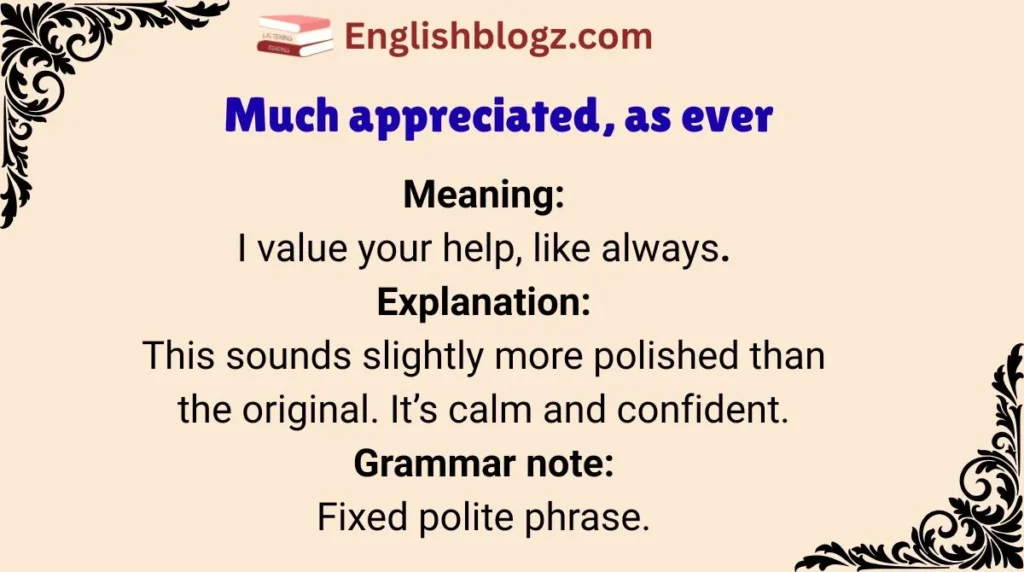
Meaning:
I value your help, like always.
Explanation:
This sounds slightly more polished than the original. It’s calm and confident.
Grammar note:
Fixed polite phrase.
Example sentence:
Much appreciated, as ever, for your guidance.
Best use:
Email, workplace
Worst use:
Casual texting
Tone:
Professional, soft
Level:
Intermediate
Similarity score:
9/10
Replaceability tip:
Use when you want to sound more refined but still familiar.
I truly appreciate your continued support
Meaning:
I am sincerely thankful for your ongoing help.
Explanation:
This feels strong and professional. It shows respect and seriousness.
Grammar note:
Formal verb phrase.
Example sentence:
I truly appreciate your continued support throughout this project.
Best use:
Formal emails, business
Worst use:
Casual chat
Tone:
Formal, professional
Level:
Advanced
Similarity score:
8/10
Replaceability tip:
Choose this for managers, clients, or senior staff.
Thanks again for everything
Meaning:
Thank you for all the help, once more.
Explanation:
Warm and friendly. Slightly emotional.
Grammar note:
Informal gratitude phrase.
Example sentence:
Thanks again for everything you do.
Best use:
Text, spoken English
Worst use:
Legal or corporate writing
Tone:
Friendly
Level:
Beginner
Similarity score:
7/10
Replaceability tip:
Use when closeness matters more than formality.
Always grateful for your help
Meaning:
I feel thankful every time you help.
Explanation:
This sounds personal and sincere.
Grammar note:
Adverb + adjective phrase.
Example sentence:
Always grateful for your help with these tasks.
Best use:
Emails, messages
Worst use:
Academic writing
Tone:
Warm, polite
Level:
Intermediate
Similarity score:
9/10
Replaceability tip:
Great when you want warmth without being casual.
With thanks, as always
Meaning:
Sending thanks, like usual.
Explanation:
Often used as an email closing. Short and clean.
Grammar note:
Formal closing phrase.
Example sentence:
With thanks, as always,
Asad
Best use:
Professional emails
Worst use:
Spoken English
Tone:
Professional
Level:
Advanced
Similarity score:
10/10
Replaceability tip:
Perfect replacement in emails.
Many thanks once again
Meaning:
Thank you again, strongly.
Explanation:
Slightly more formal than “thanks again.”
Grammar note:
Formal plural noun phrase.
Example sentence:
Many thanks once again for your prompt reply.
Best use:
Business emails
Worst use:
Casual talk
Tone:
Formal, polite
Level:
Intermediate
Similarity score:
8/10
Grateful as ever
Meaning:
Thankful, just like always.
Explanation:
Short, elegant, and slightly British in feel.
Grammar note:
Elliptical adjective phrase.
Example sentence:
Grateful as ever for your insight.
Best use:
Professional writing
Worst use:
Beginner English
Tone:
Professional, soft
Level:
Advanced
Similarity score:
9/10
Thank you for your ongoing support
Meaning:
Thanks for continuing to help.
Explanation:
Clear and professional. Very common in business.
Grammar note:
Formal verb phrase.
Example sentence:
Thank you for your ongoing support during this transition.
Best use:
Corporate emails
Worst use:
Casual messages
Tone:
Formal
Level:
Intermediate
Similarity score:
8/10
Appreciate it every time
Meaning:
I’m thankful whenever you help.
Explanation:
Friendly and conversational.
Grammar note:
Informal verb phrase.
Example sentence:
Appreciate it every time you jump in.
Best use:
Spoken English
Worst use:
Formal writing
Tone:
Friendly
Level:
Beginner
Similarity score:
6/10
Thanks, as usual
Meaning:
Thank you like always.
Explanation:
Very casual. Can sound lazy if overused.
Grammar note:
Adverbial phrase.
Example sentence:
Thanks, as usual, for covering this.
Best use:
Informal talk
Worst use:
Client emails
Tone:
Casual
Level:
Beginner
Similarity score:
7/10
I sincerely appreciate it
Meaning:
I truly thank you.
Explanation:
Short but powerful. Shows respect.
Grammar note:
Formal verb phrase.
Example sentence:
I sincerely appreciate your assistance.
Best use:
Professional emails
Worst use:
Very casual chats
Tone:
Formal
Level:
Intermediate
Similarity score:
7/10
Thanks again — much appreciated
Meaning:
Thank you again, I value it.
Explanation:
Friendly yet professional. Balanced tone.
Grammar note:
Compound gratitude phrase.
Example sentence:
Thanks again — much appreciated.
Best use:
Email, messaging
Worst use:
Academic writing
Tone:
Neutral
Level:
Beginner
Similarity score:
8/10
I’m always thankful for your support
Meaning:
I feel gratitude regularly.
Explanation:
Personal and warm.
Grammar note:
Declarative sentence.
Example sentence:
I’m always thankful for your support and advice.
Best use:
Emails, spoken
Worst use:
Formal reports
Tone:
Warm
Level:
Intermediate
Similarity score:
9/10
Thank you kindly, as always
Meaning:
Polite thanks, like usual.
Explanation:
Sounds slightly old-fashioned but respectful.
Grammar note:
Formal adverb usage.
Example sentence:
Thank you kindly, as always, for your time.
Best use:
Formal emails
Worst use:
Casual texting
Tone:
Formal, soft
Level:
Advanced
Similarity score:
10/10
Much obliged, as ever
Meaning:
I’m thankful, like always.
Explanation:
Very formal and traditional. Rare in modern casual English.
Grammar note:
Idiomatic expression.
Example sentence:
Much obliged, as ever, for your assistance.
Best use:
Formal writing, UK tone
Worst use:
Daily conversation
Tone:
Very formal
Level:
Advanced
Similarity score:
8/10
Mini Dialogue Examples
Formal conversation
A: Thank you for reviewing the document.
B: Much appreciated, as ever.
Informal conversation
A: I fixed the issue for you.
B: Thanks again for everything!
Business email style
I sincerely appreciate your continued support.
With thanks, as always,
Asad
Common Mistakes to Avoid
- Using casual phrases in formal emails
- Repeating the same phrase in every message
- Saying “thanks as always” without commas
- Using overly strong phrases for small favors
- Mixing slang with professional tone
- Overusing “as usual” (can sound rude)
Cultural and Tone Tips
In US English, variety matters. Repetition feels robotic.
In UK English, phrases like “much obliged” sound more natural.
In casual social English, shorter phrases feel warmer.
Native speakers notice tone quickly. A small word change shifts meaning.
Comparison Table of Strong Alternatives
| Phrase | Tone | Best Context | Professional Level | Example |
|---|---|---|---|---|
| With thanks, as always | Professional | High | With thanks, as always | |
| I truly appreciate your continued support | Formal | Business | Very high | I truly appreciate… |
| Thanks again for everything | Friendly | Casual | Low | Thanks again |
| Many thanks once again | Polite | Medium | Many thanks | |
| Grateful as ever | Soft formal | Work | High | Grateful as ever |
FAQs
Is “thank you, as always” rude?
No. It’s polite and respectful.
Is it okay in emails?
Yes, especially with colleagues you know.
What is the most formal alternative?
“I truly appreciate your continued support.”
What is the most polite alternative?
“With thanks, as always.”
What should beginners use?
“Thanks again for everything.”
Should I avoid it in academic writing?
Yes. Choose more formal expressions.
Conclusion
Words shape how people see you. Using only one phrase limits your voice. Learning alternatives to “thank you, as always” helps you sound natural, confident, and professional. The right expression adds warmth. It shows awareness. It builds better relationships.
Practice using different phrases in emails, messages, and conversations. Start simple. Then try more formal options. Over time, your English will feel flexible and fluent. Gratitude sounds better when it feels real.