The phrase “stay in your lane” is common in modern English. You hear it at work, online, and in everyday talk. It means focus on your own role or responsibility and don’t interfere where you don’t belong. Simple idea. Strong message.
However, the phrase can sound rude or aggressive in many situations. That’s why learning alternative expressions matters.
The words you choose shape your tone. They show respect, confidence, and emotional control. In business emails, essays, meetings, and professional chats, softer or more formal language works better.
Using varied language also makes you sound fluent and thoughtful. Native speakers rarely repeat the same phrase again and again.
Quick contrast:
- Informal: “Stay in your lane.”
- Professional: “Let’s focus on our respective responsibilities.”
Same idea. Very different impact.
This guide helps you choose the right words for the right moment.
What Does “Stay in Your Lane” Mean?
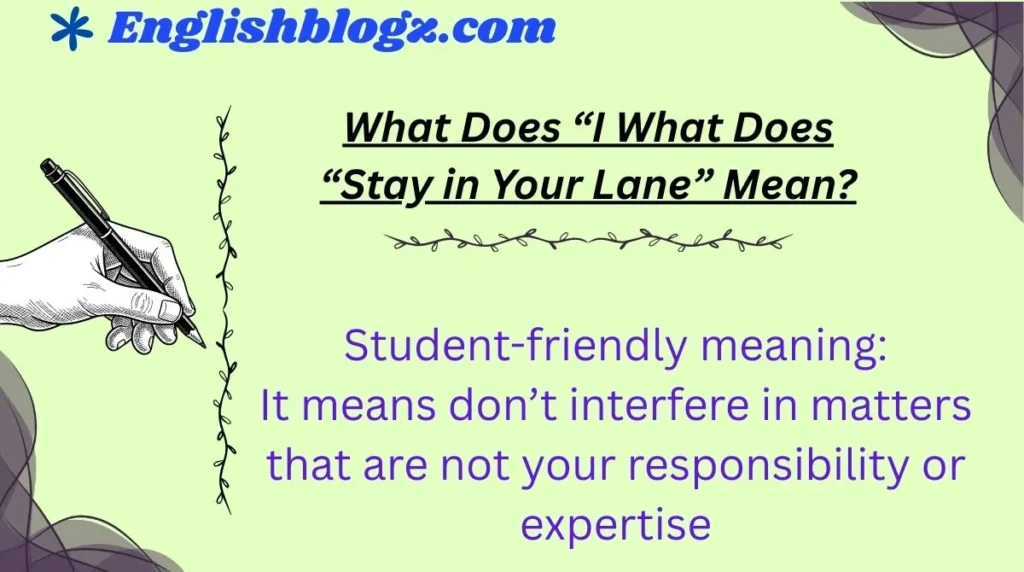
Student-friendly meaning:
It means don’t interfere in matters that are not your responsibility or expertise.
Grammar form:
- Idiom
- Imperative phrase (command)
Common synonyms:
- Mind your own business
- Focus on your role
- Stick to your responsibilities
Opposite tone phrases:
- Feel free to contribute
- Open to suggestions
- Please share your input
Example sentences:
- He told her to stay in her lane during the meeting.
- Online debates get ugly when people don’t stay in their lane.
When to Use “Stay in Your Lane”
Spoken English
Used in casual talk. Often sounds blunt or confrontational.
Business English
Rarely recommended. Can feel disrespectful.
Emails / Messages
Avoid in professional emails. Tone feels harsh.
Social Media
Common in arguments. Often sarcastic or defensive.
Academic Writing
Not appropriate. Too informal.
Professional Meetings
Better replaced with neutral or diplomatic language.
Is “Stay in Your Lane” Polite or Professional?
Politeness level: Low
Professional level: Low to medium
Emotional tone: Strong, dismissive
Tone range:
- Strong: “Stay in your lane.”
- Neutral: “That’s outside your scope.”
- Soft: “Let’s focus on our assigned roles.”
Etiquette tip:
Fine with close friends. Avoid in corporate emails or meetings unless the culture is very informal.
Pros & Cons of Using “Stay in Your Lane”
✔ Pros
- Clear and direct
- Easy to understand
- Expresses boundaries fast
✘ Cons
- Sounds rude
- Can escalate conflict
- Not suitable for formal settings
Quick Alternatives List (Fast Help)
- Mind your own business
- Focus on your role
- That’s outside your scope
- Stick to your area of expertise
- Let’s keep to our responsibilities
- Please respect boundaries
- This falls under another team
- Not within your remit
- Stay focused on your task
- Let the right person handle this
- That’s beyond your role
- Please don’t overstep
- This isn’t your call
- Handle your own responsibilities
- Let’s avoid crossing lines
Professional & Natural Alternatives Explained
Mind Your Own Business
Meaning:
Don’t interfere in personal matters.
Explanation:
This is a very direct phrase. Native speakers use it when annoyed. It often sounds rude, even if spoken calmly.
Grammar Note:
Imperative phrase.
Example Sentence:
He told them to mind their own business.
Best Use:
Informal speech, arguments.
Worst Use:
Workplace, emails.
Tone:
Strong, confrontational.
Level:
Beginner.
Similarity Score:
9/10
Replaceability Tip:
Use only when emotions are high and formality doesn’t matter.
Focus on Your Role
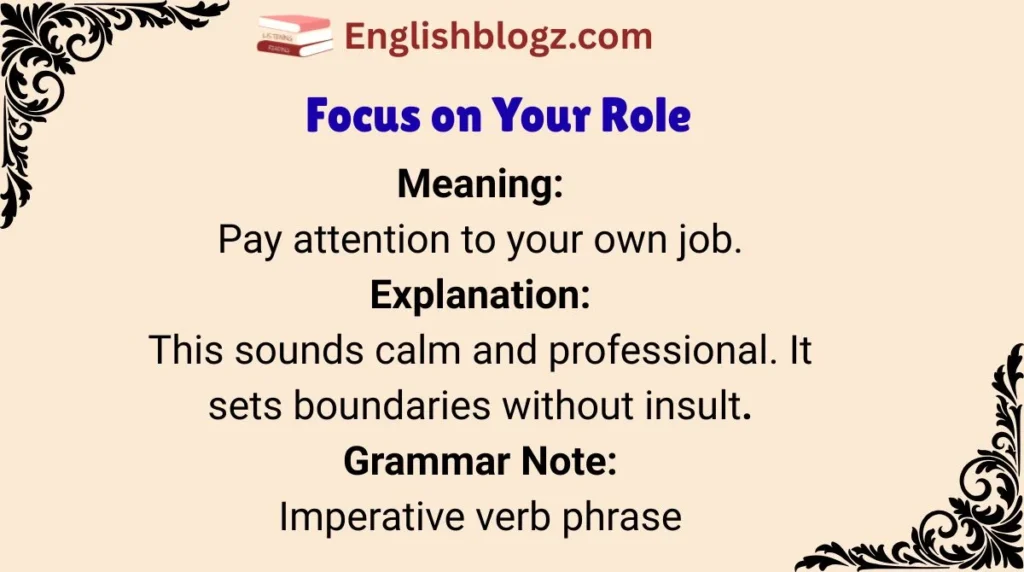
Meaning:
Pay attention to your own job.
Explanation:
This sounds calm and professional. It sets boundaries without insult.
Grammar Note:
Imperative verb phrase.
Example Sentence:
Let’s all focus on our roles to avoid confusion.
Best Use:
Workplace, meetings.
Worst Use:
Personal arguments.
Tone:
Neutral, professional.
Level:
Beginner–Intermediate.
Similarity Score:
8/10
Replaceability Tip:
Perfect replacement in offices.
That’s Outside Your Scope
Meaning:
It’s not part of your responsibility.
Explanation:
Formal and polite. Common in corporate English.
Grammar Note:
Declarative sentence.
Example Sentence:
That issue is outside your scope.
Best Use:
Emails, meetings.
Worst Use:
Casual chat.
Tone:
Formal, professional.
Level:
Intermediate.
Similarity Score:
7/10
Replaceability Tip:
Use when you want authority without rudeness.
Stick to Your Area of Expertise
Meaning:
Focus on what you know best.
Explanation:
This sounds respectful but firm. It implies skill-based boundaries.
Grammar Note:
Imperative idiomatic phrase.
Example Sentence:
Please stick to your area of expertise.
Best Use:
Professional discussions.
Worst Use:
Personal disputes.
Tone:
Professional, firm.
Level:
Intermediate.
Similarity Score:
8/10
Replaceability Tip:
Great when correcting someone politely.
Let’s Keep to Our Responsibilities
Meaning:
Everyone should do their assigned tasks.
Explanation:
Collaborative tone. Uses “let’s” to soften the message.
Grammar Note:
Inclusive suggestion.
Example Sentence:
Let’s keep to our responsibilities and move forward.
Best Use:
Team meetings.
Worst Use:
Arguments.
Tone:
Soft, professional.
Level:
Beginner.
Similarity Score:
6/10
Replaceability Tip:
Use when you want teamwork, not conflict.
That’s Not Your Call
Meaning:
You don’t have the authority to decide.
Explanation:
Firm but common in business talk.
Grammar Note:
Colloquial phrase.
Example Sentence:
Budget decisions aren’t your call.
Best Use:
Workplace discussions.
Worst Use:
Formal writing.
Tone:
Firm, neutral.
Level:
Intermediate.
Similarity Score:
8/10
Replaceability Tip:
Use when authority matters.
Please Respect Boundaries
Meaning:
Don’t cross limits.
Explanation:
Polite but serious. Often used in HR or conflict resolution.
Grammar Note:
Formal request.
Example Sentence:
Please respect professional boundaries.
Best Use:
Emails, workplace.
Worst Use:
Casual jokes.
Tone:
Soft, formal.
Level:
Intermediate.
Similarity Score:
6/10
Replaceability Tip:
Best when emotions are sensitive.
This Falls Under Another Team
Meaning:
Another group handles this.
Explanation:
Neutral and factual. No blame.
Grammar Note:
Formal statement.
Example Sentence:
That falls under another team’s responsibility.
Best Use:
Corporate communication.
Worst Use:
Arguments.
Tone:
Professional, neutral.
Level:
Intermediate.
Similarity Score:
5/10
Replaceability Tip:
Use to redirect calmly.
Not Within Your Remit
Meaning:
Outside your authority.
Explanation:
Very formal. Common in UK English.
Grammar Note:
Formal phrase.
Example Sentence:
This task is not within your remit.
Best Use:
Official settings.
Worst Use:
Casual talk.
Tone:
Formal.
Level:
Advanced.
Similarity Score:
7/10
Replaceability Tip:
Choose for high-level professionalism.
Avoid Overstepping
Meaning:
Don’t go beyond limits.
Explanation:
Gentle warning. Polite but firm.
Grammar Note:
Verb phrase.
Example Sentence:
Let’s avoid overstepping roles.
Best Use:
Meetings, HR talk.
Worst Use:
Arguments.
Tone:
Soft, professional.
Level:
Intermediate.
Similarity Score:
6/10
Replaceability Tip:
Great preventive language.
Handle Your Own Responsibilities
Meaning:
Do your assigned tasks.
Explanation:
Clear but can sound cold if not softened.
Grammar Note:
Imperative phrase.
Example Sentence:
Please handle your own responsibilities.
Best Use:
Workplace.
Worst Use:
Personal talk.
Tone:
Firm.
Level:
Beginner.
Similarity Score:
8/10
Replaceability Tip:
Add “please” to soften.
Let the Right Person Handle This
Meaning:
Someone else is responsible.
Explanation:
Diplomatic and respectful.
Grammar Note:
Suggestion phrase.
Example Sentence:
Let the right person handle this.
Best Use:
Emails, meetings.
Worst Use:
Arguments.
Tone:
Professional, soft.
Level:
Intermediate.
Similarity Score:
5/10
Replaceability Tip:
Use to avoid conflict.
That’s Beyond Your Role
Meaning:
Not part of your job.
Explanation:
Direct but still professional.
Grammar Note:
Declarative phrase.
Example Sentence:
That task is beyond your role.
Best Use:
Workplace.
Worst Use:
Casual chat.
Tone:
Neutral.
Level:
Intermediate.
Similarity Score:
7/10
Replaceability Tip:
Use when clarity matters.
Stick to Your Task
Meaning:
Focus on what you’re doing.
Explanation:
Simple and direct.
Grammar Note:
Imperative.
Example Sentence:
Please stick to your task.
Best Use:
Instructions.
Worst Use:
Sensitive discussions.
Tone:
Firm.
Level:
Beginner.
Similarity Score:
6/10
Replaceability Tip:
Good for time management.
This Isn’t Your Area
Meaning:
Not your expertise.
Explanation:
Casual but firm.
Grammar Note:
Informal phrase.
Example Sentence:
This isn’t your area, so let’s move on.
Best Use:
Informal workplace.
Worst Use:
Formal writing.
Tone:
Neutral.
Level:
Beginner.
Similarity Score:
7/10
Replaceability Tip:
Works well in relaxed teams.
Mini Dialogue Examples
Formal
Manager: “That decision falls under finance. Let’s keep to our responsibilities.”
Informal
Friend: “Why are you commenting on my job?”
You: “Relax. Stick to your area.”
Business Email Style
“Hi Alex,
This matter is outside your scope. Please coordinate with the compliance team.
Best regards.”
Mistakes to Avoid
- Using harsh phrases in emails
- Forgetting cultural tone
- Sounding sarcastic by accident
- Using slang in formal writing
- Overusing one phrase repeatedly
- Ignoring hierarchy
- Missing polite markers like “please”
Cultural & Tone Tips
US English:
Direct but softened with polite language.
UK English:
Prefers indirect, formal expressions like “not within your remit.”
Casual Social English:
Blunt phrases are common but can still offend.
Native speakers feel “stay in your lane” is aggressive unless joking.
Comparison Table
| Phrase | Tone | Best Context | Professional Level | Example |
|---|---|---|---|---|
| Focus on your role | Neutral | Workplace | Medium | Focus on your role today |
| Outside your scope | Formal | Emails | High | That’s outside your scope |
| Stick to expertise | Firm | Meetings | Medium | Stick to your expertise |
| Respect boundaries | Soft | HR | High | Please respect boundaries |
| Not your call | Neutral | Work talk | Medium | That’s not your call |
FAQs
Is “stay in your lane” rude?
Yes. It often sounds dismissive.
Is it okay in emails?
No. Avoid it in professional emails.
What’s the most formal alternative?
Not within your remit.
What’s the most polite option?
Let the right person handle this.
What should beginners use?
Focus on your role.
Can it ever be friendly?
Only with close friends and joking tone.
Conclusion
Choosing the right words changes everything. While “stay in your lane” delivers a clear message, it often hurts more than it helps.
Smart alternatives let you set boundaries without sounding rude. They improve clarity, professionalism, and trust.
When you vary your language, you sound confident and fluent. You also avoid conflict. Practice these phrases in real conversations. Try them in emails. Notice the difference in reactions.
Good English isn’t just correct. It’s thoughtful.

“Jacob Harper makes English learning simple and fun. He shares tips to help everyone improve confidently.”