You say “see you tomorrow” when you plan to meet someone the next day. It sounds friendly and clear.
However, using the same phrase every time can feel flat or too casual, especially in work, emails, or formal talks. Word choice shapes tone. It shows respect, warmth, or professionalism.
For example:
- Informal: “See you tomorrow!”
- Formal: “I look forward to meeting you tomorrow.”
Both mean the same thing, but they feel very different.
Using varied language helps you sound natural, polite, and confident. It also helps in business writing, customer service, school emails, and daily chats. When you match your words to the moment, people feel more comfortable and respected. That small change can build trust and improve communication fast.
This guide gives you strong, natural, and context-safe ways to say the same idea without sounding stiff or awkward.
What Does “See You Tomorrow” Mean?
Student-friendly meaning:
It means you expect to meet or talk to someone the next day.
Grammar form:
A casual farewell phrase. It works like an interjection or fixed expression.
Similar tone phrases:
- “Catch you tomorrow”
- “Talk to you tomorrow”
Opposite tone (formal):
- “I look forward to our meeting tomorrow”
Sample sentences:
- “Thanks for today. See you tomorrow.”
- “I’ll bring the files. See you tomorrow at nine.”
When to Use “See You Tomorrow”
Spoken English
Perfect for friends, classmates, and family. It sounds warm and relaxed.
Business English
Okay with coworkers you know well. Avoid it with clients or senior staff.
Emails / Messages
Fine for casual work chats. Not ideal for formal email threads.
Social Media
Great for comments, DMs, and friendly replies.
Academic Writing
Avoid it. Use complete and formal sentences instead.
Professional Meetings
Better to use polite closing lines. It sounds more respectful.
Is “See You Tomorrow” Polite or Professional?
This phrase is friendly and polite, but not very professional.
Tone levels:
- Soft: friendly, warm, relaxed
- Neutral: casual but clear
- Formal: not formal at all
Etiquette tip:
Good for teammates and friends. Avoid it in corporate emails, client meetings, or formal interviews. In those cases, use polite future-focused lines.
Pros & Cons of Using “See You Tomorrow”
✔ Pros:
- Easy and clear
- Friendly and natural
- Works in daily speech
- No grammar stress
✘ Cons:
- Sounds casual
- Weak in business settings
- Not suitable for formal writing
- Can feel rushed or short in emails
Quick Alternatives List (For Fast Use)
- See you then
- Catch up tomorrow
- Talk to you tomorrow
- Until tomorrow
- Looking forward to tomorrow
- See you in the morning
- Speak soon
- Until we meet tomorrow
- I’ll see you tomorrow
- We’ll connect tomorrow
- Looking forward to our meeting
- Catch you later
- See you soon
- Talk soon
- Until next time
⭐ Strong Alternatives You Can Use with Confidence
Looking forward to seeing you tomorrow
Meaning:
You feel happy about meeting tomorrow.
Explanation:
This sounds polite and positive. It shows interest and respect.
Grammar Note:
Formal sentence phrase.
Example Sentence:
“Thank you for your time. Looking forward to seeing you tomorrow.”
Best Use:
Email, workplace, professional talks
Worst Use:
Very casual chats
Tone:
Professional, warm
Level:
Beginner
Similarity Score:
9/10
Replaceability Tip:
Use this when you want to sound polite and friendly at work.
I look forward to our meeting tomorrow
Meaning:
You expect a formal meeting tomorrow.
Explanation:
Strong professional tone. Great for business settings.
Grammar Note:
Formal statement
Example Sentence:
“I look forward to our meeting tomorrow at 10 a.m.”
Best Use:
Business emails, interviews
Worst Use:
Texting friends
Tone:
Formal, respectful
Level:
Intermediate
Similarity Score:
8/10
Replaceability Tip:
Use this instead of casual goodbyes in corporate emails.
See you in the morning
Meaning:
You will meet early the next day.
Explanation:
Adds time detail. Sounds friendly and clear.
Grammar Note:
Casual farewell phrase
Example Sentence:
“Rest well. See you in the morning.”
Best Use:
Friends, coworkers
Worst Use:
Formal client emails
Tone:
Friendly
Level:
Beginner
Similarity Score:
9/10
Replaceability Tip:
Choose this when the meeting time matters.
Talk to you tomorrow
Meaning:
You plan to speak tomorrow.
Explanation:
Focuses on communication, not meeting.
Grammar Note:
Casual expression
Example Sentence:
“I’ll send the details. Talk to you tomorrow.”
Best Use:
Phone chats, messages
Worst Use:
Formal letters
Tone:
Neutral, friendly
Level:
Beginner
Similarity Score:
8/10
Replaceability Tip:
Best when you won’t meet face to face.
Catch up tomorrow
Meaning:
You will talk or meet informally tomorrow.
Explanation:
Sounds relaxed and social.
Grammar Note:
Phrasal verb
Example Sentence:
“Busy day today. Let’s catch up tomorrow.”
Best Use:
Friends, casual coworkers
Worst Use:
Professional emails
Tone:
Informal
Level:
Intermediate
Similarity Score:
7/10
Replaceability Tip:
Use when the talk will be relaxed and social.
Until tomorrow
Meaning:
Goodbye until the next day.
Explanation:
Short and polite. Slightly formal in tone.
Grammar Note:
Formal farewell phrase
Example Sentence:
“Good night. Until tomorrow.”
Best Use:
Polite speech, light formal
Worst Use:
Fast texting
Tone:
Soft, polite
Level:
Beginner
Similarity Score:
7/10
Replaceability Tip:
Nice for calm and polite endings.
We’ll connect tomorrow
Meaning:
You will speak or meet tomorrow.
Explanation:
Modern business language. Sounds professional.
Grammar Note:
Business phrasing
Example Sentence:
“I’ll review this. We’ll connect tomorrow.”
Best Use:
Work chats, meetings
Worst Use:
Friendly social talk
Tone:
Professional
Level:
Intermediate
Similarity Score:
7/10
Replaceability Tip:
Use when plans are flexible but certain.
See you then
Meaning:
You will meet at the planned time.
Explanation:
Short and neutral. Works in many settings.
Grammar Note:
Casual neutral phrase
Example Sentence:
“Tomorrow at three? See you then.”
Best Use:
Daily conversations
Worst Use:
Formal writing
Tone:
Neutral
Level:
Beginner
Similarity Score:
8/10
Replaceability Tip:
Great when time is already clear.
Until we meet tomorrow
Meaning:
Polite goodbye until tomorrow.
Explanation:
Sounds gentle and respectful.
Grammar Note:
Formal farewell
Example Sentence:
“Have a good evening. Until we meet tomorrow.”
Best Use:
Polite settings
Worst Use:
Fast texting
Tone:
Soft, formal
Level:
Advanced
Similarity Score:
7/10
Replaceability Tip:
Use when you want to sound courteous.
Looking forward to tomorrow
Meaning:
You feel positive about tomorrow.
Explanation:
Focuses on the day, not the meeting.
Grammar Note:
Casual formal blend
Example Sentence:
“Great chat today. Looking forward to tomorrow.”
Best Use:
Friendly work emails
Worst Use:
Very formal letters
Tone:
Friendly professional
Level:
Beginner
Similarity Score:
6/10
Replaceability Tip:
Good when plans are general.
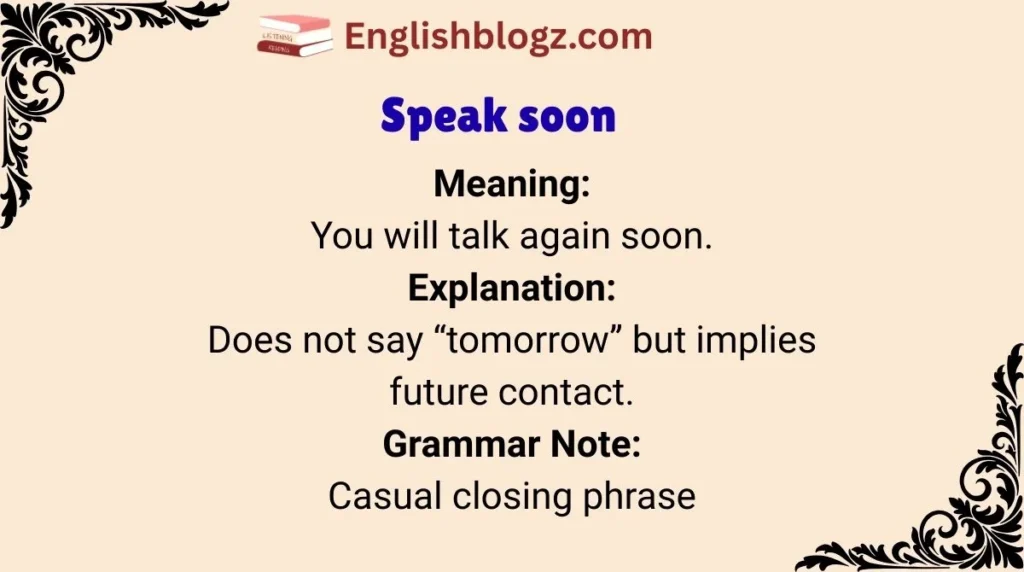
Speak soon
Meaning:
You will talk again soon.
Explanation:
Does not say “tomorrow” but implies future contact.
Grammar Note:
Casual closing phrase
Example Sentence:
“I’ll check and reply. Speak soon.”
Best Use:
Emails, messages
Worst Use:
Time-specific plans
Tone:
Neutral
Level:
Beginner
Similarity Score:
5/10
Replaceability Tip:
Use when timing is flexible.
I’ll see you tomorrow
Meaning:
Clear statement of future meeting.
Explanation:
Slightly more complete and polite.
Grammar Note:
Full sentence
Example Sentence:
“I’ll see you tomorrow at the office.”
Best Use:
Daily talk, light business
Worst Use:
Formal writing
Tone:
Neutral
Level:
Beginner
Similarity Score:
10/10
Replaceability Tip:
Use when you want clarity.
Until next time
Meaning:
Goodbye until you meet again.
Explanation:
Not time-specific. Friendly closing.
Grammar Note:
Fixed farewell phrase
Example Sentence:
“Thanks for today. Until next time.”
Best Use:
Casual goodbyes
Worst Use:
Scheduled meetings
Tone:
Friendly
Level:
Beginner
Similarity Score:
4/10
Replaceability Tip:
Use when no date is set.
We’ll pick this up tomorrow
Meaning:
You will continue work tomorrow.
Explanation:
Common in meetings. Focuses on tasks.
Grammar Note:
Business phrasing
Example Sentence:
“Let’s pause here. We’ll pick this up tomorrow.”
Best Use:
Work discussions
Worst Use:
Social talk
Tone:
Professional
Level:
Intermediate
Similarity Score:
6/10
Replaceability Tip:
Use when work will continue.
See you soon
Meaning:
You will meet again soon.
Explanation:
Warm but not specific.
Grammar Note:
Casual farewell
Example Sentence:
“Drive safe. See you soon.”
Best Use:
Friends, family
Worst Use:
Formal plans
Tone:
Friendly
Level:
Beginner
Similarity Score:
5/10
Replaceability Tip:
Use when tomorrow is not certain.
Mini Dialogue Examples
Formal Conversation
A: “Thank you for today’s meeting.”
B: “I look forward to our meeting tomorrow.”
Informal Chat
A: “Same time tomorrow?”
B: “Yeah, see you then!”
Business Email Style
“Thank you for your message. We’ll connect tomorrow to finalize the details.”
Mistakes to Avoid
- Using casual phrases in formal emails
- Saying “see you tomorrow” in job interviews
- Mixing time words like “tomorrow soon”
- Using slang with clients
- Forgetting to mention time when needed
- Using very short replies that sound rude
- Overusing the same phrase every day
Cultural & Tone Tips
In US English, “see you tomorrow” sounds warm and normal in daily life. At work, people switch to polite closings fast.
In UK English, people often prefer softer farewells like “until tomorrow” or “speak tomorrow.”
In casual social English, short phrases work well. Tone matters more than grammar. Smiles, emojis, and friendly words soften messages in chats.
In business culture, polite language shows respect. Even small word changes can improve how people see you.
Comparison Table: Best Alternatives at a Glance
| Phrase | Tone | Best Context | Professional Level | Example |
|---|---|---|---|---|
| Looking forward to seeing you tomorrow | Warm | Emails | High | “Looking forward to seeing you tomorrow.” |
| I look forward to our meeting tomorrow | Formal | Clients | Very High | “I look forward to our meeting tomorrow.” |
| We’ll connect tomorrow | Professional | Team work | High | “We’ll connect tomorrow.” |
| See you then | Neutral | Daily talk | Medium | “See you then.” |
| Talk to you tomorrow | Friendly | Messages | Low | “Talk to you tomorrow.” |
| Until tomorrow | Polite | Light formal | Medium | “Until tomorrow.” |
FAQs
Is “see you tomorrow” rude?
No. It is friendly and polite. It is just casual.
Is it okay in work emails?
Only with coworkers you know well. Avoid it with clients.
What is the most formal alternative?
“I look forward to our meeting tomorrow.”
What is the most polite alternative?
“Looking forward to seeing you tomorrow.”
What should beginners use?
“I’ll see you tomorrow” or “see you then.”
Can I use emojis with these phrases?
Yes in chats. Avoid emojis in professional emails.
Conclusion
Simple phrases carry strong meaning. “See you tomorrow” works well in daily life, but it does not fit every situation.
When you choose better words, you show respect, clarity, and confidence. Formal settings need polite language. Friendly chats need warm words. Small changes improve how people respond to you.
Practice these alternatives in emails, meetings, and daily talk. Try one new phrase each day. Over time, your English will sound smoother, smarter, and more natural. Strong language builds strong connections.

“Jacob Harper makes English learning simple and fun. He shares tips to help everyone improve confidently.”