The phrase “please provide” is commonly used in English to request something politely. It’s straightforward, professional, and often seen in emails, business reports, or academic assignments.
But using the same phrase repeatedly can make your language feel repetitive, robotic, or overly formal. That’s why knowing alternative ways to express the same idea is important.
Choosing the right words affects tone, clarity, and professionalism. A well-chosen phrase can make your request sound polite, approachable, or more authoritative, depending on the context. For example, in a formal email, you might write: “
Please provide the quarterly report.” In a casual chat with a colleague, you could say: “Could you send me the report?” Both communicate the same request but with different tones.
Varied language helps you sound more natural, confident, and fluent, whether in business emails, academic papers, or daily conversation. It also makes your writing more engaging and shows respect for the reader’s time and attention.
What Does “Please Provide” Mean?
Please provide is a polite request asking someone to give information, documents, or materials.
- Grammar form: Verb phrase
- Synonyms: Kindly supply, share, submit, furnish, send over
- Opposite tone: Demand, insist, require (less polite)
Examples:
- Formal: Please provide the necessary documents before the deadline.
- Informal: Can you send me your notes?
This phrase functions as a soft directive that keeps communication polite and professional.
When to Use “Please Provide”
Spoken English: Rarely used in casual speech; sounds formal. Better to say “Could you give me…” or “Send me…”
Business English: Perfect for emails, reports, and requests to colleagues or clients.
Emails / Messages: Widely used in professional emails: “Please provide the updated invoice.”
Social Media: Generally too formal. Opt for casual alternatives like “Share” or “Send me.”
Academic Writing: Useful when requesting data, sources, or references: “Please provide supporting evidence for your argument.”
Professional Meetings: Can be used politely in discussions: “Could you please provide more details on the project timeline?”
Is “Please Provide” Polite or Professional?
Tone Levels:
- Polite ✅
- Neutral ✅
- Strong ❌
- Soft ✅
Formal vs Informal:
- Formal: “Please provide your feedback by Friday.”
- Informal: “Can you give me your feedback?”
Etiquette Tip:
- Better for workplace emails, reports, and formal documentation.
- Avoid overusing in casual conversation; it may sound stiff.
Pros & Cons of Using “Please Provide”
✔ Pros:
- Polite and professional
- Clear and concise
- Suitable for formal writing
✘ Cons:
- Can sound repetitive or robotic
- Too formal for casual conversation
- Lacks nuance or emotional tone
Quick Alternatives List
- Kindly provide
- Send me
- Share
- Furnish
- Supply
- Submit
- Forward
- Deliver
- Grant
- Make available
- Issue
- Present
- Hand over
- Give
- Offer
15 Alternatives to “Please Provide”
Kindly Provide
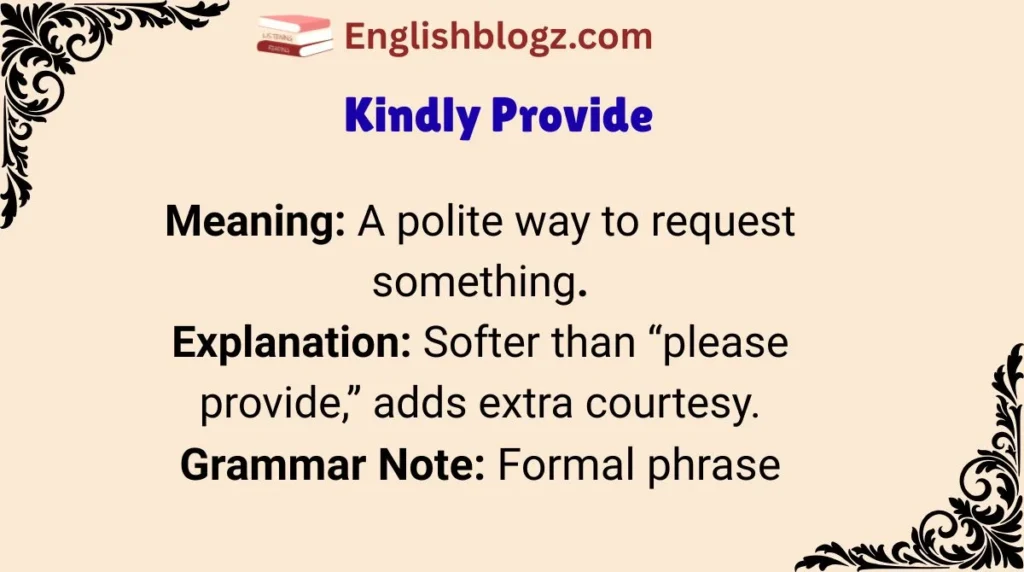
Meaning: A polite way to request something.
Explanation: Softer than “please provide,” adds extra courtesy.
Grammar Note: Formal phrase
Example Sentence: Kindly provide your updated resume by Monday.
Best Use: Email, professional correspondence
Worst Use: Casual texting
Tone: Formal, polite
Level: Intermediate
Similarity Score: 9/10
Replaceability Tip: Use when extra politeness is needed in professional emails.
Send Me
Meaning: Ask someone to deliver or forward something.
Explanation: Casual, direct, simple. Common in speech or informal emails.
Grammar Note: Verb phrase
Example Sentence: Send me the report when you finish it.
Best Use: Informal messages, chats
Worst Use: Formal documents
Tone: Friendly, neutral
Level: Beginner
Similarity Score: 8/10
Replaceability Tip: Use in informal digital communication.
Share
Meaning: Provide information or content.
Explanation: Can be casual or semi-formal; often used digitally.
Grammar Note: Verb
Example Sentence: Please share the meeting agenda with the team.
Best Use: Emails, social media, collaboration platforms
Worst Use: Highly formal requests
Tone: Neutral, friendly
Level: Beginner
Similarity Score: 8/10
Replaceability Tip: Perfect for collaborative contexts.
Furnish
Meaning: Give or supply documents or information.
Explanation: Very formal, often used in legal, business, or academic contexts.
Grammar Note: Verb
Example Sentence: Kindly furnish the committee with all necessary documents.
Best Use: Official letters, contracts
Worst Use: Casual conversation
Tone: Formal, professional
Level: Advanced
Similarity Score: 10/10
Replaceability Tip: Use in high-stakes professional communication.
Supply
Meaning: Provide something needed.
Explanation: Neutral, often implies quantity or resources.
Grammar Note: Verb
Example Sentence: Please supply the lab with additional test samples.
Best Use: Workplace, logistics, business emails
Worst Use: Informal speech
Tone: Professional, neutral
Level: Intermediate
Similarity Score: 9/10
Replaceability Tip: Use when requesting materials, not just information.
Submit
Meaning: Deliver formally for review or approval.
Explanation: Often used for assignments, applications, or reports.
Grammar Note: Verb
Example Sentence: Please submit the completed form by Thursday.
Best Use: Academic, administrative, professional emails
Worst Use: Casual messaging
Tone: Formal, professional
Level: Intermediate
Similarity Score: 9/10
Replaceability Tip: Use for documents or official items.
Forward
Meaning: Send something to another person.
Explanation: Informal to semi-formal; emphasizes transmission.
Grammar Note: Verb
Example Sentence: Could you forward me the latest sales figures?
Best Use: Emails, office communication
Worst Use: Formal letters
Tone: Neutral, professional
Level: Beginner
Similarity Score: 8/10
Replaceability Tip: Use for emails, digital documents, or messages.
Deliver
Meaning: Bring or provide something required.
Explanation: Can sound physical or abstract (ideas, reports).
Grammar Note: Verb
Example Sentence: Please deliver the finalized presentation by 5 PM.
Best Use: Workplace, logistics, project tasks
Worst Use: Casual social media chat
Tone: Formal, professional
Level: Intermediate
Similarity Score: 8/10
Replaceability Tip: Best for tangible or structured requests.
Grant
Meaning: Give officially or legally.
Explanation: Formal, often used for permissions, licenses, or approvals.
Grammar Note: Verb
Example Sentence: Kindly grant access to the project folder.
Best Use: Professional emails, official documents
Worst Use: Casual conversation
Tone: Formal, professional
Level: Advanced
Similarity Score: 8/10
Replaceability Tip: Use for authoritative or official approvals.
Make Available
Meaning: Ensure someone can access or obtain something.
Explanation: Professional but approachable.
Grammar Note: Verb phrase
Example Sentence: Please make available the financial report for the board.
Best Use: Professional emails, meetings
Worst Use: Informal text messages
Tone: Formal, neutral
Level: Intermediate
Similarity Score: 9/10
Replaceability Tip: Use when emphasizing accessibility.
Issue
Meaning: Officially provide or distribute.
Explanation: Often used in legal, administrative, or corporate contexts.
Grammar Note: Verb
Example Sentence: Kindly issue the payment authorization form.
Best Use: Formal communication, corporate emails
Worst Use: Casual speech
Tone: Formal, professional
Level: Advanced
Similarity Score: 9/10
Replaceability Tip: Use in official procedural requests.
Present
Meaning: Give formally or publicly.
Explanation: Often used in meetings, presentations, or submissions.
Grammar Note: Verb
Example Sentence: Please present your findings at the team meeting.
Best Use: Workplace meetings, academic presentations
Worst Use: Informal texting
Tone: Formal, professional
Level: Intermediate
Similarity Score: 8/10
Replaceability Tip: Use for structured or visible sharing.
Hand Over
Meaning: Physically give something to someone.
Explanation: Slightly informal but polite; emphasizes action.
Grammar Note: Phrasal verb
Example Sentence: Could you hand over the signed forms to HR?
Best Use: Office, small teams
Worst Use: Formal emails
Tone: Neutral, friendly
Level: Beginner
Similarity Score: 7/10
Replaceability Tip: Use for tangible items rather than information.
Give
Meaning: Provide something directly.
Explanation: Simple, neutral, casual; very common.
Grammar Note: Verb
Example Sentence: Can you give me your notes?
Best Use: Informal chats, casual requests
Worst Use: Formal professional writing
Tone: Friendly, neutral
Level: Beginner
Similarity Score: 7/10
Replaceability Tip: Use in everyday speech.
Offer
Meaning: Provide voluntarily or politely.
Explanation: Emphasizes willingness to give, softer than “please provide.”
Grammar Note: Verb
Example Sentence: We can offer the training materials to the new staff.
Best Use: Workplace, professional emails
Worst Use: Demanding requests
Tone: Formal, friendly
Level: Intermediate
Similarity Score: 8/10
Replaceability Tip: Use when suggesting something rather than requesting.
Mini Dialogue Examples
Formal Dialogue:
- Manager: Could you please provide the Q3 report by Friday?
- Employee: Certainly, I will send it by Thursday evening.
Informal Dialogue:
- Alex: Can you send me the slides for the meeting?
- Jamie: Sure! I’ll forward them now.
Business Email Example:
Subject: Request for Project Documents
Dear Mr. Khan,
Kindly furnish the updated project documents at your earliest convenience. This will help us finalize the report on time.Best regards,
Sara
Mistakes to Avoid
- Using “please provide” in casual chats – sounds robotic.
- Mixing formal and slang terms in the same sentence.
- Forgetting to specify what you want provided.
- Overusing the phrase in long emails – repetitive.
- Using “please provide” when asking for opinions – better alternatives exist.
- Confusing “furnish” with casual alternatives.
- Being too vague – e.g., “Please provide it” without context.
Cultural & Tone Tips
- UK English: Often prefers “kindly provide” or “share” in formal emails.
- US English: Direct and polite phrases like “send me” or “please provide” are common.
- Casual Social English: “Send me,” “share,” or “give me” are natural.
- Tone matters: formal expressions show respect, while casual alternatives create approachability.
Comparison Table of Best Alternatives
| Phrase | Tone | Best Context | Professional Level | Example |
|---|---|---|---|---|
| Kindly Provide | Polite | Emails, letters | Advanced | Kindly provide your resume. |
| Furnish | Formal | Legal, official documents | Advanced | Please furnish the required certificates. |
| Share | Neutral | Collaboration, emails | Intermediate | Share the meeting agenda with the team. |
| Submit | Formal | Academic, administrative | Intermediate | Submit the assignment by Monday. |
| Send Me | Friendly | Chat, informal email | Beginner | Send me the notes from class. |
| Make Available | Neutral | Workplace access | Intermediate | Please make available the financial report. |
FAQs
Is “please provide” rude?
No, it’s polite and professional, especially in emails and formal communication.
Is it okay in emails?
Yes, it’s standard in professional emails, but overuse can sound repetitive.
What is the most formal alternative?
“Furnish” or “kindly provide” are highly formal.
What is the most polite alternative?
“Kindly provide” adds extra courtesy.
What should beginners use?
“Send me” or “share” are simple and natural.
Can it be used in spoken English?
Yes, but it may sound stiff; casual alternatives are better.
Conclusion
Using alternatives to “please provide” improves your English fluency and professionalism. Varied expressions help you sound polite, confident, and context-appropriate, whether in emails, meetings, or casual conversations.
Learning these alternatives also reduces repetition and makes your writing more engaging. Practice with real conversations, emails, and documents to master tone and nuance.

“Jacob Harper makes English learning simple and fun. He shares tips to help everyone improve confidently.”