The phrase “not my problem” means you don’t take responsibility for a situation. You’re saying, “This isn’t my job to fix.” People use it every day.
However, the words can sound cold, rude, or careless if you say them the wrong way.
That’s why alternatives matter. Word choice shapes how others see you. In work emails, meetings, essays, and even texts, the right phrase can keep things calm and professional. The wrong phrase can start an argument fast.
For example:
- Informal: “Not my problem.”
- Formal: “This falls outside my responsibility.”
Same idea. Very different tone.
When you learn many ways to say the same thing, you sound smarter, clearer, and more polite. You also avoid awkward moments. This guide gives you strong, natural options you can use in real life.
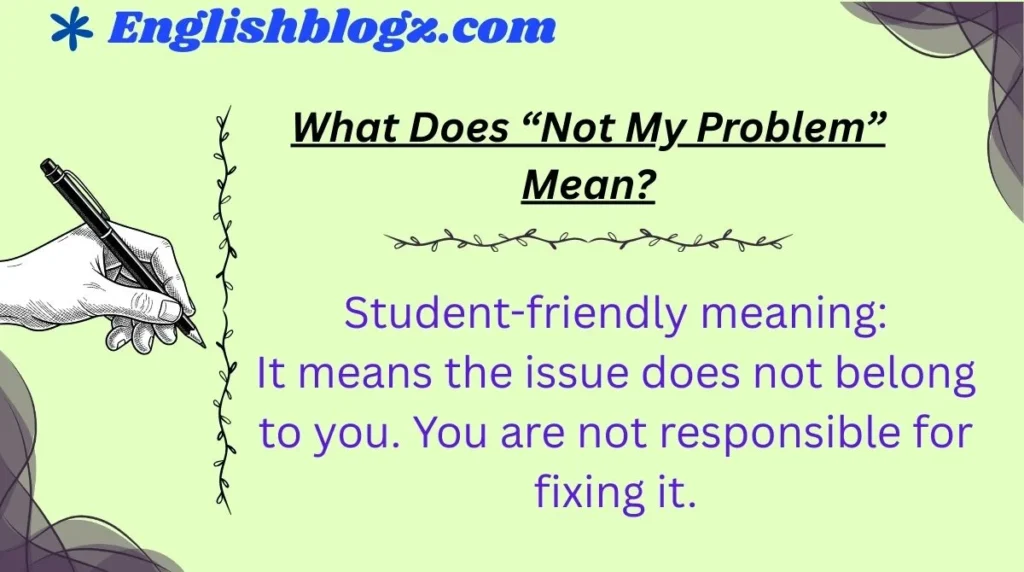
What Does “Not My Problem” Mean?
Student-friendly meaning:
It means the issue does not belong to you. You are not responsible for fixing it.
Grammar form:
It’s an informal fixed phrase. Some people treat it like an idiom.
Similar ideas (same tone):
- Not my responsibility
- That’s on you
- Not my concern
Opposite ideas:
- I’ll take care of it
- I’ll handle it
- Let me fix this
Example sentences:
- “The printer is broken? Not my problem. Call IT.”
- “That deadline isn’t my problem. I finished my part.”
When to Use “Not My Problem”
Spoken English
Friends use it jokingly or casually. Tone matters a lot here. With the wrong tone, it can sound harsh.
Business English
Not recommended. It feels blunt and unhelpful. Better to use softer, professional wording.
Emails and Messages
Avoid it in work emails. It can look rude and lazy, even if you are right.
Social Media
People use it often in comments or jokes. It’s fine for humor, not great for serious talks.
Academic Writing
Never use it. Academic writing needs formal, neutral language.
Professional Meetings
Avoid it. Instead, explain roles and limits politely.
Is “Not My Problem” Polite or Professional?
Short answer: No.
Let’s break it down by tone:
- Polite: ❌ Not polite
- Neutral: ⚠️ Rarely neutral
- Strong: ✅ Very strong
- Soft: ❌ Not soft at all
- Formal: ❌ Not formal
- Informal: ✅ Very informal
It sounds dismissive. Even when true, it can damage teamwork.
Etiquette tip:
In the workplace, never say this in emails or meetings. Instead, say who should handle the issue or offer the next step.
Pros and Cons of Using “Not My Problem”
✔ Pros:
- Very clear
- Short and direct
- Easy for beginners
✘ Cons:
- Sounds rude
- Hurts teamwork
- Not professional
- Can start conflict
- Not good for writing
Quick Alternatives List (For Fast Use)
Here are short, safe swaps you can use right away:
- That’s not my responsibility
- This falls outside my role
- You may need to contact someone else
- I’m not the right person for this
- That’s beyond my scope
- It’s out of my hands
- I can’t assist with that
- This needs another department
- That’s for them to decide
- I don’t handle that
- Please check with support
- That’s not within my duties
- I’m unable to help with this
- You’ll need to follow up with them
- This isn’t assigned to me
Strong and Natural Alternatives You Can Use
That’s not my responsibility
Meaning:
It is not part of your job or duty.
Explanation:
This is clear and professional. It sets boundaries without sounding angry.
Grammar Note:
Formal phrase with noun “responsibility.”
Example Sentence:
“That’s not my responsibility. Please contact the billing team.”
Best Use:
Workplace, emails, meetings
Worst Use:
With close friends, where it may feel stiff
Tone:
Professional, neutral
Level:
Beginner
Similarity Score:
9/10
Replaceability Tip:
Use this when you need to be firm but polite.
This falls outside my role
Meaning:
It is not part of what you are supposed to do.
Explanation:
This sounds calm and mature. It works well in corporate settings.
Grammar Note:
Formal business phrasing.
Example Sentence:
“This falls outside my role, but HR may help.”
Best Use:
Corporate emails, meetings
Worst Use:
Casual chats
Tone:
Formal, professional
Level:
Intermediate
Similarity Score:
8/10
Replaceability Tip:
Use this when you want to sound cooperative, not defensive.
I’m not the right person for this
Meaning:
Someone else should handle it.
Explanation:
It shifts focus to finding the right help. It feels supportive.
Grammar Note:
Simple sentence with adjective phrase.
Example Sentence:
“I’m not the right person for this. Try tech support.”
Best Use:
Workplace, customer service
Worst Use:
When you actually should handle it
Tone:
Soft, professional
Level:
Beginner
Similarity Score:
7/10
Replaceability Tip:
Use when redirecting, not rejecting.
You’ll need to contact someone else
Meaning:
Another person or team must handle it.
Explanation:
Clear and helpful. It gives direction, not blame.
Grammar Note:
Future modal verb “will.”
Example Sentence:
“You’ll need to contact accounting for that.”
Best Use:
Emails, support desks
Worst Use:
Arguments
Tone:
Neutral, polite
Level:
Beginner
Similarity Score:
7/10
Replaceability Tip:
Use when guiding people to the next step.
That’s beyond my scope
Meaning:
It is outside your area of work.
Explanation:
Common in professional and technical fields.
Grammar Note:
Formal phrase using noun “scope.”
Example Sentence:
“That’s beyond my scope, but the legal team can advise.”
Best Use:
Formal business talk
Worst Use:
Casual social talk
Tone:
Formal, professional
Level:
Advanced
Similarity Score:
8/10
Replaceability Tip:
Great for setting professional limits.
It’s out of my hands
Meaning:
You have no control over the situation.
Explanation:
This shows you cannot change the outcome.
Grammar Note:
Idiom
Example Sentence:
“I sent the request. Now it’s out of my hands.”
Best Use:
Work, casual talk
Worst Use:
When you actually still have control
Tone:
Neutral, slightly soft
Level:
Intermediate
Similarity Score:
6/10
Replaceability Tip:
Use when you already did your part.
I don’t handle that
Meaning:
That task is not part of your duties.
Explanation:
Short and clear. Slightly informal but useful.
Grammar Note:
Present simple verb.
Example Sentence:
“I don’t handle refunds. Customer service does.”
Best Use:
Workplace conversations
Worst Use:
Formal writing
Tone:
Neutral
Level:
Beginner
Similarity Score:
7/10
Replaceability Tip:
Use in spoken office talk.
This isn’t assigned to me
Meaning:
You were not given this task.
Explanation:
It explains responsibility clearly.
Grammar Note:
Passive voice construction.
Example Sentence:
“This isn’t assigned to me. Let me check who owns it.”
Best Use:
Team projects
Worst Use:
Customer-facing roles
Tone:
Professional, neutral
Level:
Intermediate
Similarity Score:
7/10
Replaceability Tip:
Use when tasks are clearly divided.
That’s for them to decide
Meaning:
Another person has the authority.
Explanation:
You shift decision power politely.
Grammar Note:
Pronoun reference “them.”
Example Sentence:
“That’s for management to decide.”
Best Use:
Meetings, group work
Worst Use:
When you actually have authority
Tone:
Neutral, respectful
Level:
Intermediate
Similarity Score:
6/10
Replaceability Tip:
Use when decisions are above your level.
I’m unable to help with this
Meaning:
You cannot assist.
Explanation:
Very polite and safe for emails.
Grammar Note:
Formal modal structure.
Example Sentence:
“I’m unable to help with this request.”
Best Use:
Professional emails
Worst Use:
Friendly chats
Tone:
Formal, soft
Level:
Beginner
Similarity Score:
6/10
Replaceability Tip:
Use when refusing politely.
This needs another department
Meaning:
A different team should handle it.
Explanation:
Common in large organizations.
Grammar Note:
Present simple with object noun.
Example Sentence:
“This needs another department. Try logistics.”
Best Use:
Office settings
Worst Use:
Non-work situations
Tone:
Neutral, professional
Level:
Beginner
Similarity Score:
7/10
Replaceability Tip:
Use when routing tasks.
That’s not within my duties
Meaning:
It is not part of your job.
Explanation:
Sounds official and formal.
Grammar Note:
Formal prepositional phrase.
Example Sentence:
“That’s not within my duties as an assistant.”
Best Use:
HR or legal contexts
Worst Use:
Casual talk
Tone:
Formal
Level:
Advanced
Similarity Score:
8/10
Replaceability Tip:
Use in formal job role discussions.
I can’t take this on
Meaning:
You cannot accept this task.
Explanation:
Shows workload limits, not rejection.
Grammar Note:
Phrasal verb “take on.”
Example Sentence:
“I can’t take this on right now.”
Best Use:
Team communication
Worst Use:
When refusal may seem lazy
Tone:
Friendly, honest
Level:
Intermediate
Similarity Score:
5/10
Replaceability Tip:
Use when workload is the issue.
That’s outside my control
Meaning:
You cannot change the outcome.
Explanation:
Good for rules, systems, or policies.
Grammar Note:
Formal noun phrase.
Example Sentence:
“Pricing is outside my control.”
Best Use:
Customer service
Worst Use:
Personal matters
Tone:
Professional, calm
Level:
Intermediate
Similarity Score:
6/10
Replaceability Tip:
Use when rules limit you.
You may want to check with them
Meaning:
Another person might help better.
Explanation:
Very soft and polite redirection.
Grammar Note:
Modal verb “may.”
Example Sentence:
“You may want to check with IT.”
Best Use:
Emails, polite talk
Worst Use:
Urgent situations
Tone:
Soft, polite
Level:
Beginner
Similarity Score:
5/10
Replaceability Tip:
Use when you want to stay friendly.
Mini Dialogue Examples
Formal workplace talk
Manager: “Can you approve this budget?”
Employee: “That’s outside my scope. Finance handles approvals.”
Casual conversation
Friend: “My phone won’t work. Fix it.”
You: “I’m not the right person for that. Try the service center.”
Business email style
“Thank you for your message. I’m unable to help with this request, but the support team can assist you further.”
Mistakes to Avoid (Common Learner Errors)
- Using “not my problem” in work emails
- Sounding angry when setting boundaries
- Forgetting to guide people to the right contact
- Using slang in formal settings
- Saying “I can’t help” without explanation
- Overusing one phrase again and again
- Mixing casual tone with serious business topics
Cultural and Tone Tips
In the US, people value teamwork. Direct refusal can feel rude. Soft redirection sounds better.
In the UK, indirect language is common. Phrases like “You may want to…” feel polite and normal.
In casual social English, tone does most of the work. The same words can sound joking or harsh, depending on how you say them.
Smiling voice, calm words, and helpful direction change everything.
Comparison Table: Best Alternatives at a Glance
| Phrase | Tone | Best Context | Professional Level | Example |
|---|---|---|---|---|
| That’s not my responsibility | Professional | Workplace | High | “That’s not my responsibility. Try support.” |
| I’m not the right person for this | Soft | Work + casual | Medium | “I’m not the right person for this.” |
| This falls outside my role | Formal | Corporate | High | “This falls outside my role.” |
| It’s out of my hands | Neutral | Work + daily | Medium | “It’s out of my hands now.” |
| You may want to check with them | Polite | Emails | High | “You may want to check with IT.” |
| I don’t handle that | Neutral | Office talk | Medium | “I don’t handle refunds.” |
FAQs
Is “not my problem” rude?
Yes. It often sounds dismissive and unfriendly, even if you are correct.
Is it okay to use in emails?
No. Use professional alternatives like “I’m unable to help with this” instead.
What is the most formal alternative?
“This falls outside my scope” or “That’s not within my duties.”
What is the most polite alternative?
“You may want to check with them” or “I’m not the right person for this.”
What should beginners use?
“That’s not my responsibility” and “I don’t handle that” are simple and safe.
Can I still be firm without sounding rude?
Yes. Clear, calm language with direction keeps you firm and professional.
Conclusion
Saying “not my problem” may feel easy, but it often creates tension. Better words build better results. When you choose calm, clear alternatives, you protect your image and keep conversations smooth.
Strong language does not mean rude language. With the right phrases, you can set limits, stay polite, and sound confident at the same time.
Practice these expressions in daily talk, emails, and meetings. The more you use them, the more natural they feel. Small changes in wording can open big doors in communication.

“Jacob Harper makes English learning simple and fun. He shares tips to help everyone improve confidently.”