The phrase “never mind” is one of the most common expressions in English, yet it carries subtle nuances that make it tricky for learners and professionals alike.
At its core, it signals that something previously mentioned is no longer important or relevant.
However, the way we express this idea can change the tone of a conversation, the impression we leave in professional settings, and the clarity of our writing.
Choosing the right alternative is especially important in emails, essays, and workplace discussions, where words matter. For example, saying “never mind” informally to a friend sounds casual and friendly:
- “Never mind, I’ll do it later.”
In a business email, however, a more formal alternative sounds professional:
- “Please disregard my previous message.”
Using varied expressions allows you to communicate smoothly in different situations and shows linguistic flexibility, making your English more polished and natural.
What Does “Never Mind” Mean?
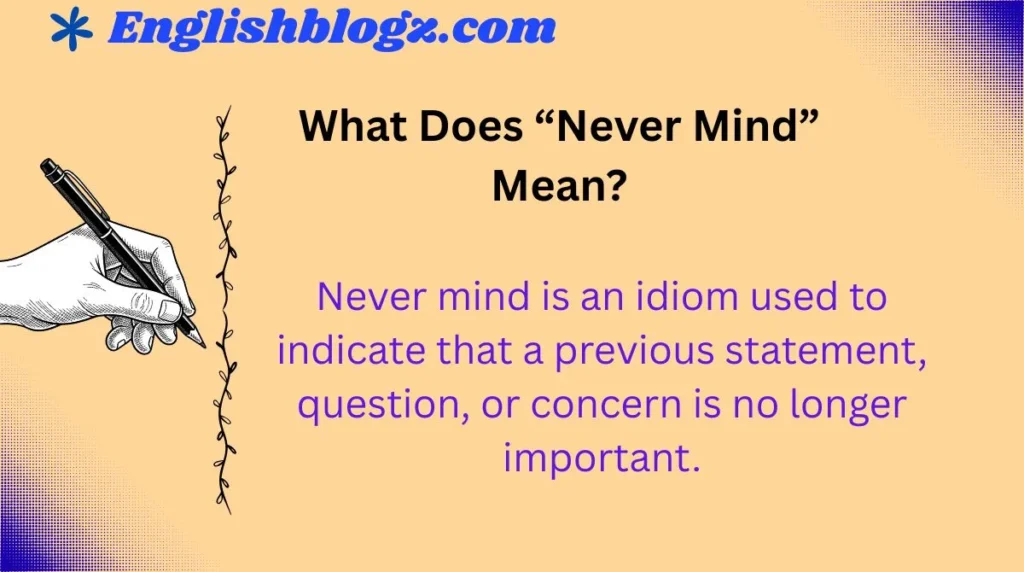
Never mind is an idiom used to indicate that a previous statement, question, or concern is no longer important.
Grammar Form:
- Idiom / Interjection
Synonyms:
- Forget it, no worries, disregard, it’s okay
Opposite Tones:
- Instead of never mind, using pay attention or remember signals urgency or importance.
Sample Sentences:
- “Never mind what I said earlier; it’s not relevant.”
- “Oh, never mind—you’ve already finished it.”
When to Use “Never Mind”
Spoken English:
Commonly used in casual conversation to quickly dismiss a previous point.
Business English:
Used in emails or meetings to politely retract a statement or correct an error.
Emails / Messages:
Helpful when asking someone to ignore a previous request or instruction.
Social Media:
Used casually to dismiss mistakes or minor misunderstandings in comments or chats.
Academic Writing:
Rarely used; more formal alternatives like “please disregard” or “this is no longer relevant” are preferred.
Professional Meetings:
Can soften corrections or signal that a prior discussion point is no longer necessary.
Is “Never Mind” Polite or Professional?
Tone Levels:
- Polite: ✓ Often polite in casual settings
- Neutral: ✓ Neutral in general conversation
- Strong: ✗ Rarely strong
- Soft: ✓ Softens previous statements
Formal vs Informal:
- Informal: “Never mind, I’ll handle it.”
- Formal: “Please disregard my earlier comment.”
Etiquette Tip:
- Better for workplace: Use formal alternatives in emails and professional meetings.
- Avoid: Overusing casual forms like “never mind” in corporate emails.
Pros & Cons of Using “Never Mind”
✔ Pros:
- Quick and easy to use
- Softens mistakes or miscommunications
- Works in casual spoken English
✘ Cons:
- Can sound too informal in professional settings
- Overuse may appear dismissive
- Not always clear in academic writing
Quick Alternatives List (One-Line Phrases Only)
- Forget it
- No worries
- Disregard that
- Don’t worry about it
- It’s fine
- Ignore that
- Let it go
- All good
- Please disregard
- Not important
- That’s okay
- Never mind about that
- No problem
- Skip it
- No need to bother
- Move on
- Not a big deal
- All right
- No matter
- Leave it
- Cancel that
- Drop it
- Forget what I said
- It’s nothing
- No need to worry
- Never mind, really
- Don’t sweat it
- No harm done
- That’s nothing
- Let’s forget it
- All forgotten
- Not worth mentioning
08 Alternatives to “Never Mind”
1. Forget It
Meaning: Ask someone to disregard what you just said.
Explanation: Casual, easygoing way to dismiss a previous statement.
Grammar Note: Idiom
Example Sentence: “Forget it, I’ll handle the booking myself.”
Best Use: Informal, text message, casual conversation
Worst Use: Formal emails or business reports
Tone: Friendly
Level: Beginner
Similarity Score: 9
Replaceability Tip: Use when speaking to friends or family casually.
2. No Worries
Meaning: Everything is fine; don’t stress.
Explanation: Friendly, reassuring way to dismiss concern or apology.
Grammar Note: Informal phrase
Example Sentence: “No worries, I can cover for you tomorrow.”
Best Use: Informal, social media, text
Worst Use: Corporate emails with clients
Tone: Friendly
Level: Beginner
Similarity Score: 8
Replaceability Tip: Use to soften minor inconveniences in conversation.
3. Disregard That
Meaning: Ignore the previous comment or instruction.
Explanation: Formal, professional way to retract something said.
Grammar Note: Formal phrase
Example Sentence: “Please disregard my last email; the attachment was incorrect.”
Best Use: Business emails, professional meetings
Worst Use: Casual chats with friends
Tone: Formal / Professional
Level: Intermediate
Similarity Score: 10
Replaceability Tip: Ideal for correcting mistakes in formal communication.
4. Don’t Worry About It
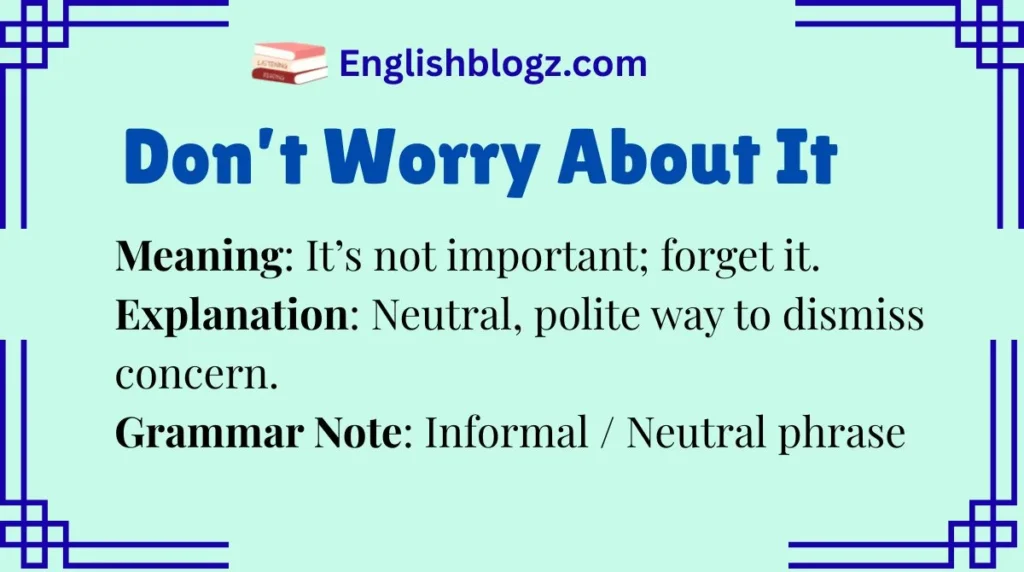
Meaning: It’s not important; forget it.
Explanation: Neutral, polite way to dismiss concern.
Grammar Note: Informal / Neutral phrase
Example Sentence: “Don’t worry about it, we’ll fix it later.”
Best Use: Spoken English, casual emails
Worst Use: Academic writing
Tone: Neutral / Friendly
Level: Beginner
Similarity Score: 9
Replaceability Tip: Safe in most informal situations.
5. It’s Fine
Meaning: Everything is okay; the previous issue is negligible.
Explanation: Neutral, minimal expression to end concern.
Grammar Note: Informal / Neutral
Example Sentence: “It’s fine, we can skip that step for now.”
Best Use: Spoken English, casual emails
Worst Use: Formal documents
Tone: Neutral / Friendly
Level: Beginner
Similarity Score: 8
Replaceability Tip: Use when you want to quickly reassure someone.
6. Ignore That
Meaning: Don’t pay attention to what was said.
Explanation: Direct and slightly firm, works in casual and professional contexts.
Grammar Note: Verb phrase
Example Sentence: “Ignore that comment; it’s irrelevant.”
Best Use: Business emails, casual chat
Worst Use: Too blunt for sensitive conversations
Tone: Neutral
Level: Intermediate
Similarity Score: 9
Replaceability Tip: Use in emails to correct or retract statements.
7. Let It Go
Meaning: Stop worrying or thinking about it.
Explanation: Soft, emotional nuance; often used to ease tension.
Grammar Note: Idiom
Example Sentence: “Let it go, it’s not worth arguing.”
Best Use: Informal conversation, personal advice
Worst Use: Formal reports
Tone: Friendly / Soft
Level: Intermediate
Similarity Score: 7
Replaceability Tip: Great for comforting someone.
8. All Good
Meaning: Everything is okay; no harm done.
Explanation: Informal, reassuring phrase, common in casual speech.
Grammar Note: Slang / Idiom
Example Sentence: “All good, I’ve already completed the task.”
Best Use: Text messages, social media, casual talks
Worst Use: Formal business letters
Tone: Friendly
Level: Beginner
Similarity Score: 7
Replaceability Tip: Use among peers and friends.
Mini Dialogue Examples
Formal Dialogue:
- Manager: “Please submit the report by today.”
- Employee: “Never mind, I’ve already finished it.”
Informal Dialogue:
- Friend 1: “Did you see my text?”
- Friend 2: “Ah, forget it, I found it myself.”
Business Email Example:
- Subject: Update on Previous Instructions
- Body: “Dear Team, please disregard my earlier email regarding the schedule. The updated version is attached. Thank you.”
Mistakes to Avoid
- Using “never mind” in formal emails
- Overusing in professional settings
- Using the wrong tone for social contexts
- Confusing “never mind” with “pay attention”
- Writing it in academic papers
- Making it sound dismissive or rude
- Using “forget it” instead of a professional alternative in business
Cultural & Tone Tips
- UK English: Slightly softer, often polite in casual use
- US English: Commonly used in everyday conversation, neutral tone
- Casual Social English: Signals friendliness, reduces tension
Comparison Table (Top 6 Alternatives)
| Phrase | Tone | Best Context | Professional Level | Example |
|---|---|---|---|---|
| Disregard That | Formal | Email / Meeting | High | “Please disregard my last email.” |
| Forget It | Friendly | Conversation | Low | “Forget it, I’ll manage it myself.” |
| No Worries | Friendly | Social / Text | Low | “No worries, I can cover for you.” |
| Don’t Worry About It | Neutral | Casual / Spoken | Medium | “Don’t worry about it, we’ll fix it later.” |
| Let It Go | Soft | Personal advice | Low | “Let it go, it’s not worth arguing.” |
| Ignore That | Neutral | Email / Chat | Medium | “Ignore that comment; it’s irrelevant.” |
FAQs
Is “never mind” rude?
- Not usually; depends on tone.
Is it okay in emails?
- Use formal alternatives for professional emails.
What is the most formal alternative?
- “Please disregard”
What is the most polite alternative?
- “Don’t worry about it”
What should beginners use?
- “Forget it” or “No worries”
Can it be used in social media?
- Yes, informal versions like “All good” or “Never mind” work well.
Conclusion
Expanding your vocabulary beyond “never mind” improves clarity, professionalism, and tone in English.
By using alternatives like disregard that, no worries, or forget it, learners and professionals can express the same idea naturally and appropriately across casual, academic, and workplace contexts.
Practicing these variations in real conversations boosts fluency and makes your English sound polished, friendly, and flexible.

“Jacob Harper makes English learning simple and fun. He shares tips to help everyone improve confidently.”