You hear “mark your calendars” all the time. In meetings. In emails. On social posts. It means don’t forget this date — it matters.
However, using the same phrase again and again feels flat. In work emails, it can sound casual. In formal writing, it may feel too relaxed. In friendly chats, it may sound stiff.
That’s why smart word choice matters. The right phrase can sound polite, urgent, friendly, or official. It can also make your message clearer and more natural.
Using varied language helps you:
- sound fluent
- avoid repeating the same words
- match the tone of your audience
Quick contrast:
- Formal: “Please note the date for our annual review.”
- Informal: “Save the date!”
Same idea. Different feeling. Let’s learn how to choose the best one for every situation.
What Does “Mark Your Calendars” Mean?
Student-friendly meaning:
It means remember this date and plan for it.
You are telling people that something important will happen on a certain day and they should not forget it.
Grammar form:
This is an idiomatic command phrase. It uses an imperative verb: mark.
Similar meaning phrases:
- save the date
- note the date
- don’t forget this day
Opposite tone ideas:
- it’s optional
- no rush
- if you’re free
Sample sentences:
- “Mark your calendars. The launch is on Friday.”
- “Mark your calendars for our team dinner next week.”
When to Use “Mark Your Calendars”
Spoken English
Great for announcements, meetings, and friendly reminders.
Business English
Okay for internal teams, but not ideal for formal clients.
Emails and messages
Fine for casual workplace emails. Avoid in official notices.
Social media
Very common and natural for events and promotions.
Academic writing
Not suitable. Sounds too conversational.
Professional meetings
Acceptable for team talk. Use softer phrases for senior staff or clients.
Is “Mark Your Calendars” Polite or Professional?
The phrase is friendly and direct. It is not rude, but it is not very formal either.
Tone levels:
- Polite: ✔ yes
- Neutral: ✔ yes
- Strong: ✘ no
- Soft: ✔ moderate
- Formal: ✘ no
- Informal: ✔ yes
Etiquette tip:
Use this phrase with teammates and friends. Avoid it in corporate announcements, legal notices, or official invitations. In those cases, choose more respectful language.
Pros and Cons of Using “Mark Your Calendars”
✔ Pros:
- Easy to understand
- Sounds friendly
- Creates excitement
- Works well in speech and social posts
✘ Cons:
- Too casual for formal writing
- Sounds repetitive if overused
- Not polite enough for senior clients
- Weak in serious business situations
Quick Alternatives List (For Fast Use)
- Save the date
- Please note the date
- Add this to your calendar
- Keep this date in mind
- Don’t forget this date
- Reserve the date
- Kindly take note of the date
- Schedule this date
- Remember this date
- Set a reminder
- Plan for this date
- Please make a note of it
- Block your calendar
- Pencil it in
- Circle the date
⭐ Strong Alternatives with Full Guidance
Save the date
Meaning: Remember this date for a future event.
Explanation: Very popular for weddings, parties, and announcements. It sounds warm and inviting.
Grammar note: Imperative phrase.
Example sentence: “Save the date for our company picnic on May 12.”
Best use: Social media, invitations, friendly emails.
Worst use: Legal or corporate policy emails.
Tone: Friendly, positive.
Level: Beginner.
Similarity score: 9/10.
Replaceability tip: Use when you want excitement, not pressure.
Please note the date
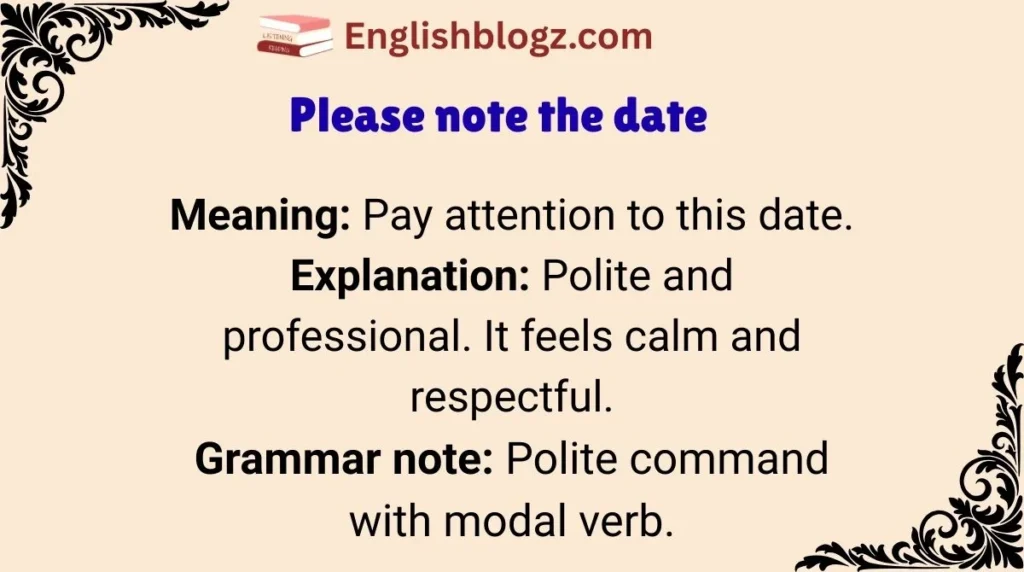
Meaning: Pay attention to this date.
Explanation: Polite and professional. It feels calm and respectful.
Grammar note: Polite command with modal verb.
Example sentence: “Please note the date for the quarterly review meeting.”
Best use: Workplace emails, official notices.
Worst use: Casual chats with friends.
Tone: Formal, polite.
Level: Intermediate.
Similarity score: 8/10.
Replaceability tip: Use when writing to clients or senior staff.
Add this to your calendar
Meaning: Put the event into your schedule.
Explanation: Very clear and practical. It focuses on action.
Grammar note: Imperative phrase.
Example sentence: “Add this to your calendar so you don’t miss the webinar.”
Best use: Work reminders, digital teams.
Worst use: Formal letters.
Tone: Neutral, practical.
Level: Beginner.
Similarity score: 8/10.
Replaceability tip: Use when scheduling matters more than excitement.
Kindly take note of the date
Meaning: Please remember this date.
Explanation: Very polite and formal. Common in professional writing.
Grammar note: Polite formal command.
Example sentence: “Kindly take note of the date for the audit review.”
Best use: Corporate emails, formal notices.
Worst use: Friendly chats.
Tone: Formal, respectful.
Level: Advanced.
Similarity score: 7/10.
Replaceability tip: Choose when respect matters most.
Reserve the date
Meaning: Keep the date free for an event.
Explanation: Suggests commitment without sounding strict.
Grammar note: Imperative verb phrase.
Example sentence: “Please reserve the date for our annual conference.”
Best use: Event planning, invitations.
Worst use: Casual reminders.
Tone: Professional, calm.
Level: Intermediate.
Similarity score: 8/10.
Replaceability tip: Use when attendance is expected.
Keep this date in mind
Meaning: Remember it, but no strong pressure.
Explanation: Soft and friendly. Not demanding.
Grammar note: Verb phrase.
Example sentence: “Keep this date in mind in case you’re available.”
Best use: Informal planning.
Worst use: Official scheduling.
Tone: Soft, friendly.
Level: Beginner.
Similarity score: 6/10.
Replaceability tip: Use when plans are not final.
Don’t forget this date
Meaning: Remember the date.
Explanation: Direct and clear. Slightly strong.
Grammar note: Negative command.
Example sentence: “Don’t forget this date. The deadline is strict.”
Best use: Urgent reminders.
Worst use: Formal business letters.
Tone: Strong, direct.
Level: Beginner.
Similarity score: 7/10.
Replaceability tip: Use when urgency matters.
Block your calendar
Meaning: Make yourself unavailable on that date.
Explanation: Common in corporate settings. Shows commitment.
Grammar note: Imperative verb phrase.
Example sentence: “Block your calendar for the leadership workshop.”
Best use: Workplace scheduling.
Worst use: Social invitations.
Tone: Professional, firm.
Level: Intermediate.
Similarity score: 7/10.
Replaceability tip: Use when attendance is required.
Set a reminder
Meaning: Create an alert so you remember.
Explanation: Casual and modern. Tech-focused.
Grammar note: Imperative phrase.
Example sentence: “Set a reminder so you don’t miss the call.”
Best use: Text messages, team chats.
Worst use: Formal writing.
Tone: Casual, helpful.
Level: Beginner.
Similarity score: 6/10.
Replaceability tip: Use when people often forget.
Please make a note of it
Meaning: Write it down or remember it.
Explanation: Polite and neutral.
Grammar note: Polite verb phrase.
Example sentence: “Please make a note of it for next week’s meeting.”
Best use: Work emails, planning talks.
Worst use: Social posts.
Tone: Polite, neutral.
Level: Intermediate.
Similarity score: 7/10.
Replaceability tip: Use when giving instructions calmly.
Plan for this date
Meaning: Prepare for activities on that day.
Explanation: Suggests future action, not just memory.
Grammar note: Verb phrase.
Example sentence: “Please plan for this date as travel may be required.”
Best use: Work planning, logistics.
Worst use: Casual invites.
Tone: Professional, practical.
Level: Intermediate.
Similarity score: 6/10.
Replaceability tip: Use when preparation matters.
Circle the date
Meaning: Remember it because it’s special.
Explanation: Friendly and expressive. Visual and fun.
Grammar note: Idiomatic phrase.
Example sentence: “Circle the date. It’s going to be a big day.”
Best use: Social posts, celebrations.
Worst use: Business writing.
Tone: Fun, friendly.
Level: Beginner.
Similarity score: 8/10.
Replaceability tip: Use for exciting events.
Pencil it in
Meaning: Tentatively schedule something.
Explanation: Shows plans may change.
Grammar note: Idiom.
Example sentence: “Let’s pencil it in and confirm later.”
Best use: Informal planning.
Worst use: Formal commitments.
Tone: Casual, flexible.
Level: Intermediate.
Similarity score: 5/10.
Replaceability tip: Use when plans are not final.
Schedule this date
Meaning: Officially plan the event.
Explanation: Very practical and direct.
Grammar note: Verb phrase.
Example sentence: “Please schedule this date for system maintenance.”
Best use: Business operations.
Worst use: Friendly invitations.
Tone: Professional, neutral.
Level: Intermediate.
Similarity score: 7/10.
Replaceability tip: Use for formal planning tasks.
Please remember this date
Meaning: Do not forget the date.
Explanation: Polite and simple.
Grammar note: Polite imperative.
Example sentence: “Please remember this date for your interview.”
Best use: Professional reminders.
Worst use: Marketing posts.
Tone: Polite, neutral.
Level: Beginner.
Similarity score: 7/10.
Replaceability tip: Use when clarity matters more than style.
Mini Dialogue Examples
Formal conversation
Manager: “Please note the date for our compliance training.”
Staff: “Sure, I’ll add it to my calendar.”
Informal conversation
Friend: “Circle the date. My birthday party is next Friday.”
You: “Already excited!”
Business email style
Subject: Upcoming Client Review
“Kindly take note of the date for the client review meeting scheduled for March 10.”
Mistakes to Avoid
- Using casual phrases in formal emails
- Saying “mark your calendars” in academic writing
- Mixing formal and slang in the same message
- Forgetting to mention the actual date
- Using strong commands with senior staff
- Repeating the same phrase in every message
- Using idioms in legal or official documents
Cultural and Tone Tips
In US English, “mark your calendars” feels friendly and energetic. It is common in marketing and events.
In UK English, people often prefer softer phrases like “please note the date” or “save the date.”
In casual social English, fun phrases like “circle the date” or “save the date” feel warm and natural.
In professional cultures, polite wording signals respect. Softer language often works better than strong commands.
Comparison Table of Top Alternatives
| Phrase | Tone | Best Context | Professional Level | Example |
|---|---|---|---|---|
| Save the date | Friendly | Invitations | Low | Save the date for our party |
| Please note the date | Formal | Office emails | High | Please note the date for review |
| Add this to your calendar | Neutral | Team reminders | Medium | Add this to your calendar |
| Reserve the date | Professional | Event planning | Medium | Reserve the date for conference |
| Block your calendar | Firm | Workplace scheduling | High | Block your calendar for training |
| Circle the date | Fun | Social posts | Low | Circle the date, it’s big |
FAQs
Is “mark your calendars” rude?
No. It is friendly and clear. It is just not very formal.
Is it okay to use in emails?
Yes, for casual or internal emails. Avoid it in official business writing.
What is the most formal alternative?
“Kindly take note of the date” or “Please note the date.”
What is the most polite option?
“Please make a note of it” sounds gentle and respectful.
What should beginners use?
“Save the date” and “Don’t forget this date” are simple and clear.
Which phrase sounds most professional?
“Please note the date” and “Block your calendar” fit workplace settings well.
Conclusion
Small phrases make a big difference. When you change how you say things, your message feels clearer, kinder, and more professional.
“Mark your calendars” works well, but it is not perfect for every situation. By learning strong alternatives, you gain control over tone and meaning.
You sound more fluent. You sound more confident. Try using different phrases in emails, meetings, and daily talks.
With practice, choosing the right words will feel natural. And your English will keep getting sharper every day.

“Jacob Harper makes English learning simple and fun. He shares tips to help everyone improve confidently.”