The phrase “kindly request” is widely used in English to politely ask someone to do something.
It’s common in business emails, formal letters, and professional communications. However, overusing it can sound repetitive or stiff.
Knowing alternatives helps you sound natural, professional, and context-appropriate.
Choosing the right words affects tone, clarity, and professionalism. For example, saying “I kindly request your feedback” sounds formal, while “Could you please give me your feedback?” is friendlier and more conversational.
Using varied expressions also improves your writing and spoken English, making you sound confident and fluent in emails, meetings, essays, and casual conversations.
By exploring alternatives, learners can match tone to the situation, whether in formal workplace emails or friendly messages to colleagues. This article provides over 13 alternatives and practical tips for using them effectively.
What Does “Kindly Request” Mean?
Kindly request is a polite phrase used to ask someone for something, often in formal or professional contexts.
- Grammar Form: Verb phrase
- Synonyms: “Please ask,” “humbly request,” “would you mind”
- Opposites: Demands like “I order” or “do this”
Examples:
- We kindly request your presence at the meeting tomorrow.
- I kindly request that you review the attached document.
When to Use “Kindly Request”
Spoken English: Rare in casual conversations; may sound overly formal.
Business English: Perfect for formal emails or letters.
Emails / Messages: Works well in polite corporate communication.
Social Media: Avoid; it can sound stiff.
Academic Writing: Useful in formal research correspondence.
Professional Meetings: Only in written invitations or official memos.
Is “Kindly Request” Polite or Professional?
- Polite: ✅ Very polite
- Neutral: ⚪ Sometimes too formal for casual requests
- Strong: ⚪ Not assertive; conveys politeness
- Soft: ✅ Gentle and respectful
- Formal vs Informal: Strongly formal; avoid in casual speech
Etiquette Tip: Use in workplace emails, official letters, and professional requests. Avoid in casual chats or social media.
Pros & Cons of Using “Kindly Request”
✔ Pros:
- Shows respect and politeness
- Professional tone suitable for formal correspondence
- Makes requests sound less demanding
✘ Cons:
- Can sound outdated or overly stiff
- Not ideal for casual conversations
- May reduce clarity if overused
Quick Alternatives (One-Line Phrases)
- Please
- Would you mind
- Could you kindly
- I would appreciate it if
- May I ask you to
- I humbly request
- I seek your assistance
- Requesting your support
- Your attention is requested
- Please be so kind as to
- I would be grateful if
- Kindly consider
- May I request
- Could I trouble you to
- I ask for your cooperation
15 Alternatives to “Kindly Request”
1. Please
Meaning: Simple polite request.
Explanation: Universal, short, and friendly. Suitable for almost any situation.
Grammar Note: Interjection / adverb
Example Sentence: Please send me the report by Monday.
Best Use: Email, text, casual requests
Worst Use: Overly formal letters needing elevated tone
Tone: Polite, friendly
Level: Beginner
Similarity Score: 8/10
Replaceability Tip: Use for straightforward, polite requests in any setting.
2. Would You Mind
Meaning: Soft, indirect request.
Explanation: Polite, less commanding, shows consideration.
Grammar Note: Modal verb phrase
Example Sentence: Would you mind reviewing my presentation?
Best Use: Casual emails, spoken English
Worst Use: Formal corporate memos
Tone: Friendly, polite
Level: Intermediate
Similarity Score: 7/10
Replaceability Tip: Perfect for informal spoken English or softening requests.
3. Could You Kindly
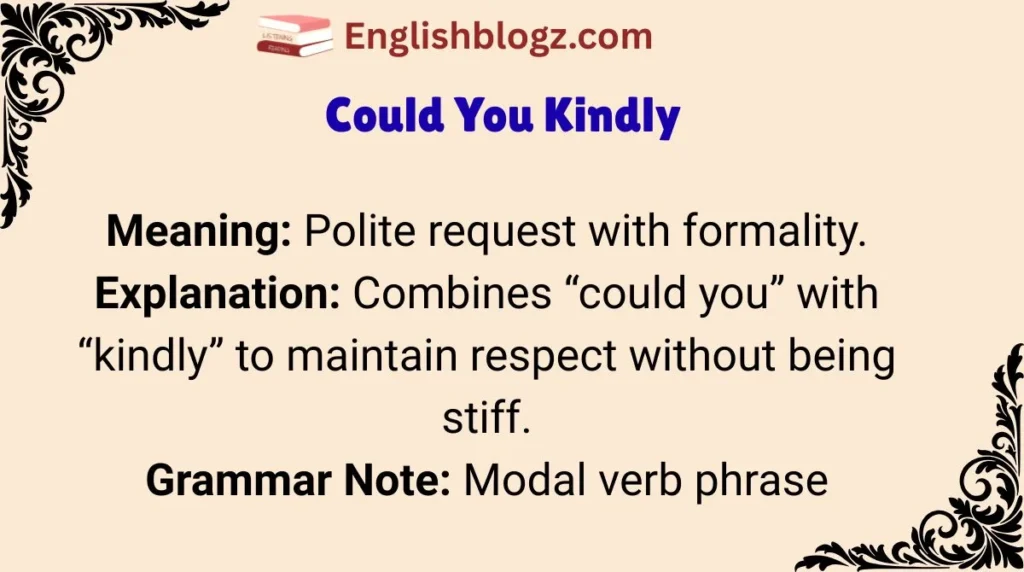
Meaning: Polite request with formality.
Explanation: Combines “could you” with “kindly” to maintain respect without being stiff.
Grammar Note: Modal verb phrase
Example Sentence: Could you kindly send me the invoice?
Best Use: Formal emails, business letters
Worst Use: Casual conversations
Tone: Formal, professional
Level: Intermediate
Similarity Score: 9/10
Replaceability Tip: Ideal for professional requests when “kindly request” sounds repetitive.
4. I Would Appreciate It If
Meaning: Expresses gratitude in advance.
Explanation: Shows respect and appreciation for the recipient’s effort.
Grammar Note: Conditional verb phrase
Example Sentence: I would appreciate it if you could share the draft by tomorrow.
Best Use: Emails, business requests
Worst Use: Informal texting
Tone: Polite, professional
Level: Intermediate
Similarity Score: 9/10
Replaceability Tip: Use to add a courteous touch to requests.
5. May I Ask You To
Meaning: Formal way to make a request.
Explanation: Softens the demand and keeps it professional.
Grammar Note: Modal verb phrase
Example Sentence: May I ask you to approve this document?
Best Use: Professional meetings, emails
Worst Use: Informal conversations
Tone: Formal, polite
Level: Intermediate
Similarity Score: 8/10
Replaceability Tip: Works well when asking superiors or clients.
6. I Humbly Request
Meaning: Very formal, respectful request.
Explanation: Often used in official letters or formal emails.
Grammar Note: Verb phrase
Example Sentence: I humbly request your presence at the ceremony.
Best Use: Official invitations, formal letters
Worst Use: Casual conversations
Tone: Very formal, soft
Level: Advanced
Similarity Score: 10/10
Replaceability Tip: Use when showing high respect or humility.
7. I Seek Your Assistance
Meaning: Professional, slightly formal way to request help.
Explanation: Highlights the need for help rather than making a direct demand.
Grammar Note: Verb phrase
Example Sentence: I seek your assistance in completing this project.
Best Use: Emails, business letters
Worst Use: Informal text messages
Tone: Professional, polite
Level: Advanced
Similarity Score: 9/10
Replaceability Tip: Ideal for workplace scenarios requiring cooperation.
8. Requesting Your Support
Meaning: Formal, collaborative request.
Explanation: Indicates you need help or approval without sounding commanding.
Grammar Note: Verb phrase
Example Sentence: Requesting your support in implementing this plan.
Best Use: Corporate emails, professional meetings
Worst Use: Casual conversations
Tone: Professional, formal
Level: Intermediate
Similarity Score: 9/10
Replaceability Tip: Works well in team-oriented or corporate communication.
9. Your Attention Is Requested
Meaning: Formal, directive, polite.
Explanation: Often used in memos, announcements, or invitations.
Grammar Note: Passive verb phrase
Example Sentence: Your attention is requested at the upcoming board meeting.
Best Use: Official memos, formal notices
Worst Use: Casual or personal messages
Tone: Formal, professional
Level: Advanced
Similarity Score: 10/10
Replaceability Tip: Perfect for high-level workplace communication.
10. Please Be So Kind As To
Meaning: Very polite, formal request.
Explanation: Often used in letters to convey extra politeness.
Grammar Note: Idiomatic phrase
Example Sentence: Please be so kind as to forward this email to your team.
Best Use: Letters, formal emails
Worst Use: Spoken English, texting
Tone: Formal, courteous
Level: Advanced
Similarity Score: 10/10
Replaceability Tip: Use when extra courtesy is required.
11. I Would Be Grateful If
Meaning: Shows appreciation in advance.
Explanation: Polite and professional, softens requests.
Grammar Note: Conditional phrase
Example Sentence: I would be grateful if you could provide the documents by Friday.
Best Use: Business emails, academic correspondence
Worst Use: Casual texting
Tone: Polite, professional
Level: Intermediate
Similarity Score: 9/10
Replaceability Tip: Adds a formal, thankful tone.
12. Kindly Consider
Meaning: Soft, polite suggestion or request.
Explanation: Often used when asking someone to review or approve something.
Grammar Note: Verb phrase
Example Sentence: Kindly consider my application for the position.
Best Use: Emails, applications, proposals
Worst Use: Informal speech
Tone: Formal, polite
Level: Intermediate
Similarity Score: 8/10
Replaceability Tip: Ideal for written requests needing review.
13. May I Request
Meaning: Polite formal inquiry or request.
Explanation: Used in professional and official correspondence.
Grammar Note: Modal verb phrase
Example Sentence: May I request your guidance on this matter?
Best Use: Workplace emails, letters
Worst Use: Casual texting
Tone: Formal, polite
Level: Intermediate
Similarity Score: 9/10
Replaceability Tip: Works well for respectful professional interaction.
14. Could I Trouble You To
Meaning: Polite, slightly humble request.
Explanation: Shows respect and softens the request.
Grammar Note: Modal verb phrase
Example Sentence: Could I trouble you to check the attached report?
Best Use: Formal emails, professional settings
Worst Use: Casual conversation
Tone: Polite, formal
Level: Intermediate
Similarity Score: 8/10
Replaceability Tip: Use when you need cooperation without demanding.
15. I Ask For Your Cooperation
Meaning: Formal, requesting support.
Explanation: Useful in workplace, team projects, or collaborative situations.
Grammar Note: Verb phrase
Example Sentence: I ask for your cooperation in completing the quarterly audit.
Best Use: Workplace, official communication
Worst Use: Casual texting
Tone: Formal, professional
Level: Intermediate
Similarity Score: 9/10
Replaceability Tip: Ideal for team-based or procedural requests.
Mini Dialogue Examples
Formal Dialogue:
- A: I kindly request your attendance at tomorrow’s meeting.
- B: Certainly, I’ll be there.
Informal Dialogue:
- A: Could you kindly send me that file?
- B: Sure, sending it now!
Business Email:
Subject: Request for Report Submission
Dear John,
I would appreciate it if you could submit the quarterly report by Friday. Thank you for your cooperation.
Best regards,
Sarah
Mistakes to Avoid
- Overusing “kindly request” in casual conversations
- Using it in social media posts (sounds stiff)
- Confusing “kindly request” with commands
- Omitting “please” or “kindly” in polite requests
- Overcomplicating sentences with multiple polite phrases
- Using it redundantly in every sentence
- Ignoring tone differences between UK and US English
Cultural & Tone Tips
- UK English: Sounds formal but polite; common in letters
- US English: Often replaced with “please” or “would you mind” in casual speech
- Casual social English: Avoid; use simpler phrases like “please” or “can you”
- Tone shifts: Native speakers notice stiff phrasing; overly formal language may seem distant
Comparison Table of Best Alternatives
| Phrase | Tone | Best Context | Professional Level | Example |
|---|---|---|---|---|
| Please | Friendly | Any | Beginner | Please send the file. |
| Could You Kindly | Polite | Intermediate | Could you kindly review this document? | |
| I Would Appreciate It If | Polite | Intermediate | I would appreciate it if you could approve this. | |
| I Humbly Request | Very Formal | Letters | Advanced | I humbly request your guidance. |
| Kindly Consider | Polite | Applications | Intermediate | Kindly consider my proposal. |
FAQs
Is “kindly request” rude?
No, it is polite and respectful.
Is it okay in emails?
Yes, especially in formal or professional emails.
What is the most formal alternative?
“I humbly request” is very formal and respectful.
What is the most polite alternative?
“I would appreciate it if” sounds polite and gentle.
What should beginners use?
Use “please” or “could you kindly” for simple, polite requests.
Can it be used in casual conversations?
Not usually; it can sound stiff or unnatural.
Conclusion
Using alternatives to “kindly request” improves your tone, clarity, and professionalism. Different phrases help you match context, whether in emails, meetings, or casual speech.
By practicing these expressions, you can communicate politely, confidently, and naturally in English. Mix formal, polite, and friendly alternatives to sound fluent and adaptable in any situation.

“Jacob Harper makes English learning simple and fun. He shares tips to help everyone improve confidently.”