The phrase “It is a must” is widely used in English to express necessity, importance, or requirement.
Whether you are giving advice, setting rules, or recommending an action, this phrase communicates that something is essential.
However, using the same expression repeatedly can make your speech or writing sound repetitive or unpolished.
Choosing the right alternative not only enhances your vocabulary but also improves your tone, professionalism, and clarity.
For example, in a formal report, saying “It is imperative” sounds stronger and more professional than “It is a must”, whereas in casual conversation, you might simply say “You’ve got to do this.”
Using varied expressions ensures your message fits the context, whether in emails, meetings, essays, or social interactions.
What Does “It Is a Must” Mean?
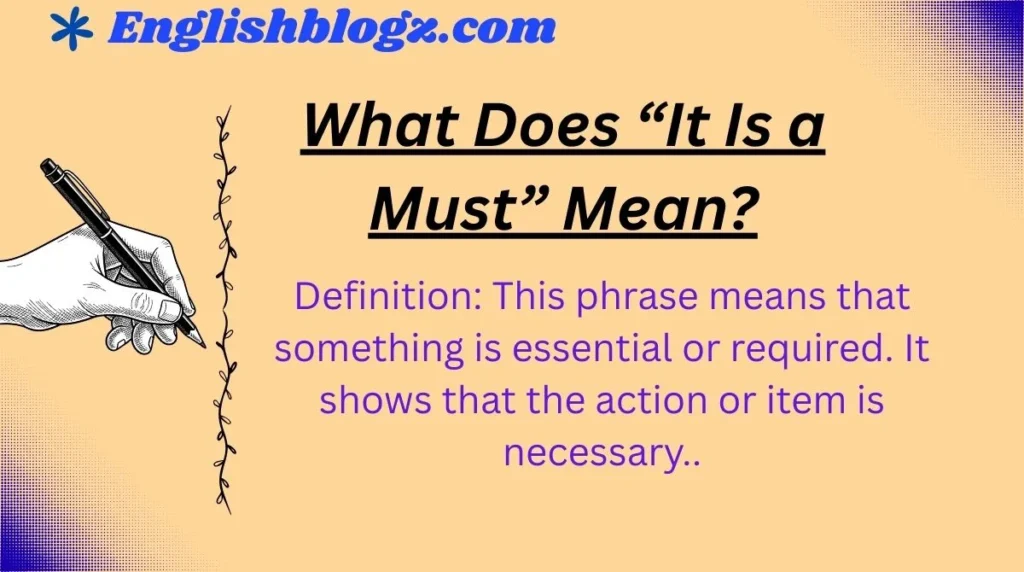
Definition: This phrase means that something is essential or required. It shows that the action or item is necessary.
Grammar Form: Idiomatic phrase used as a statement.
Synonyms: essential, mandatory, required, crucial, indispensable
Opposite Tones: optional, unnecessary, avoidable
Example Sentences:
- Attending the training session is a must for all new employees.
- Good communication skills are a must for this position.
When to Use “It Is a Must”
Spoken English: Use in casual conversations to emphasize necessity.
Business English: Works well in meetings or recommendations but can be replaced with more professional phrases for formal tone.
Emails / Messages: Suitable for short, clear recommendations, but alternatives can enhance professionalism.
Social Media: Works in informal posts or captions but can be replaced with catchy alternatives.
Academic Writing: Often replaced with formal synonyms like “imperative” or “crucial.”
Professional Meetings: Use strong formal alternatives to convey urgency or importance without sounding casual.
Is “It Is a Must” Polite or Professional?
- Polite: Neutral – does not sound rude.
- Neutral: Yes, works in general contexts.
- Strong: Slightly strong, indicates necessity.
- Soft: Can be softened by adding “highly recommended.”
Etiquette Tip:
Better for informal workplace conversations or internal emails. Avoid in corporate reports or formal academic writing. Instead, use alternatives like “essential” or “imperative.”
Pros & Cons of Using “It Is a Must”
✔ Pros:
- Easy to understand
- Direct and clear
- Works in casual and semi-formal situations
✘ Cons:
- Overused and repetitive
- Not suitable for highly formal writing
- Lacks nuance for professional or academic contexts
Quick Alternatives List (One-Line Phrases Only)
- Essential
- Imperative
- Critical
- Mandatory
- Indispensable
- Required
- Obligatory
- Compulsory
- Vital
- Highly recommended
- Key
- Non-negotiable
- Fundamental
- Necessary
- Important
- Recommended
- Unavoidable
Main Body: 17 Alternatives to “It Is a Must”
Essential
Meaning: Absolutely necessary, cannot be ignored.
Explanation: Shows high importance in any context. Works well in both formal and informal settings.
Grammar Note: Adjective
Example Sentence: Regular exercise is essential for good health.
Best Use: Formal, Informal, Email, Workplace
Worst Use: Overly casual texting where slang might be preferred
Tone: Neutral / Professional
Level: Beginner–Intermediate
Similarity Score: 9
Replaceability Tip: Use when emphasizing importance professionally.
Imperative
Meaning: Extremely important and urgent.
Explanation: Conveys strong necessity, often in instructions or commands.
Grammar Note: Adjective / Formal phrase
Example Sentence: It is imperative that all reports are submitted by Friday.
Best Use: Formal, Academic, Business
Worst Use: Casual conversations, may sound harsh
Tone: Formal / Strong
Level: Advanced
Similarity Score: 10
Replaceability Tip: Use in high-stakes professional situations.
Critical
Meaning: Very important for success or function.
Explanation: Often used for decision-making, safety, or performance contexts.
Grammar Note: Adjective
Example Sentence: Timely feedback is critical to the project’s success.
Best Use: Workplace, Academic, Email
Worst Use: Casual chat, sounds overly serious
Tone: Professional / Strong
Level: Intermediate–Advanced
Similarity Score: 9
Replaceability Tip: Use for key priorities or urgent matters.
Mandatory
Meaning: Required by rules or law.
Explanation: Signals an obligation, often used in official contexts.
Grammar Note: Adjective
Example Sentence: Wearing safety helmets on-site is mandatory.
Best Use: Workplace, Formal, Academic
Worst Use: Casual conversation
Tone: Formal / Neutral
Level: Intermediate
Similarity Score: 9
Replaceability Tip: Use for rule-based requirements.
Indispensable
Meaning: Cannot do without it.
Explanation: Highlights that something is necessary and highly valued.
Grammar Note: Adjective
Example Sentence: A good mentor is indispensable for career growth.
Best Use: Professional, Academic, Email
Worst Use: Casual slang-heavy chats
Tone: Formal / Professional
Level: Advanced
Similarity Score: 8
Replaceability Tip: Emphasizes irreplaceable importance.
Required
Meaning: Needed or expected.
Explanation: Neutral necessity; works in instructions and formal writing.
Grammar Note: Adjective
Example Sentence: A valid ID is required to enter the building.
Best Use: Formal, Workplace, Email
Worst Use: Informal speech
Tone: Neutral / Professional
Level: Beginner–Intermediate
Similarity Score: 9
Replaceability Tip: General replacement for “must” in instructions.
Obligatory
Meaning: Officially or socially required.
Explanation: Shows duty or compliance; more formal than “must.”
Grammar Note: Adjective
Example Sentence: Attending the annual meeting is obligatory for all staff.
Best Use: Formal, Academic, Business
Worst Use: Informal conversations
Tone: Formal / Neutral
Level: Intermediate
Similarity Score: 8
Replaceability Tip: Use in official rules or policies.
Compulsory
Meaning: Required by law or rules.
Explanation: Strong obligation, often legal or procedural.
Grammar Note: Adjective
Example Sentence: Wearing seat belts is compulsory in this country.
Best Use: Formal, Legal, Academic
Worst Use: Casual speech
Tone: Formal / Strong
Level: Intermediate–Advanced
Similarity Score: 9
Replaceability Tip: For rules and regulations.
Vital
Meaning: Absolutely necessary for life or success.
Explanation: High urgency and importance, slightly dramatic for emphasis.
Grammar Note: Adjective
Example Sentence: Maintaining customer trust is vital for any business.
Best Use: Business, Academic, Email
Worst Use: Casual text, can sound serious
Tone: Professional / Strong
Level: Intermediate
Similarity Score: 9
Replaceability Tip: Use to stress essential outcomes.
Highly Recommended
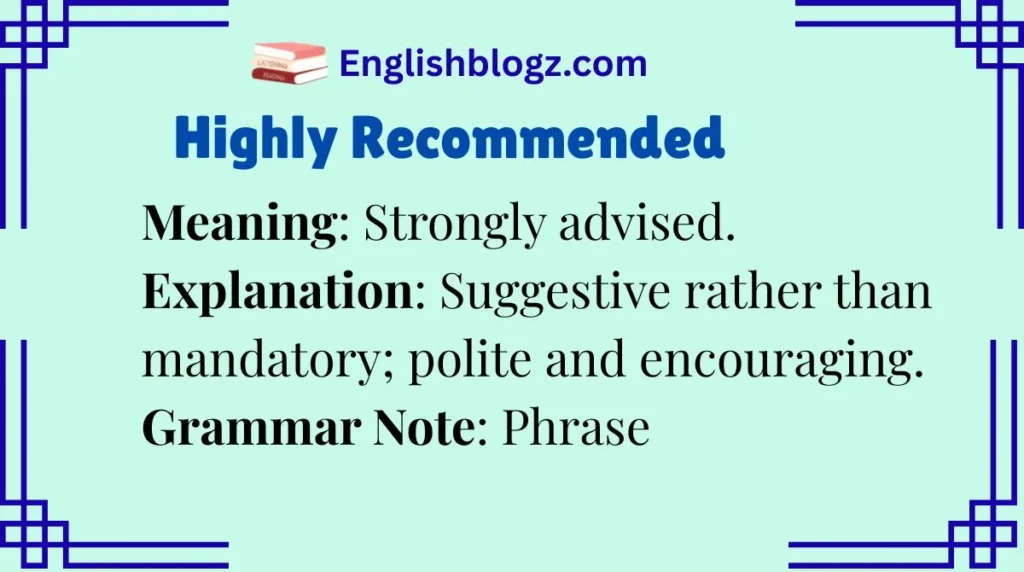
Meaning: Strongly advised.
Explanation: Suggestive rather than mandatory; polite and encouraging.
Grammar Note: Phrase
Example Sentence: This book is highly recommended for exam preparation.
Best Use: Email, Academic, Social Media
Worst Use: Formal legal documents
Tone: Polite / Friendly
Level: Beginner–Intermediate
Similarity Score: 8
Replaceability Tip: For polite suggestions.
Key
Meaning: Very important or central.
Explanation: Often used to highlight crucial elements.
Grammar Note: Adjective / Noun
Example Sentence: Time management is a key skill for students.
Best Use: Academic, Workplace, Email
Worst Use: Casual slang-heavy speech
Tone: Neutral / Professional
Level: Beginner–Intermediate
Similarity Score: 8
Replaceability Tip: Use when focusing on central importance.
Non-Negotiable
Meaning: Cannot be changed or ignored.
Explanation: Very strong requirement, often firm in rules or terms.
Grammar Note: Phrase
Example Sentence: Meeting the deadline is non-negotiable.
Best Use: Business, Workplace, Email
Worst Use: Casual conversation
Tone: Strong / Professional
Level: Intermediate–Advanced
Similarity Score: 9
Replaceability Tip: For firm rules or essential conditions.
Fundamental
Meaning: Basic and essential foundation.
Explanation: Indicates core necessity rather than urgent requirement.
Grammar Note: Adjective
Example Sentence: Honesty is a fundamental value in our company.
Best Use: Academic, Professional, Email
Worst Use: Slang-heavy chat
Tone: Neutral / Professional
Level: Intermediate
Similarity Score: 8
Replaceability Tip: Use for core principles or basics.
Necessary
Meaning: Needed to achieve a goal.
Explanation: Neutral and widely applicable; slightly softer than “must.”
Grammar Note: Adjective
Example Sentence: It is necessary to backup data regularly.
Best Use: General, Workplace, Academic
Worst Use: Overly casual slang
Tone: Neutral / Professional
Level: Beginner–Intermediate
Similarity Score: 9
Replaceability Tip: Use for everyday essentials.
Important
Meaning: Significant or of great value.
Explanation: Polite, neutral, suitable in any context.
Grammar Note: Adjective
Example Sentence: Punctuality is important for building trust.
Best Use: General, Workplace, Academic
Worst Use: Very casual slang, may seem formal
Tone: Neutral / Professional
Level: Beginner
Similarity Score: 8
Replaceability Tip: Use when emphasizing significance politely.
Recommended
Meaning: Suggested as the best choice.
Explanation: Polite alternative, less forceful than “must.”
Grammar Note: Verb / Adjective
Example Sentence: It is recommended to drink water regularly.
Best Use: Email, Academic, Workplace
Worst Use: For legal obligations
Tone: Polite / Neutral
Level: Beginner–Intermediate
Similarity Score: 8
Replaceability Tip: For soft advice or guidance.
Unavoidable
Meaning: Cannot be avoided or ignored.
Explanation: Expresses inevitability and necessity.
Grammar Note: Adjective
Example Sentence: Stress is unavoidable during exams.
Best Use: Academic, Workplace, Email
Worst Use: Casual slang-heavy chat
Tone: Neutral / Strong
Level: Intermediate
Similarity Score: 9
Replaceability Tip: Use when something is inevitable.
Mini Dialogue Examples
Formal Dialogue:
A: “Submitting the report on time is a must.”
B: “Yes, it is imperative for compliance purposes.”
Informal Dialogue:
A: “Going to the party is a must!”
B: “Totally, you can’t miss it!”
Business Email Example:
“Attending the training session is highly recommended for all team members to ensure smooth workflow.”
Mistakes to Avoid
- Using “It is a must” in very formal reports.
- Overusing the phrase, leading to repetition.
- Confusing polite alternatives with mandatory ones.
- Using casual slang in professional emails.
- Ignoring tone differences between US and UK English.
- Using “must” in negative contexts incorrectly.
- Replacing with advanced synonyms without understanding nuance.
Cultural & Tone Tips
- In UK English, “It is a must” sounds casual but clear; prefer formal alternatives in business.
- In US English, the phrase is widely accepted in informal contexts; “imperative” or “essential” is stronger professionally.
- In casual social English, it can be replaced with “you’ve got to” or “can’t miss.”
- Tone shifts: softer alternatives are polite, strong words emphasize urgency or authority.
Comparison Table: 5–7 Best Alternatives
| Phrase | Tone | Best Context | Professional Level | Example |
|---|---|---|---|---|
| Essential | Neutral | General, Workplace | Beginner–Adv | Exercise is essential for health. |
| Imperative | Strong | Business, Academic | Advanced | Meeting deadlines is imperative. |
| Critical | Strong | Project, Workplace | Intermediate | Feedback is critical to success. |
| Mandatory | Formal | Workplace, Legal | Intermediate | Wearing ID is mandatory. |
| Indispensable | Professional | Career, Academic | Advanced | Mentors are indispensable for growth. |
| Highly Recommended | Polite | Email, Social Media | Beginner–Inter | Reading this book is highly recommended. |
| Non-Negotiable | Strong | Business, Rules | Intermediate | Deadline is non-negotiable. |
FAQs
Is “It Is a Must” rude?
No, it is neutral but can sound casual in formal contexts.
Is it okay in emails?
Yes, for informal or semi-formal emails. Replace with “essential” for corporate emails.
What is the most formal alternative?
Imperative or indispensable works best in professional writing.
What is the most polite alternative?
Highly recommended or recommended is polite and encouraging.
What should beginners use?
Necessary, important, or essential are simple and clear choices.
Can it be used in academic writing?
Yes, but replace with formal alternatives like imperative, critical, or vital.
Conclusion
Using “It is a must” and its alternatives helps English learners and professionals express necessity clearly and naturally.
Choosing the right phrase improves tone, professionalism, and clarity across business, academic, and casual contexts.
By practicing these alternatives in writing and conversation, you’ll sound fluent, versatile, and confident in expressing what is essential or required.

“Jacob Harper makes English learning simple and fun. He shares tips to help everyone improve confidently.”