The phrase “I’m sorry you feel that way” shows sympathy, but it can also sound distant. Some people hear care. Others hear dismissal.
That’s why choosing the right words matters. A small change in language can shift the tone from cold to kind, or from neutral to professional.
In daily talk, you want to sound human and warm. In emails, you want to sound calm and respectful. In business, you want to avoid blame while keeping things clear. Using varied language helps you do all three.
Compare this:
- Formal: “I’m sorry you feel that way.”
- Warmer: “I understand why you’d feel upset about this.”
Same idea. Very different feeling.
This guide gives you strong, natural, and context-safe alternatives. You’ll learn what each phrase means, when to use it, and when to avoid it. By the end, you’ll sound more fluent, polite, and confident—without saying the same line again and again.
What Does “I’m Sorry You Feel That Way” Mean?
Student-friendly meaning:
It means you feel bad that someone is upset, but you are not saying you caused the problem.
Grammar form:
A full sentence with an adjective (sorry) and a clause (you feel that way). It works like a polite emotional response, not an apology for an action.
Similar ideas:
- “I understand your feelings.”
- “That sounds hard.”
Opposite tone ideas:
- “That’s not my problem.”
- “You’re overreacting.”
Sample sentences:
- “I’m sorry you feel that way, but we had to follow the rules.”
- “I’m sorry you feel that way. I didn’t mean to upset you.”
When to Use “I’m Sorry You Feel That Way”
Spoken English
Useful when you want to stay calm and avoid arguing.
Business English
Okay for sensitive topics, but it can sound cold if overused.
Emails / Messages
Safe, but not warm. Add understanding words if you can.
Social media
Often sounds defensive. People may think you don’t care.
Academic writing
Not common. Academic tone prefers neutral wording.
Professional meetings
Works when you need to acknowledge feelings without admitting fault.
Is “I’m Sorry You Feel That Way” Polite or Professional?
This phrase sits in the middle of the tone scale.
- Polite: Yes, it uses soft language.
- Neutral: Often sounds emotionally distant.
- Soft: Not very. It doesn’t show deep care.
- Strong: No. It avoids strong emotion.
- Formal vs Informal: Works in both, but leans formal.
Etiquette tip:
In the workplace, it’s safer to say what you understand instead of only saying you’re sorry. That shows respect and keeps trust strong.
Pros and Cons of Using the Phrase
✔ Pros:
- Keeps things calm
- Avoids blame
- Works in professional settings
- Easy to say
✘ Cons:
- Can sound cold
- May feel dismissive
- Doesn’t show understanding
- Can escalate conflict online
Quick Alternatives List (For Fast Use)
If you need quick options, try these:
- I understand why you feel that way.
- That sounds really frustrating.
- I can see how that would upset you.
- I didn’t mean to cause stress.
- Thanks for sharing how you feel.
- I hear you.
- I get why this is hard.
- That wasn’t my intention.
- I appreciate you telling me.
- Let’s talk about what we can do.
- I regret that this affected you.
- I see your point.
- I wish this felt better for you.
- Your feelings make sense.
- I’m sorry this has been difficult.
Strong, Natural Alternatives You Can Use
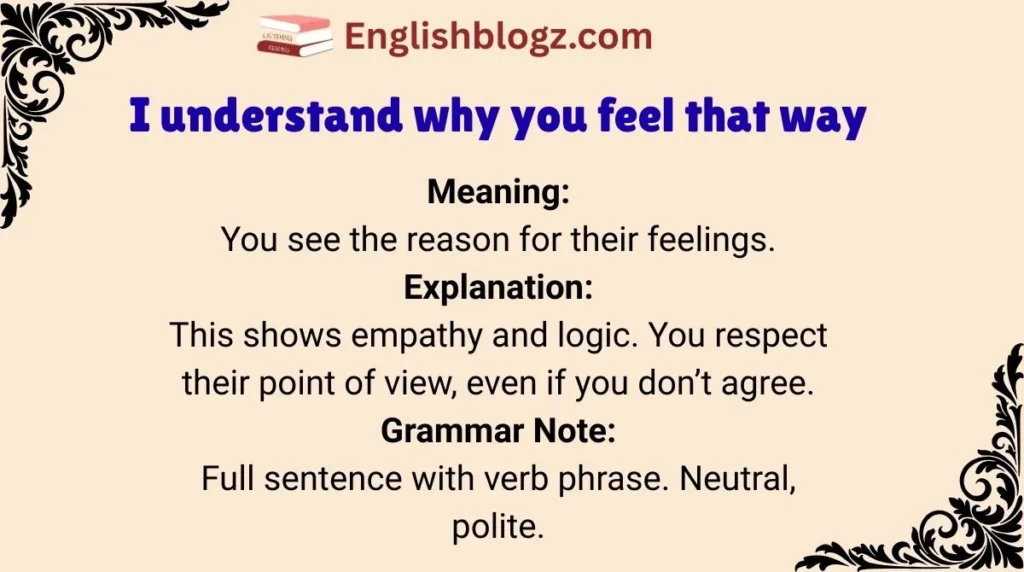
I understand why you feel that way
Meaning:
You see the reason for their feelings.
Explanation:
This shows empathy and logic. You respect their point of view, even if you don’t agree.
Grammar Note:
Full sentence with verb phrase. Neutral, polite.
Example Sentence:
“I understand why you feel that way after what happened.”
Best Use:
Workplace, emails, serious talks
Worst Use:
Jokes or casual chats
Tone:
Professional, soft
Level:
Beginner
Similarity Score:
9/10
Replaceability Tip:
Use this when you want to sound more caring than the original phrase.
That sounds really frustrating
Meaning:
You recognize their struggle.
Explanation:
This focuses on emotion, not blame. It builds connection fast.
Grammar Note:
Descriptive sentence with emotional adjective.
Example Sentence:
“That sounds really frustrating. I’d feel the same.”
Best Use:
Friends, support chats, teamwork
Worst Use:
Formal legal or HR emails
Tone:
Friendly, soft
Level:
Beginner
Similarity Score:
7/10
Replaceability Tip:
Use this when someone needs comfort, not logic.
I can see how that would upset you
Meaning:
You accept their emotional reaction.
Explanation:
Shows empathy while keeping distance from fault.
Grammar Note:
Modal verb phrase, polite structure.
Example Sentence:
“I can see how that would upset you after waiting so long.”
Best Use:
Customer service, office talks
Worst Use:
When emotions are very intense
Tone:
Professional, calm
Level:
Intermediate
Similarity Score:
9/10
Replaceability Tip:
Great for professional empathy without admitting mistakes.
I didn’t mean to cause any stress
Meaning:
You express regret for impact, not intent.
Explanation:
This shifts focus to your action’s effect, not your motive.
Grammar Note:
Negative past tense statement.
Example Sentence:
“I didn’t mean to cause any stress with the deadline.”
Best Use:
Workplace, emails
Worst Use:
When you clearly caused harm
Tone:
Soft, responsible
Level:
Intermediate
Similarity Score:
8/10
Replaceability Tip:
Use when impact matters more than blame.
I appreciate you telling me how you feel
Meaning:
You thank them for sharing emotions.
Explanation:
This builds trust and lowers tension.
Grammar Note:
Polite appreciation phrase.
Example Sentence:
“I appreciate you telling me how you feel about this.”
Best Use:
Feedback talks, conflict resolution
Worst Use:
Arguments where action is needed
Tone:
Respectful, warm
Level:
Intermediate
Similarity Score:
7/10
Replaceability Tip:
Use when someone opens up emotionally.
I hear what you’re saying
Meaning:
You acknowledge their words.
Explanation:
This shows active listening, not agreement.
Grammar Note:
Present tense listening phrase.
Example Sentence:
“I hear what you’re saying, and I want to fix this.”
Best Use:
Meetings, negotiations
Worst Use:
When someone wants emotional comfort
Tone:
Professional, neutral
Level:
Beginner
Similarity Score:
6/10
Replaceability Tip:
Good when you want to shift toward solutions.
I get why this feels unfair
Meaning:
You validate their sense of injustice.
Explanation:
Strong emotional recognition. Very human.
Grammar Note:
Casual spoken structure.
Example Sentence:
“I get why this feels unfair after all your effort.”
Best Use:
Friends, coworkers
Worst Use:
Formal writing
Tone:
Friendly, supportive
Level:
Beginner
Similarity Score:
8/10
Replaceability Tip:
Use in emotional but calm situations.
That wasn’t my intention
Meaning:
You clarify your purpose.
Explanation:
This protects your position while staying polite.
Grammar Note:
Past tense clarification phrase.
Example Sentence:
“That wasn’t my intention. I wanted to help.”
Best Use:
Professional disputes
Worst Use:
When apology is needed
Tone:
Neutral, defensive-soft
Level:
Intermediate
Similarity Score:
6/10
Replaceability Tip:
Use when misunderstandings happen.
I regret that this affected you
Meaning:
You feel bad about the result.
Explanation:
Formal and respectful. Good for business.
Grammar Note:
Formal regret expression.
Example Sentence:
“I regret that this affected you negatively.”
Best Use:
Emails, official messages
Worst Use:
Casual chats
Tone:
Formal, professional
Level:
Advanced
Similarity Score:
9/10
Replaceability Tip:
Choose this for polished, corporate tone.
Your feelings make sense
Meaning:
You validate emotional logic.
Explanation:
Very supportive. Shows acceptance.
Grammar Note:
Simple present validation phrase.
Example Sentence:
“Your feelings make sense after that experience.”
Best Use:
Personal talks, coaching
Worst Use:
Legal or HR situations
Tone:
Soft, caring
Level:
Beginner
Similarity Score:
8/10
Replaceability Tip:
Use when emotions need validation.
I wish this were easier for you
Meaning:
You express compassion without blame.
Explanation:
Gentle and kind. Avoids responsibility claims.
Grammar Note:
Wish clause, soft emotional tone.
Example Sentence:
“I wish this were easier for you right now.”
Best Use:
Supportive talks
Worst Use:
When solutions are expected
Tone:
Warm, gentle
Level:
Intermediate
Similarity Score:
7/10
Replaceability Tip:
Use when you can’t change the situation.
Let’s talk about how to move forward
Meaning:
You shift to solutions.
Explanation:
Future-focused and constructive.
Grammar Note:
Imperative suggestion phrase.
Example Sentence:
“Let’s talk about how to move forward from here.”
Best Use:
Work conflicts, projects
Worst Use:
When emotions are still high
Tone:
Professional, active
Level:
Intermediate
Similarity Score:
5/10
Replaceability Tip:
Use after acknowledging feelings first.
I see your point
Meaning:
You recognize their argument.
Explanation:
Logical validation, not emotional.
Grammar Note:
Short agreement phrase.
Example Sentence:
“I see your point about the timeline.”
Best Use:
Debates, meetings
Worst Use:
Emotional conflicts
Tone:
Neutral, respectful
Level:
Beginner
Similarity Score:
5/10
Replaceability Tip:
Use when discussing ideas, not feelings.
I’m sorry this has been difficult
Meaning:
You apologize for hardship.
Explanation:
Stronger than the original phrase. More caring.
Grammar Note:
Apology with present perfect.
Example Sentence:
“I’m sorry this has been difficult for you.”
Best Use:
Customer support, serious talks
Worst Use:
Very casual chats
Tone:
Soft, sincere
Level:
Intermediate
Similarity Score:
10/10
Replaceability Tip:
Best direct replacement when empathy matters.
Thank you for being honest with me
Meaning:
You respect their openness.
Explanation:
Builds trust and calm.
Grammar Note:
Gratitude phrase.
Example Sentence:
“Thank you for being honest with me about this.”
Best Use:
Feedback sessions
Worst Use:
Arguments
Tone:
Warm, respectful
Level:
Beginner
Similarity Score:
6/10
Replaceability Tip:
Use when honesty matters more than emotion.
Mini Dialogue Examples
Formal Conversation
A: “I’m unhappy with the decision.”
B: “I understand why you feel that way, and I appreciate you sharing your concerns.”
Informal Conversation
A: “This really messed up my plans.”
B: “Yeah, that sounds really frustrating. I get why you’re upset.”
Business Email Style
“Thank you for your message. I regret that this situation affected you, and I’d like to discuss how we can move forward.”
Mistakes to Avoid
- Using the phrase when you should apologize for real harm
- Sounding defensive instead of understanding
- Repeating the same phrase in every conflict
- Using casual phrases in formal emails
- Ignoring emotions and jumping to solutions too fast
- Saying “but” right after empathy, which cancels it
- Using sarcasm or jokes in serious talks
Cultural and Tone Tips
In US English, people expect emotional acknowledgment. Short, caring phrases work well.
In UK English, people often prefer calm, indirect wording. Polite neutrality is common.
In casual social English, emotional validation matters more than perfect grammar. Warmth beats formality.
Across cultures, tone matters more than grammar. A soft voice and kind wording reduce conflict fast.
Comparison Table of Strong Alternatives
| Phrase | Tone | Best Context | Professional Level | Example |
|---|---|---|---|---|
| I understand why you feel that way | Professional | Meetings, emails | High | “I understand why you feel that way after the delay.” |
| That sounds really frustrating | Friendly | Support chats | Medium | “That sounds really frustrating, honestly.” |
| I regret that this affected you | Formal | Business emails | Very High | “I regret that this affected you negatively.” |
| Your feelings make sense | Soft | Personal talks | Medium | “Your feelings make sense after that.” |
| I’m sorry this has been difficult | Caring | Customer support | High | “I’m sorry this has been difficult for you.” |
| Let’s talk about how to move forward | Active | Team conflict | High | “Let’s talk about how to move forward.” |
FAQs
Is “I’m sorry you feel that way” rude?
Not rude, but it can sound cold or distant if used alone.
Is it okay to use in emails?
Yes, but adding understanding words sounds better.
What is the most formal alternative?
“I regret that this affected you” works well in professional writing.
What is the most polite alternative?
“I understand why you feel that way” shows respect and care.
What should beginners use?
“That sounds frustrating” or “I get why you feel that way” are easy and natural.
Should I always say sorry in conflicts?
No. Sometimes understanding matters more than apology.
Conclusion
Words shape how people feel. When you change your phrasing, you change the outcome. Saying “I’m sorry you feel that way” can work, but it often sounds distant. Warm, clear alternatives show respect, care, and confidence.
By learning different ways to express empathy, you improve your English and your relationships. You sound more natural. You avoid conflict. You communicate like a skilled speaker.
Practice these phrases in daily talks, emails, and meetings. Try one new option each day. Small changes in language bring big changes in connection.

“Jacob Harper makes English learning simple and fun. He shares tips to help everyone improve confidently.”