The phrase “I’m down” is widely used in English, but its meaning changes depending on context. Generally, it expresses agreement, willingness, or enthusiasm.
For example, if a friend says, “Do you want to go to the movies?” replying with “I’m down” means, “Yes, I want to join.”
Using alternative expressions is essential for English learners and professionals because the tone of your words shapes how others perceive you.
The right word can make you sound friendly, professional, or enthusiastic. On the other hand, using informal language in formal settings may seem careless or unpolished.
For instance, in a casual text: “I’m down for lunch” works perfectly. But in a corporate email, saying “I am available to join the meeting” sounds professional and clear.
Expanding your vocabulary with context-appropriate alternatives improves clarity, fluency, and confidence in conversations, emails, and academic writing.
What Does “I’m Down” Mean?
Student-Friendly Definition:
“I’m down” means you agree with a suggestion, are willing to do something, or are excited about a plan.
Grammar Form:
- Phrase type: Idiom / Informal expression
- Functions as: Interjection or verb phrase
Synonyms:
- Excited, interested, ready, game, willing
Opposite Tones:
- Not interested, unavailable, can’t make it
Sample Sentences:
- Casual: “Want to go hiking this weekend?” — “I’m down!”
- Professional: “Are you available for a team meeting?” — “I’m down” can be replaced with “I am available.”
When to Use “I’m Down”
Spoken English:
Perfect in casual conversations with friends or peers. Example: “I’m down for a coffee after work.”
Business English:
Better replaced with formal alternatives like “I’m available” or “I can join” to maintain professionalism.
Emails / Messages:
Avoid the slang in corporate emails. Use “I’d be happy to participate” instead.
Social Media:
Great for informal posts, comments, or group chats. Example: “I’m down for the concert this weekend!”
Academic Writing:
Not suitable. Use formal expressions like “I am willing to contribute”.
Professional Meetings:
Replace with “I can attend” or “I’m available at that time” to convey clarity and professionalism.
Is “I’m Down” Polite or Professional?
Tone Levels:
- Polite: ✘ Not inherently polite in professional settings
- Neutral: ✔ Acceptable in casual conversation
- Strong: ✔ Shows enthusiasm in informal contexts
- Soft: ✔ Can be friendly among peers
Formal vs Informal:
- Informal: Perfect among friends or on social media.
- Formal: Avoid in emails or corporate settings; choose “I am available” or “I would be happy to join.”
Etiquette Tip:
Better for casual environments. Avoid using it in corporate emails or academic writing.
Pros & Cons of Using “I’m Down”
✔ Pros:
- Expresses enthusiasm and willingness
- Casual and relatable
- Short, easy to say
✘ Cons:
- Too informal for professional or academic settings
- Can be misunderstood by non-native speakers
- Lacks clarity in business communication
Quick Alternatives List
- I’m available
- Count me in
- I’m interested
- I’d love to
- I can join
- Sounds good
- I’m game
- I’m ready
- I’m on board
- I’m happy to
- I’d be glad to participate
- Let’s do it
- I’m willing
- Sure thing
- Absolutely
15 Alternatives to “I’m Down”
1. I’m Available
Meaning: You can participate or attend.
Explanation: Neutral and professional. Ideal for meetings or scheduling.
Grammar Note: Verb phrase
Example Sentence: “I’m available for the meeting at 3 PM.”
Best Use: Workplace, Email
Worst Use: Casual texting with friends
Tone: Formal
Level: Beginner
Similarity Score: 9/10
Replaceability Tip: Use when clarity is essential in professional settings.
2. Count Me In
Meaning: I want to join or participate.
Explanation: Friendly and slightly informal. Shows enthusiasm.
Grammar Note: Idiom
Example Sentence: “Count me in for the team lunch!”
Best Use: Casual, social activities
Worst Use: Formal emails
Tone: Friendly
Level: Beginner
Similarity Score: 8/10
Replaceability Tip: Use with peers or friends.
3. I’m Interested
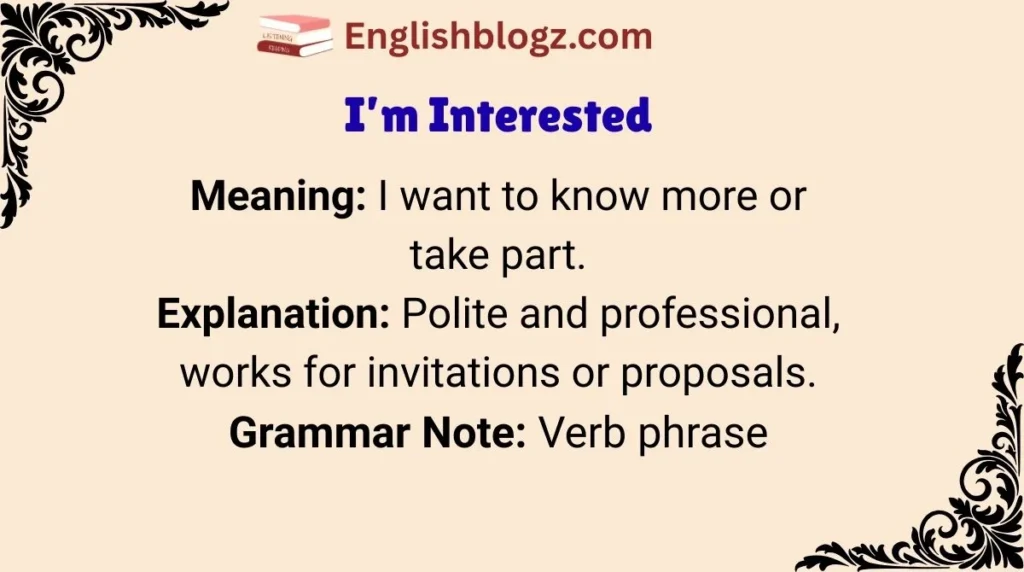
Meaning: I want to know more or take part.
Explanation: Polite and professional, works for invitations or proposals.
Grammar Note: Verb phrase
Example Sentence: “I’m interested in joining the new project.”
Best Use: Professional, academic, emails
Worst Use: Casual slang context
Tone: Neutral/Formal
Level: Beginner
Similarity Score: 8/10
Replaceability Tip: Best for professional invitations.
4. I’d Love To
Meaning: Shows eagerness to participate.
Explanation: Polite and friendly. Adds warmth.
Grammar Note: Modal + verb
Example Sentence: “I’d love to attend the seminar.”
Best Use: Informal & professional invitations
Worst Use: Formal business contracts
Tone: Friendly
Level: Beginner/Intermediate
Similarity Score: 9/10
Replaceability Tip: Use to convey excitement without slang.
5. I Can Join
Meaning: Able to participate.
Explanation: Neutral, practical for scheduling.
Grammar Note: Verb phrase
Example Sentence: “I can join the Zoom call at 2 PM.”
Best Use: Emails, workplace
Worst Use: Social media slang
Tone: Neutral/Formal
Level: Beginner
Similarity Score: 9/10
Replaceability Tip: Choose when confirming attendance.
6. Sounds Good
Meaning: I agree; this works for me.
Explanation: Informal; widely used in conversation or messaging.
Grammar Note: Idiom
Example Sentence: “Meeting at 5? Sounds good.”
Best Use: Texts, casual conversation
Worst Use: Formal emails
Tone: Friendly
Level: Beginner
Similarity Score: 8/10
Replaceability Tip: Use casually to confirm plans.
7. I’m Game
Meaning: Ready and willing.
Explanation: Informal, playful; expresses excitement.
Grammar Note: Idiom
Example Sentence: “I’m game for a weekend trip.”
Best Use: Social, informal contexts
Worst Use: Corporate emails
Tone: Friendly
Level: Intermediate
Similarity Score: 8/10
Replaceability Tip: Good for enthusiastic peer conversations.
8. I’m Ready
Meaning: Prepared and willing.
Explanation: Can be both casual and professional depending on context.
Grammar Note: Adjective phrase
Example Sentence: “I’m ready to start the project.”
Best Use: Workplace, casual
Worst Use: Academic essays
Tone: Neutral
Level: Beginner
Similarity Score: 8/10
Replaceability Tip: Use for readiness or availability.
9. I’m On Board
Meaning: Agree and ready to participate.
Explanation: Professional and motivational; common in business.
Grammar Note: Idiom
Example Sentence: “I’m on board with the new strategy.”
Best Use: Workplace, meetings
Worst Use: Slang-only casual conversations
Tone: Professional
Level: Intermediate
Similarity Score: 9/10
Replaceability Tip: Shows commitment in professional contexts.
10. I’m Happy To
Meaning: Willing and pleased to do something.
Explanation: Polite and soft; excellent for professional tone.
Grammar Note: Verb phrase
Example Sentence: “I’m happy to help with the presentation.”
Best Use: Emails, workplace
Worst Use: Slang texting
Tone: Polite/Formal
Level: Beginner
Similarity Score: 9/10
Replaceability Tip: Good for polite professional responses.
11. I’d Be Glad To Participate
Meaning: Shows willingness with respect.
Explanation: Formal, professional, conveys respect.
Grammar Note: Modal + verb phrase
Example Sentence: “I’d be glad to participate in the workshop.”
Best Use: Academic, professional emails
Worst Use: Casual texting
Tone: Formal
Level: Intermediate
Similarity Score: 9/10
Replaceability Tip: Use for respectful confirmations.
12. Let’s Do It
Meaning: Enthusiastic agreement.
Explanation: Casual and motivating; shows eagerness.
Grammar Note: Imperative phrase
Example Sentence: “You want to try the new game? Let’s do it!”
Best Use: Social, informal
Worst Use: Corporate email
Tone: Friendly
Level: Beginner
Similarity Score: 7/10
Replaceability Tip: Perfect for peer encouragement.
13. I’m Willing
Meaning: Open to participate or try.
Explanation: Neutral, slightly formal; shows readiness.
Grammar Note: Verb phrase
Example Sentence: “I’m willing to assist with the project.”
Best Use: Workplace, professional
Worst Use: Informal texting
Tone: Neutral/Formal
Level: Intermediate
Similarity Score: 8/10
Replaceability Tip: Use when offering help formally.
14. Sure Thing
Meaning: Casual agreement; enthusiastic.
Explanation: Informal, friendly; widely used in US English.
Grammar Note: Idiom
Example Sentence: “You want to join the game? Sure thing!”
Best Use: Casual conversation
Worst Use: Academic writing
Tone: Friendly
Level: Beginner
Similarity Score: 8/10
Replaceability Tip: Use for easygoing confirmations.
15. Absolutely
Meaning: Strong agreement; enthusiastic yes.
Explanation: Polite yet confident; works across contexts.
Grammar Note: Adverb
Example Sentence: “Are you joining the team meeting?” — “Absolutely.”
Best Use: Professional, casual
Worst Use: Overuse in informal chats may seem robotic
Tone: Confident/Formal
Level: Beginner
Similarity Score: 9/10
Replaceability Tip: Good for emphasizing strong agreement.
Mini Dialogue Examples
Formal Dialogue:
- Manager: “Can you join the strategy meeting at 4 PM?”
- Employee: “Yes, I’m available and happy to contribute.”
Informal Dialogue:
- Friend 1: “Want to grab dinner tonight?”
- Friend 2: “I’m down! Let’s go to that new place.”
Business Email Example:
Subject: Meeting Participation
Hi Sarah,
I’d be glad to participate in the upcoming workshop. Please let me know the agenda and timings.
Best regards,
Alex
Mistakes to Avoid
- Using “I’m down” in formal emails or academic writing.
- Overusing slang in professional meetings.
- Confusing “I’m down” with being sad.
- Ignoring tone differences in UK vs US English.
- Using casual alternatives with senior managers.
- Not matching phrase formality to audience.
- Mispronouncing or miswriting idioms like “I’m game”.
Cultural & Tone Tips
- In the US, “I’m down” is casual and positive; widely understood among young adults.
- In the UK, it may sound less common; “I’m game” or “count me in” are more typical.
- Casual social English allows more playful forms, while professional English prefers clarity and neutral tone.
- Always match your expression to the setting: enthusiasm is great socially, but professionalism matters in corporate contexts.
Comparison Table of Best Alternatives
| Phrase | Tone | Best Context | Professional Level | Example |
|---|---|---|---|---|
| I’m available | Neutral | Meetings, Emails | High | “I’m available for the 10 AM call.” |
| Count me in | Friendly | Social events | Low | “Count me in for the party.” |
| I’d love to | Friendly | Invitations | Medium | “I’d love to attend the seminar.” |
| I’m on board | Professional | Workplace, Strategy | High | “I’m on board with the new plan.” |
| I’d be glad to participate | Formal | Academic, Emails | High | “I’d be glad to participate in the session.” |
FAQs
Is “I’m down” rude?
No, it’s informal, not rude, but inappropriate for formal contexts.
Is it okay in emails?
Only in casual or internal emails; better alternatives exist for corporate settings.
What is the most formal alternative?
“I’d be glad to participate” or “I am available.”
What is the most polite alternative?
“I’m happy to” conveys politeness and willingness.
What should beginners use?
“I’m available,” “Count me in,” or “I’d love to” are simple and safe.
Can it be used in academic writing?
No, academic writing requires formal alternatives like “I am willing to contribute.”
Conclusion
Using alternatives to “I’m down” improves clarity, professionalism, and conversational fluency.
Choosing the right phrase for each context—casual chat, email, or workplace meeting—ensures your message is understood and positively received.
Practicing these alternatives in daily conversations or writing helps learners sound confident, polite, and versatile in English.
Expanding your vocabulary beyond slang opens doors to better communication in both social and professional settings.

“Jacob Harper makes English learning simple and fun. He shares tips to help everyone improve confidently.”