Saying “I’m busy” is simple, but it can come across as blunt, impolite, or even boring if overused.
Knowing alternative ways to express the same idea helps you sound natural, professional, and polite.
The phrase essentially communicates that your time is occupied or that you cannot attend to something immediately.
Choosing the right words affects tone, clarity, and professionalism. For example, in a casual chat, saying “I’m slammed” sounds friendly and relatable.
In contrast, in an email to a manager, “I’m currently engaged with other tasks” conveys the same meaning politely and professionally.
Using varied language makes your English sound fluent, confident, and appropriate in different contexts—business meetings, emails, essays, or social conversations.
With the right alternatives, you can politely decline, set boundaries, or simply communicate your availability without sounding rude or stressed.
What Does “I’m Busy” Mean?
Definition:
“I’m busy” means that your time is occupied with work, tasks, or other responsibilities, leaving little room for additional activities.
Grammar Form:
- Phrase type: Subject + verb + adjective (copular sentence)
- Part of speech: Verb phrase with an adjective
Synonyms:
- Engaged
- Occupied
- Tied up
- Swamped
Opposites:
- Free
- Available
- Unoccupied
Example Sentences:
- “I can’t join the call right now; I’m busy preparing for the presentation.”
- “She’s busy today, but we can schedule a meeting for tomorrow.”
When to Use “I’m Busy”
Spoken English: Use casual alternatives with friends or colleagues.
Business English: Stick to polite and professional alternatives in meetings or emails.
Emails / Messages: Formal phrasing works best to maintain professionalism.
Social Media: Informal expressions are acceptable in captions or comments.
Academic Writing: Avoid casual phrases; instead, use “occupied with tasks” or “engaged in research.”
Professional Meetings: Use neutral, professional alternatives to communicate workload without sounding abrupt.
Is “I’m Busy” Polite or Professional?
Tone Levels:
- Polite: ✔ Neutral and honest
- Neutral: ✔ Standard usage
- Strong: ✘ Can sound dismissive
- Soft: ✔ Softer phrasing improves politeness
Formal vs Informal:
- Informal: “I’m busy,” “Swamped,” “Tied up”
- Formal: “Currently engaged in other tasks,” “Occupied with prior commitments”
Etiquette Tip:
- Better for workplace: “Currently tied up,” “Engaged with other tasks”
- Avoid in corporate emails: “Can’t, I’m busy,” “Too slammed”
Pros & Cons of Using “I’m Busy”
✔ Pros:
- Quick and direct
- Easy to understand
- Expresses unavailability clearly
✘ Cons:
- Can sound rude if overused
- Lacks variety in professional communication
- Doesn’t convey politeness in formal emails
Quick Alternatives List (One-Line Phrases Only)
- I’m tied up
- Swamped at the moment
- Engaged with tasks
- Occupied right now
- My schedule is full
- Handling something urgent
- In the middle of work
- Otherwise occupied
- Focused on a project
- Overloaded with tasks
- Slammed today
- Preoccupied currently
- Fully booked
- Juggling multiple things
- Working on a deadline
- Caught up with work
- Busy with errands
- Wrapped up in a task
- Immersed in work
- On a tight schedule
- Up to my ears
- Scheduled back-to-back
- Running against the clock
- Tied to a project
- Engrossed in work
- In the zone
- Dealing with priorities
- Otherwise engaged
- Not available at the moment
- Attending to responsibilities
10 Alternatives with Details
I’m Tied Up
Meaning: Your time is occupied.
Explanation: Neutral, polite, commonly used in professional and casual contexts.
Grammar Note: Idiom
Example Sentence: “I’m tied up with a report, can we talk later?”
Best Use: Formal, Email, Workplace
Worst Use: Social media (sounds stiff)
Tone: Neutral / Professional
Level: Beginner
Similarity Score: 9
Replaceability Tip: Use when politely declining someone’s request.
Swamped at the Moment
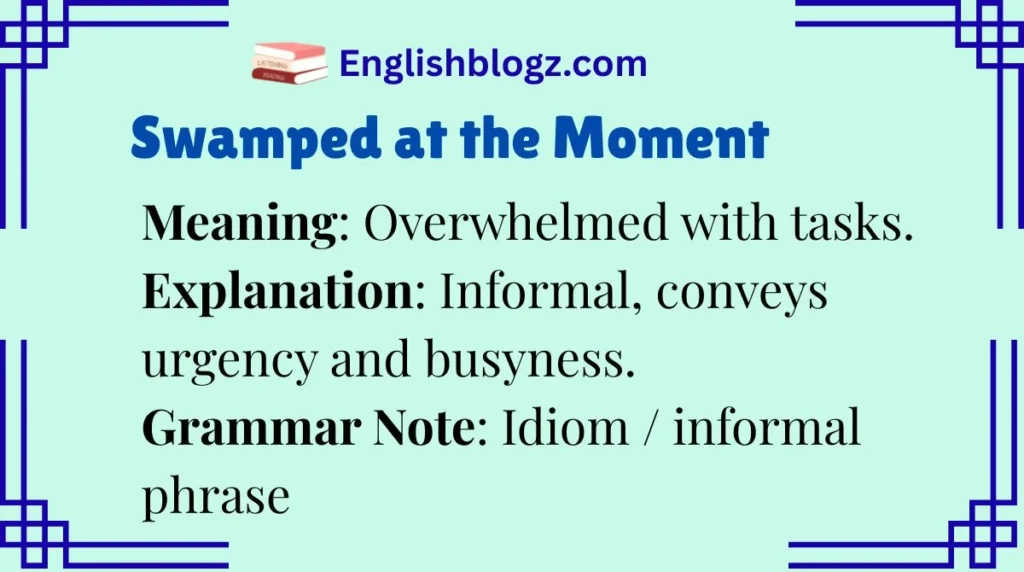
Meaning: Overwhelmed with tasks.
Explanation: Informal, conveys urgency and busyness.
Grammar Note: Idiom / informal phrase
Example Sentence: “I’m swamped at the moment, can we reschedule?”
Best Use: Informal, Text, Workplace
Worst Use: Formal academic writing
Tone: Friendly / Strong
Level: Intermediate
Similarity Score: 8
Replaceability Tip: Use for casual workplace or friend interactions.
Engaged with Tasks
Meaning: Occupied with work duties.
Explanation: Formal, professional, polite alternative.
Grammar Note: Verb phrase
Example Sentence: “I’m currently engaged with tasks and will get back to you shortly.”
Best Use: Email, Professional meeting
Worst Use: Casual chat
Tone: Formal / Neutral
Level: Intermediate
Similarity Score: 10
Replaceability Tip: Perfect for polite email replies.
Occupied Right Now
Meaning: Cannot take other tasks at the moment.
Explanation: Neutral, flexible in professional and informal contexts.
Grammar Note: Verb phrase
Example Sentence: “Sorry, I’m occupied right now; can we discuss this later?”
Best Use: Text, Workplace, Email
Worst Use: Academic writing (too casual)
Tone: Neutral / Polite
Level: Beginner
Similarity Score: 9
Replaceability Tip: Use for polite real-time responses.
My Schedule is Full
Meaning: All tasks or appointments are booked.
Explanation: Polite and formal, signals unavailability clearly.
Grammar Note: Noun phrase
Example Sentence: “I’m afraid my schedule is full today; can we meet tomorrow?”
Best Use: Formal, Email, Professional
Worst Use: Informal texting
Tone: Formal / Professional
Level: Intermediate
Similarity Score: 9
Replaceability Tip: Best for workplace communication.
Handling Something Urgent
Meaning: Busy due to an important task.
Explanation: Shows priority and professionalism.
Grammar Note: Verb phrase
Example Sentence: “I’m handling something urgent; I’ll call you back soon.”
Best Use: Workplace, Email
Worst Use: Social media slang
Tone: Professional / Neutral
Level: Intermediate
Similarity Score: 8
Replaceability Tip: Indicates urgency politely.
In the Middle of Work
Meaning: Currently occupied with tasks.
Explanation: Casual yet clear expression of busyness.
Grammar Note: Prepositional phrase
Example Sentence: “I’m in the middle of work; can we catch up later?”
Best Use: Informal chat, Workplace
Worst Use: Academic writing
Tone: Neutral / Friendly
Level: Beginner
Similarity Score: 9
Replaceability Tip: Use for mid-task interruptions.
Otherwise Occupied
Meaning: Busy with something else.
Explanation: Polite, slightly formal.
Grammar Note: Idiom / adjective phrase
Example Sentence: “I’d love to join, but I’m otherwise occupied this afternoon.”
Best Use: Formal, Email, Professional
Worst Use: Casual text (too formal)
Tone: Formal / Polite
Level: Advanced
Similarity Score: 8
Replaceability Tip: Good for polite refusals.
Focused on a Project
Meaning: Concentrating on a specific task.
Explanation: Professional, emphasizes dedication.
Grammar Note: Verb phrase
Example Sentence: “I can’t join the meeting; I’m focused on a project deadline.”
Best Use: Workplace, Email
Worst Use: Casual social conversation
Tone: Formal / Neutral
Level: Intermediate
Similarity Score: 9
Replaceability Tip: Shows work focus respectfully.
Overloaded with Tasks
Meaning: Too many tasks to handle.
Explanation: Informal-professional, highlights workload stress.
Grammar Note: Adjective phrase
Example Sentence: “I’m overloaded with tasks today; can we postpone the call?”
Best Use: Workplace, Informal email
Worst Use: Formal academic writing
Tone: Neutral / Friendly
Level: Intermediate
Similarity Score: 8
Replaceability Tip: Good for informal workplace updates.
Mini Dialogue Examples
Formal Dialogue:
- A: “Can you join the strategy meeting?”
- B: “I’m currently engaged with other tasks, but I can join the next session.”
Informal Dialogue:
- A: “Hey, want to grab coffee?”
- B: “I’m swamped right now, maybe later?”
Business Email Example:
Subject: Meeting Request
Hi John,
I’m tied up with current projects and unable to attend the meeting today. Can we reschedule for next week?
Best regards,
Sarah
Mistakes to Avoid
- Saying “I’m busy” repeatedly without alternatives.
- Using overly casual phrases in formal emails.
- Ignoring tone differences (swamped vs engaged).
- Overloading informal slang in professional settings.
- Failing to suggest a follow-up when declining.
- Using vague phrases that confuse the listener.
- Mixing formal and informal phrases in the same context.
Cultural & Tone Tips
- Native speakers often appreciate softening phrases like “occupied” instead of blunt “busy.”
- UK English: Polite understatement is common; “I’m tied up” works well.
- US English: Directness is acceptable; “I’m swamped” is friendly.
- Casual social English: Informal idioms like “slammed” or “up to my ears” are common.
Comparison Table – 7 Best Alternatives
| Phrase | Tone | Best Context | Professional Level | Example |
|---|---|---|---|---|
| I’m tied up | Neutral | Workplace/Email | Medium | “I’m tied up; can we talk later?” |
| Engaged with tasks | Formal | Meeting/Email | High | “I’m engaged with tasks; will respond soon.” |
| My schedule is full | Formal | Email/Professional | High | “My schedule is full; let’s reschedule.” |
| Swamped at the moment | Informal | Workplace/Chat | Medium | “I’m swamped, can we meet tomorrow?” |
| Focused on a project | Neutral | Workplace | Medium | “Focused on a project; call later?” |
| Otherwise occupied | Formal | Email/Professional | High | “Otherwise occupied; can’t attend today.” |
| Handling something urgent | Professional | Workplace/Email | High | “Handling something urgent; will get back.” |
FAQs
Is “I’m busy” rude?
Not necessarily, but overuse can seem abrupt or dismissive.
Is it okay in emails?
Yes, but formal alternatives like “engaged with tasks” are preferred.
What is the most formal alternative?
“Engaged with other tasks” or “otherwise occupied.”
What is the most polite alternative?
“I’m tied up at the moment” softens the tone.
What should beginners use?
Begin with “I’m busy” or “tied up” for clarity.
Can social media use casual alternatives?
Yes, idioms like “swamped” or “slammed” are friendly and relatable.
Conclusion
Using alternatives to “I’m busy” elevates your English, making you sound polite, professional, and versatile.
Selecting the right phrase for context improves clarity in emails, meetings, essays, and conversations.
Practice these variations to sound fluent and confident, adapting your tone from formal workplace discussions to casual chats with friends.
Word variety is key to effective communication, so explore these alternatives regularly.

“Jacob Harper makes English learning simple and fun. He shares tips to help everyone improve confidently.”