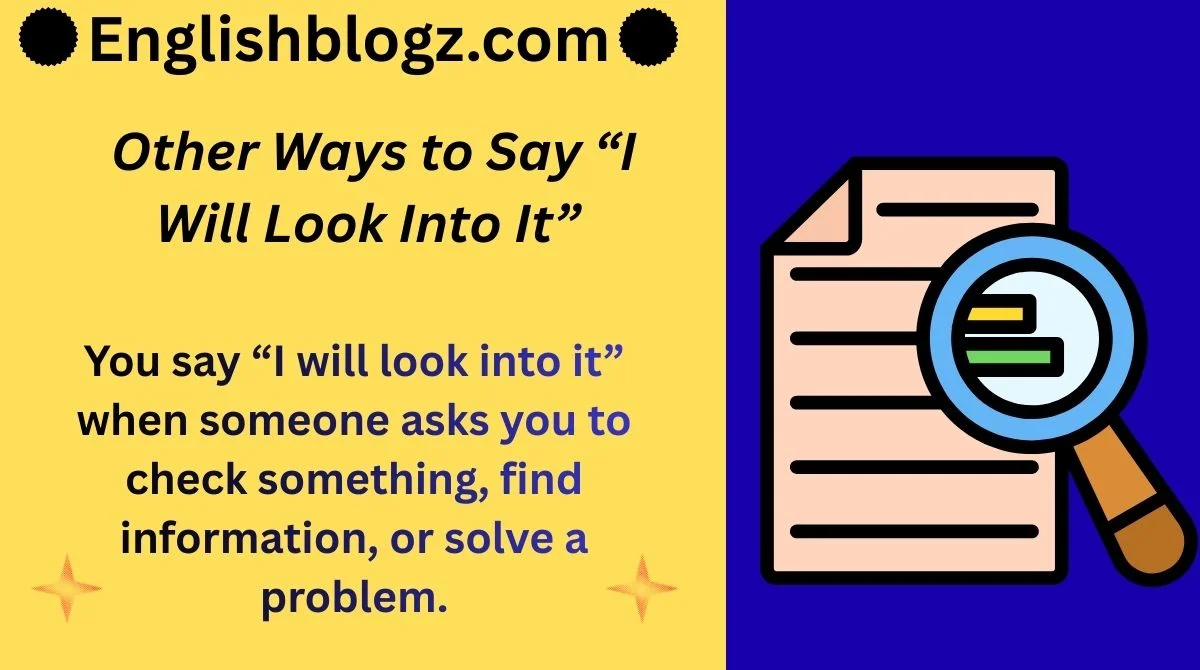
You say “I will look into it” when someone asks you to check something, find information, or solve a problem.
It’s common in work emails, meetings, and customer support. This phrase sounds polite, but it can feel vague or overused.
Using the same line again and again can make communication boring or unclear.
Choosing the right expression helps you show confidence, responsibility, and personality. It adjusts tone—professional, friendly, or casual.
It also shows English fluency, especially in business and academic communication.
Example:
Formal: “I will investigate the matter and update you soon.”
Informal: “I’ll check it out.”
This guide gives strong alternatives that sound natural and appropriate in every situation.
What the Phrase Means
Meaning: You’ll check information, research, or follow up.
Grammar: Verb phrase (future intention).
Synonyms: examine, review, check, verify, investigate.
Opposites: ignore it, not deal with it.
Sample sentences:
• “Thanks for sharing. I will look into it and get back to you.”
• “Don’t worry. I’ll look into the issue right away.”
When to Use the Phrase
Spoken English: Quick promise to check something soon.
Business English: When handling tasks, technical issues, client concerns.
Emails/Messages: Polite reply when info isn’t ready.
Social Media: When responding to a suggestion or complaint.
Academic Writing: When planning research or reviewing sources.
Professional Meetings: To show responsibility without rushing to answer.
Is It Polite or Professional?
It is polite and helpful, but sometimes too general. Tone depends on voice and context.
• Polite: Shows willingness to help
• Neutral: No strong emotion
• Soft: Non-committal (avoid if you must give a firm answer)
• Formal vs Informal: Works in both, but different alternatives can sound more natural
Etiquette tip:
Use clearer alternatives in corporate emails so people trust your follow-through.
Pros & Cons of Using the Phrase
✔ Pros:
• Safe and polite
• Flexible in many contexts
• Easy for all English levels
✘ Cons:
• Sounds vague or lazy in professional settings
• People may doubt you’ll actually solve the issue
• Repetitive and boring
Quick Alternatives List
Short and fast replacements you can copy into messages:
• I’ll check it.
• I’ll find out.
• Let me verify that.
• I’ll investigate.
• I’ll follow up.
• Let me confirm.
• I’ll review it.
• I’ll explore options.
• I’ll handle it.
• I’ll see what’s going on.
• I’ll ask the team.
• I’ll update you soon.
• I’ll get the details.
• Leave it with me.
• Let me look into this further.
• I’ll take care of it.
16 Powerful Alternatives with Detailed Usage
1) “I’ll check it out.”
Meaning: I’ll see what’s happening.
Explanation: Casual and quick. Shows you’re friendly and responsive.
Grammar Note: Phrasal verb.
Example: “That link isn’t working? I’ll check it out.”
Best Use: Texts, casual chats, friendly workplace.
Worst Use: Legal or formal business emails.
Tone: Friendly
Level: Beginner
Similarity Score: 9/10
Replaceability Tip: Use when something seems simple.
2) “I’ll investigate the issue.”
Meaning: I’ll check deeply and find the cause.
Explanation: Sounds serious and thorough.
Grammar Note: Verb, formal register.
Example: “Thank you for reporting the bug. I’ll investigate the issue.”
Best Use: Technical support, workplace reports.
Worst Use: Casual conversations.
Tone: Professional, strong
Level: Intermediate
Similarity Score: 9/10
Replaceability Tip: Use when you need to show accountability.
3) “Let me confirm that.”
Meaning: Let me check facts or details.
Explanation: Shows accuracy and care.
Grammar Note: Request phrase.
Example: “Let me confirm the booking for you.”
Best Use: Customer service, email.
Worst Use: When something needs long research.
Tone: Polite
Level: Intermediate
Similarity Score: 8/10
Replaceability Tip: Great for factual information.
4) “I’ll review it.”
Meaning: I’ll check carefully.
Explanation: Good for documents and ideas.
Grammar Note: Formal verb.
Example: “I’ll review the report before the meeting.”
Best Use: Workplace writing, academics.
Worst Use: Quick fixes or problems.
Tone: Neutral
Level: Intermediate
Similarity Score: 7/10
Replaceability Tip: Use when looking at text or data.
5) “I’ll look into this further.”
Meaning: Deeper research needed.
Explanation: Shows you understand complexity.
Grammar Note: Polite and formal.
Example: “I’ll look into this further and send an update tomorrow.”
Best Use: Email, professional conversation.
Worst Use: Super simple things.
Tone: Professional
Level: Advanced
Similarity Score: 10/10
Replaceability Tip: When original phrase feels too vague.
6) “I’ll take care of it.”
Meaning: You’ll handle everything.
Explanation: Confident and responsible.
Grammar Note: Idiomatic.
Example: “Don’t worry. I’ll take care of it.”
Best Use: Leadership, teamwork, customer care.
Worst Use: When you need others’ approval.
Tone: Strong
Level: Intermediate
Similarity Score: 8/10
Replaceability Tip: When you want to reassure someone.
7) “I’ll get the details.”
Meaning: I’ll gather info.
Explanation: Shows curiosity and planning.
Grammar Note: Neutral.
Example: “I’ll get the details and share them soon.”
Best Use: Workplace chats.
Worst Use: Problems needing urgent fixing.
Tone: Neutral
Level: Beginner
Similarity Score: 8/10
Replaceability Tip: Use for research tasks.
8) “Leave it with me.”
Meaning: You’ll handle it soon.
Explanation: Friendly, confident.
Grammar Note: Informal British-style phrase.
Example: “The file won’t open? Leave it with me.”
Best Use: Friendly workplace, quick issues.
Worst Use: Academic or formal writing.
Tone: Friendly
Level: Intermediate
Similarity Score: 7/10
Replaceability Tip: Use to show support.
9) “I’ll follow up on that.”
Meaning: I’ll ask others and continue progress.
Explanation: Shows responsibility and teamwork.
Grammar Note: Phrasal verb.
Example: “I’ll follow up with the design team today.”
Best Use: Business communication.
Worst Use: When you can solve alone.
Tone: Professional
Level: Intermediate
Similarity Score: 8/10
Replaceability Tip: Use when others are involved.
10) “I’ll find out.”
Meaning: I’ll discover the answer.
Explanation: Quick and confident.
Grammar Note: Neutral.
Example: “Not sure, but I’ll find out.”
Best Use: Fast replies, spoken English.
Worst Use: Formal documents.
Tone: Neutral
Level: Beginner
Similarity Score: 9/10
Replaceability Tip: Great for immediate replies.
11) “I’ll get right on it.”
Meaning: You’ll start immediately.
Explanation: Highly action-focused.
Grammar Note: Informal idiom.
Example: “Sure thing! I’ll get right on it.”
Best Use: Customer service, teamwork.
Worst Use: Academic writing.
Tone: Energetic
Level: Intermediate
Similarity Score: 7/10
Replaceability Tip: Use for urgent tasks.
12) “I’ll verify that information.”
Meaning: I’ll confirm accuracy.
Explanation: Shows professionalism and detail care.
Grammar Note: Formal.
Example: “I’ll verify that information and let you know.”
Best Use: Business, finance, law.
Worst Use: Casual chats.
Tone: Formal
Level: Advanced
Similarity Score: 7/10
Replaceability Tip: When accuracy matters.
13) “I’ll explore possible solutions.”
Meaning: I’ll check different options.
Explanation: Shows creative problem-solving.
Grammar Note: Professional phrasing.
Example: “I’ll explore possible solutions and update you soon.”
Best Use: Projects, planning roles.
Worst Use: Very small tasks.
Tone: Professional
Level: Advanced
Similarity Score: 6/10
Replaceability Tip: Use for problem-solving roles.
14) “I’ll see what I can do.”
Meaning: You’ll try your best.
Explanation: Softens expectation.
Grammar Note: Common informal phrase.
Example: “I’ll see what I can do about your request.”
Best Use: When unsure of success.
Worst Use: When you must take responsibility.
Tone: Soft, polite
Level: Intermediate
Similarity Score: 7/10
Replaceability Tip: Use when you’re not 100% sure.
15) “I’ll handle the situation.”
Meaning: You’ll solve the problem.
Explanation: Assertive and responsible.
Grammar Note: Strong leadership tone.
Example: “The client is upset? I’ll handle the situation.”
Best Use: Workplace leadership.
Worst Use: When you don’t have authority.
Tone: Confident
Level: Advanced
Similarity Score: 8/10
Replaceability Tip: Shows ownership.
16) “I’ll update you soon.”
Meaning: You’ll share results later.
Explanation: Focuses on communication.
Grammar Note: Very polite.
Example: “I’ll update you soon with the final numbers.”
Best Use: Email, messaging.
Worst Use: When no research is needed.
Tone: Polite
Level: Beginner
Similarity Score: 6/10
Replaceability Tip: Pair with a stronger phrase for full clarity.
Mini Dialogue Examples
Formal Meeting
A: “Do we know why the system crashed?”
B: “Not yet, but I’ll investigate the issue and update you soon.”
Informal Conversation
A: “The website looks weird.”
B: “Okay, I’ll check it out.”
Business Email
“Thank you for bringing this to my attention. I’ll review the document and follow up with the team by tomorrow.”
Common Mistakes to Avoid
• Saying “I will look into it” without giving a timeline
• Overusing it in every reply
• Using casual versions in formal writing
• Sounding unsure in situations requiring confidence
• Promising help when you can’t deliver
• Not following up after saying it
• Using slang in professional emails
Cultural & Tone Tips
US English: Direct alternatives sound better (I’ll take care of it).
UK English: Softer forms common (Leave it with me).
Casual social English: Shorter verbs like check, see, find out.
Native speakers often expect follow-up, not just words.
Comparison Table
| Phrase | Tone | Best Context | Professional Level | Example |
|---|---|---|---|---|
| I’ll investigate the issue | Strong, formal | Tech/workplace | Advanced | “I’ll investigate the issue and respond soon.” |
| I’ll follow up on that | Professional | Business emails | Intermediate | “I’ll follow up with HR today.” |
| I’ll take care of it | Confident | Teamwork, customers | Intermediate | “I’ll take care of it right away.” |
| I’ll review it | Neutral | Documents/reports | Intermediate | “I’ll review the report tonight.” |
| I’ll confirm that | Polite | Factual checks | Beginner | “Let me confirm that detail.” |
FAQs
Is “I will look into it” rude?
No, it’s polite. But sometimes sounds too vague.
Is it okay to use in emails?
Yes. But vary your language for clarity.
What is the most formal alternative?
“I will investigate the issue.”
What is the friendliest alternative?
“I’ll check it out.”
What is the most confident alternative?
“I’ll take care of it.”
What should beginners use?
Simple forms: “I’ll find out.” or “I’ll check it.”
Conclusion
Using different phrases makes your English sound natural and smart. It helps you show confidence at work and kindness in daily life.
Each situation needs a different tone—strong, friendly, or formal. These alternatives let you choose the best message every time.
Practice them in emails and conversations. Small changes in words create big improvements in communication skills.

“Jacob Harper makes English learning simple and fun. He shares tips to help everyone improve confidently.”