You’ve probably seen or used FYI many times. It’s short. It’s fast. It works.
But here’s the problem—FYI can sound lazy, cold, or unclear, especially in professional settings.
FYI means you’re sharing information. Nothing more. Nothing less.
However, how you share information matters.
Word choice changes:
- Your tone
- Your level of professionalism
- How polite or helpful you sound
In emails, meetings, essays, and daily conversations, using better alternatives helps you sound clear, confident, and natural.
Compare this:
- Informal: FYI, the meeting moved to Friday.
- Professional: Just to keep you informed, the meeting has been moved to Friday.
Same message. Very different impact.
This guide shows clear, natural, and context-smart alternatives so you always choose the right words.
What Does “FYI” Mean?
FYI stands for “For Your Information.”
Simple Meaning
It’s used to share information that the listener may need now or later.
Grammar Form
- Abbreviation / initialism
- Functions like a discourse marker
- Common in writing and speech
Similar Expressions
- Just so you know
- To let you know
Opposite Tone
- Commands like “You must know”
- Demands like “Pay attention to this”
Example Sentences
- FYI, the office will be closed tomorrow.
- FYI, I already sent the report.
When to Use “FYI”
Spoken English
Used casually among friends or coworkers.
Business English
Acceptable in internal chats. Risky in formal emails.
Emails & Messages
Works in quick updates. Avoid in formal requests.
Social Media
Common and friendly.
Academic Writing
Not recommended. Sounds informal.
Professional Meetings
Better replaced with polished alternatives.
Is “FYI” Polite or Professional?
FYI is neutral—but emotionally flat.
Tone Levels
- Polite: ❌ (not very)
- Neutral: ✅
- Strong: ❌
- Soft: ❌
- Formal: ❌
- Informal: ✅
Etiquette Tip
✔ Fine for internal messages
✘ Avoid in corporate emails, clients, or senior leadership communication
Pros & Cons of Using “FYI”
✔ Pros
- Short and fast
- Easy to understand
- Common in casual work chats
✘ Cons
- Can sound cold
- Feels dismissive to some readers
- Lacks warmth and clarity
Quick Alternatives List (For Busy Readers)
- Just so you know
- For your reference
- Please note
- I wanted to let you know
- As a heads-up
- To keep you informed
- Kindly note
- This is to inform you
- For awareness
- As information
- For your review
Just So You Know
Meaning
Sharing information casually.
Explanation
Friendly and natural. Often used in conversation or informal emails.
Grammar Note
Phrase / discourse marker.
Example Sentence
Just so you know, I’ll be late today.
Best Use
Informal speech, texts, friendly emails.
Worst Use
Formal reports or legal writing.
Tone
Friendly, soft.
Level
Beginner.
Similarity Score
9/10
Replaceability Tip
Use this when you want warmth without sounding formal.
Please Note
Meaning
Asking someone to pay attention to information.
Explanation
Polite and clear. Slightly formal.
Grammar Note
Formal phrase.
Example Sentence
Please note that the deadline has changed.
Best Use
Emails, notices, workplace communication.
Worst Use
Casual texts with friends.
Tone
Professional, neutral.
Level
Intermediate.
Similarity Score
8/10
Replaceability Tip
Choose this when clarity matters more than friendliness.
For Your Reference
Meaning
Information provided for future use.
Explanation
Not urgent. Often used with documents or links.
Grammar Note
Formal phrase.
Example Sentence
For your reference, I’ve attached last year’s report.
Best Use
Emails, documents, corporate settings.
Worst Use
Spoken casual English.
Tone
Formal, professional.
Level
Intermediate.
Similarity Score
7/10
Replaceability Tip
Perfect when sharing files or background details.
I Wanted to Let You Know
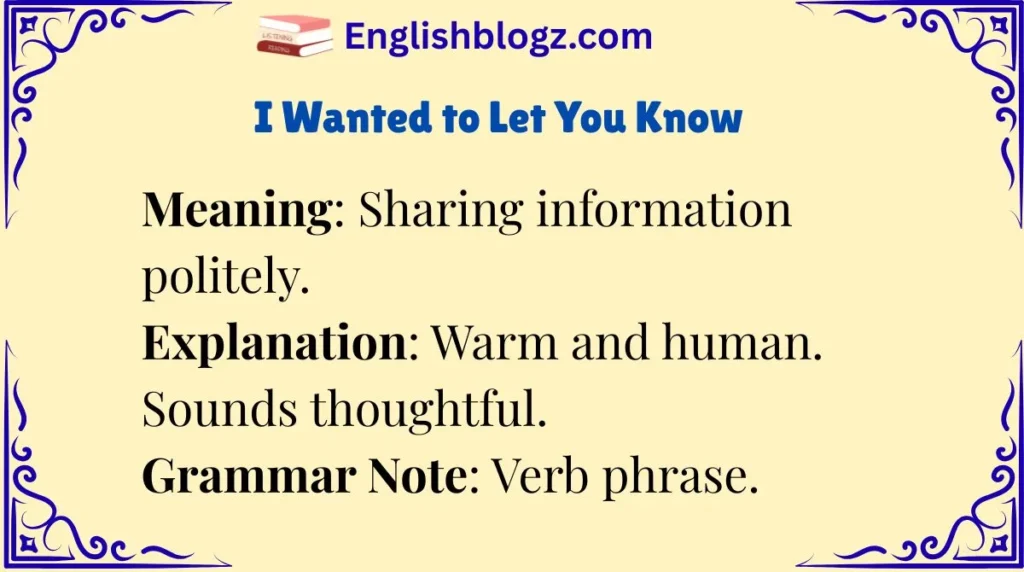
Meaning
Sharing information politely.
Explanation
Warm and human. Sounds thoughtful.
Grammar Note
Verb phrase.
Example Sentence
I wanted to let you know that the issue is resolved.
Best Use
Emails, workplace conversations.
Worst Use
Very short messages.
Tone
Polite, friendly.
Level
Beginner.
Similarity Score
8/10
Replaceability Tip
Use when tone matters more than speed.
As a Heads-Up
Meaning
Early warning or advance notice.
Explanation
Casual but helpful. Often used before changes.
Grammar Note
Idiom.
Example Sentence
As a heads-up, traffic may be heavy today.
Best Use
Work chats, spoken English.
Worst Use
Formal writing.
Tone
Friendly, informal.
Level
Intermediate.
Similarity Score
7/10
Replaceability Tip
Great for alerts without pressure.
To Keep You Informed
Meaning
Providing updates regularly.
Explanation
Professional and respectful.
Grammar Note
Infinitive phrase.
Example Sentence
To keep you informed, the project timeline has been updated.
Best Use
Emails, reports, professional settings.
Worst Use
Casual texting.
Tone
Professional, neutral.
Level
Advanced.
Similarity Score
7/10
Replaceability Tip
Best for ongoing updates.
Kindly Note
Meaning
Polite request to notice something.
Explanation
Formal and courteous. Common in international business English.
Grammar Note
Formal phrase.
Example Sentence
Kindly note that payments are due by Friday.
Best Use
Formal emails, notices.
Worst Use
Casual conversations.
Tone
Formal, polite.
Level
Advanced.
Similarity Score
6/10
Replaceability Tip
Use carefully—can sound stiff in US English.
This Is to Inform You
Meaning
Official notification.
Explanation
Direct and formal. Often used in announcements.
Grammar Note
Formal clause.
Example Sentence
This is to inform you that the office will remain closed.
Best Use
Official emails, notices.
Worst Use
Friendly emails.
Tone
Formal, strong.
Level
Advanced.
Similarity Score
6/10
Replaceability Tip
Choose this for official communication only.
For Awareness
Meaning
Sharing non-urgent information.
Explanation
Used in corporate environments.
Grammar Note
Prepositional phrase.
Example Sentence
For awareness, the system will be updated tonight.
Best Use
Business emails, reports.
Worst Use
Everyday speech.
Tone
Professional, neutral.
Level
Advanced.
Similarity Score
6/10
Replaceability Tip
Good when no action is required.
For Your Review
Meaning
Asking someone to look over information.
Explanation
Often paired with documents.
Grammar Note
Formal phrase.
Example Sentence
Attached is the draft for your review.
Best Use
Work emails.
Worst Use
Casual chatting.
Tone
Professional.
Level
Intermediate.
Similarity Score
5/10
Replaceability Tip
Use when feedback may follow.
Mini Dialogue Examples
Formal
Please note that the schedule has been updated.
Informal
Just so you know, I won’t be online later.
Business Email
To keep you informed, the client meeting has been rescheduled.
Mistakes to Avoid
- Using FYI in formal emails
- Sounding demanding with Please note
- Mixing casual phrases in academic writing
- Overusing one phrase repeatedly
- Using abbreviations with clients
- Forgetting tone and audience
Cultural & Tone Tips
US English
FYI can feel blunt. Polite alternatives are preferred.
UK English
Softer phrases sound more natural.
Casual Social English
FYI is common and acceptable.
Comparison Table
| Phrase | Tone | Best Context | Professional Level | Example |
|---|---|---|---|---|
| Just so you know | Friendly | Conversation | Low | Just so you know, plans changed |
| Please note | Neutral | Emails | Medium | Please note the update |
| For your reference | Formal | Documents | High | For your reference |
| To keep you informed | Professional | Reports | High | To keep you informed |
| As a heads-up | Casual | Speech | Low | As a heads-up |
FAQs
Is FYI rude?
Not rude, but it can sound cold.
Is FYI okay in emails?
Yes, but avoid it in formal emails.
What is the most formal alternative?
This is to inform you.
What is the most polite alternative?
I wanted to let you know.
What should beginners use?
Just so you know.
Can FYI sound passive-aggressive?
Yes, depending on tone and context.
Conclusion
Words shape how people hear you—even in writing.
While FYI is useful, it’s often too flat for professional or polite communication.
Using better alternatives helps you:
- Sound confident
- Communicate clearly
- Match tone with context
The more expressions you know, the more natural your English becomes.
Practice these phrases in emails, meetings, and conversations.
Soon, choosing the right words will feel automatic.

“Jacob Harper makes English learning simple and fun. He shares tips to help everyone improve confidently.”