When you send an important message, the follow-up is always tricky. You want to know if the other person saw your email, but you don’t want to sound impatient or rude.
The common phrase many English learners use is “Did you receive my email?” It’s clear and direct. However, if you use the same sentence again and again, it can feel repetitive or even demanding.
Choosing different expressions helps you sound more natural, polite, and professional. In business communication, your tone matters just as much as your words.
A formal workplace might prefer something like “Could you please confirm you received my email?” while friends would use “Hey, did you get my email?”
With better alternatives, you’ll write emails that show respect, confidence, and great communication skills.
What does “Did you receive my email?” mean?
This sentence asks if the person successfully got and read your message.
It’s a question using the verb “receive” in the past tense.
You can also use simple synonyms like get, see, or check.
Example sentences:
• Did you receive my email about the meeting tomorrow?
• I just wanted to check if you got my message earlier.
It’s a useful phrase but sometimes too direct or too serious depending on the situation.
When to Use “Did you receive my email?”
It fits best when:
Spoken English
You want verbal confirmation, especially after sending something important.
Business English
You need a clear, professional question.
Emails / Messages
Perfect for follow-ups when you’re waiting for a reply.
Social Media
Works in private messages but can sound stiff.
Academic writing
Okay for emailing teachers or universities, but softer options are better.
Professional meetings
Useful if you’re confirming documents or reports.
Is “Did you receive my email?” polite or professional?
It’s neutral. Not rude, not overly polite.
Tone levels:
• Polite but can sound firm
• Neutral for workplace communication
• If repeated, it may look impatient
• It’s okay in corporate emails but better with a friendly opener
Etiquette tip:
Always thank the receiver or remind them briefly what the message was about. Example: Hi Sarah, I hope you’re well. Did you receive my email about the project plan?
Pros & Cons of Using the Phrase
✔ Pros:
• Clear meaning
• Good for formal emails
• Works in almost every situation
✘ Cons:
• Repetitive if used often
• May sound pushy without context
• Can feel too serious in friendly chats
Quick Alternatives List (Short and Simple)
• Have you seen my email?
• Did you get my message?
• Just checking in about my email.
• Can you confirm you received my email?
• Did my email reach you?
• Any update on my email?
• Hope you saw my email earlier.
• Please let me know if you got my email.
• Following up on my email below.
• Wanted to make sure my email came through.
• Have you had a chance to look at my email?
• Did you manage to read my email yet?
• Just making sure my email didn’t end up in spam.
• I’m reaching out again about my email.
• Do you have any feedback on my email?
15+ Strong Alternatives with Full Usage Guide
Have you seen my email?
Meaning: Asking if they noticed or read it.
Explanation: Softer and more casual than “receive.”
Grammar Note: Present perfect question.
Example Sentence: Have you seen my email about the trip details?
Best Use: Casual work chats, texts
Worst Use: Formal corporate communication
Tone: Friendly
Level: Beginner
Similarity Score: 9/10
Replaceability Tip: Great for gentle reminders.
Did you get my message?
Meaning: Simple question about receipt.
Explanation: Works for emails, texts, or DMs.
Grammar Note: Simple past question.
Example Sentence: Did you get my message about tomorrow’s plan?
Best Use: Informal conversations
Worst Use: Academic or formal emails
Tone: Casual
Level: Beginner
Similarity Score: 8/10
Replaceability Tip: Use when you don’t know if it was email or text.
Can you confirm you received my email?
Meaning: You need confirmation.
Explanation: Very professional and careful.
Grammar Note: Modal verb “can.”
Example Sentence: Can you confirm you received my email with the invoice attached?
Best Use: Business correspondence
Worst Use: Casual chats
Tone: Formal, Professional
Level: Intermediate
Similarity Score: 10/10
Replaceability Tip: Excellent when deadlines are important.
Any update on my email?
Meaning: You expect action, not just confirmation.
Explanation: Good for follow-ups after silence.
Grammar Note: Short question fragment
Example Sentence: Any update on my email from Monday?
Best Use: Workplace, projects
Worst Use: First follow-up, friendly messaging
Tone: Strong but polite
Level: Intermediate
Similarity Score: 7/10
Replaceability Tip: Use when you need progress.
Following up on my previous email.
Meaning: You are sending a reminder.
Explanation: Very common in office communication.
Grammar Note: Introductory phrase
Example Sentence: Following up on my previous email regarding the client meeting.
Best Use: Business emails
Worst Use: Text messages
Tone: Professional
Level: Intermediate
Similarity Score: 9/10
Replaceability Tip: Prefer for delayed responses.
Just checking in about my email.
Meaning: Soft reminder.
Explanation: Shows patience and kindness.
Grammar Note: Gerund phrase
Example Sentence: Just checking in about my email from yesterday.
Best Use: Work emails, friendly reminders
Worst Use: Formal letters
Tone: Soft, Polite
Level: Beginner
Similarity Score: 8/10
Replaceability Tip: Use when you don’t want pressure.
Did my email reach you?
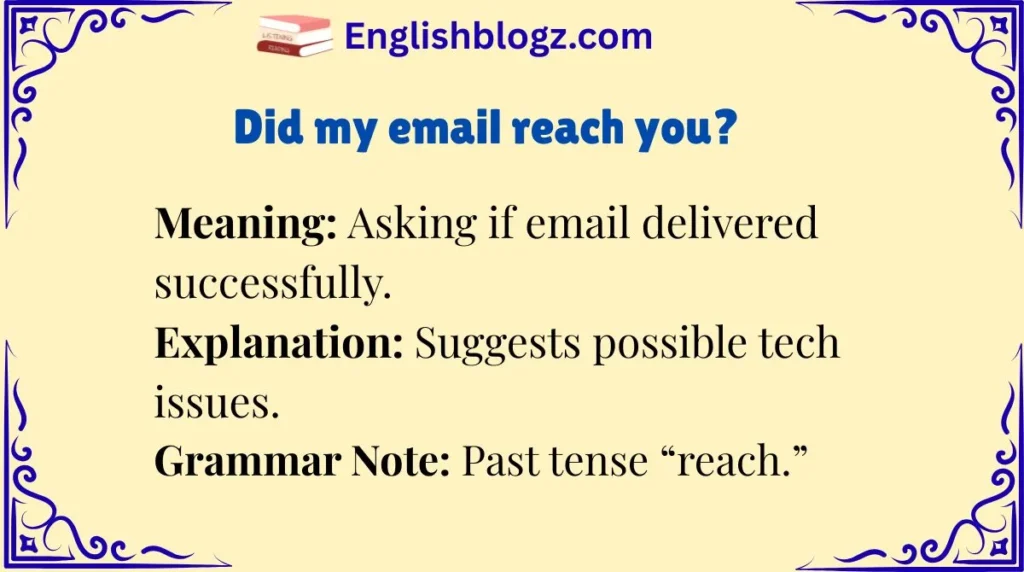
Meaning: Asking if email delivered successfully.
Explanation: Suggests possible tech issues.
Grammar Note: Past tense “reach.”
Example Sentence: Did my email reach you or did it go to spam?
Best Use: When unsure about delivery
Worst Use: When asking about reply updates
Tone: Polite
Level: Intermediate
Similarity Score: 9/10
Replaceability Tip: Great for first reminders.
Hope you saw my email earlier.
Meaning: Gentle reminder to read.
Explanation: Friendly and soft tone.
Grammar Note: Informal reduced sentence
Example Sentence: Hope you saw my email about the assignment.
Best Use: Peers, colleagues
Worst Use: Academic applications
Tone: Friendly
Level: Beginner
Similarity Score: 8/10
Replaceability Tip: Use with colleagues you know well.
I’m reaching out again about my email.
Meaning: Second or third follow-up.
Explanation: Shows persistence professionally.
Grammar Note: Present continuous
Example Sentence: I’m reaching out again about my email regarding next week’s session.
Best Use: Professional reminders
Worst Use: Casual texting
Tone: Formal
Level: Intermediate
Similarity Score: 7/10
Replaceability Tip: Good when previous messages ignored.
Do you have any feedback on my email?
Meaning: Request for a response, not just seen.
Explanation: Focus on review/action.
Grammar Note: Question with “do.”
Example Sentence: Do you have any feedback on my email draft?
Best Use: Team projects
Worst Use: First reminder
Tone: Professional
Level: Intermediate
Similarity Score: 6/10
Replaceability Tip: Best when response required.
Please let me know if you got my email.
Meaning: Polite follow-up.
Explanation: Shows respect using “please.”
Grammar Note: Imperative with polite tone
Example Sentence: Please let me know if you got my email about the schedule.
Best Use: Customer support, service emails
Worst Use: Informal texting
Tone: Polite
Level: Beginner
Similarity Score: 10/10
Replaceability Tip: Safe for all business emails.
Did you manage to read my email yet?
Meaning: Asking if they had time to check it.
Explanation: A bit more pressure than “receive.”
Grammar Note: Modal verb “manage.”
Example Sentence: Did you manage to read my email about the document approval?
Best Use: Projects needing immediate review
Worst Use: Formal requests to older people
Tone: Neutral
Level: Intermediate
Similarity Score: 7/10
Replaceability Tip: Use when waiting for comments.
Just making sure my email didn’t go to your spam.
Meaning: Funny and polite reminder.
Explanation: Blames the system, not the person.
Grammar Note: Informal phrase
Example Sentence: Just making sure my email didn’t go to your spam folder.
Best Use: Friendly workplaces
Worst Use: Very formal business
Tone: Light, casual
Level: Intermediate
Similarity Score: 7/10
Replaceability Tip: Perfect for softening follow-ups.
Have you had a chance to look at my email?
Meaning: Asking if they read your message.
Explanation: Sheer politeness and patience.
Grammar Note: Present perfect
Example Sentence: Have you had a chance to look at the report I emailed you?
Best Use: Corporate emails
Worst Use: Quick casual chat
Tone: Polite, Formal
Level: Intermediate
Similarity Score: 9/10
Replaceability Tip: Great follow-up for managers or clients.
Wanted to confirm you got my email.
Meaning: Delivery check.
Explanation: Short, efficient workplace language.
Grammar Note: Informal sentence fragment
Example Sentence: Wanted to confirm you got my email with the attachments.
Best Use: Work messages
Worst Use: Academic letters
Tone: Neutral
Level: Intermediate
Similarity Score: 8/10
Replaceability Tip: Good when you’re busy.
Any thoughts on my email? (Bonus Alternative)
Meaning: Asking for opinions or a response.
Explanation: Encourages engagement.
Grammar Note: Short question
Example Sentence: Any thoughts on my email proposal?
Best Use: Team projects, negotiations
Worst Use: first confirmation
Tone: Polite
Level: Intermediate
Similarity Score: 6/10
Replaceability Tip: Use when you need a decision.
Mini Dialogue Examples
Formal
A: Good morning Mr. Khan. Have you had a chance to look at my email from Tuesday?
B: Yes, I’ll respond shortly. Thanks for the reminder.
Informal
A: Hey! Did you get my message about the party?
B: Yeah! I’ll be there!
Business Email Style
Hi Maria,
Following up on my previous email regarding the contract draft. Please let me know if you need any more details.
Best regards,
Arman
Mistakes to Avoid
• Sounding impatient: don’t repeat follow-ups too fast
• Using a rude tone with bosses or clients
• Forgetting polite starters like Hi or Hope you’re well
• Not reminding what the email was about
• Using slang in formal messages
• Writing in ALL CAPS
• Asking twice in the same email
Cultural & Tone Tips
US English
More casual wording is acceptable in workplaces.
UK English
Understatement and politeness matter more. Softer forms are better.
Casual social English
Short versions like Did you get my email? or even emojis are okay.
General rule: Match your tone to your relationship with the person.
Comparison Table: Best Alternatives
| Phrase | Tone | Best Context | Professional Level | Example |
|---|---|---|---|---|
| Can you confirm you received my email? | Formal | Business, clients | High | Please confirm you received my email with the form. |
| Following up on my previous email. | Professional | Reminders | High | Following up on my earlier message about payroll. |
| Have you had a chance to look at my email? | Polite | Corporate | Intermediate | Have you had a chance to look at the request form? |
| Just checking in about my email. | Soft | Friendly offices | Intermediate | Just checking in about my email from Friday. |
| Did you get my message? | Casual | Friends | Beginner | Did you get my message last night? |
FAQs
Is “Did you receive my email?” rude?
No, but it can sound impatient without polite wording.
Is it okay in professional emails?
Yes. Add a greeting and a thank-you to soften the tone.
What is the most formal alternative?
Can you please confirm you received my email?
What is the most polite option?
Have you had a chance to look at my email?
What should beginners use?
Did you get my message? or Please let me know if you got my email.
How long should I wait before following up?
At least 24–48 hours for normal work tasks.
Conclusion
Good communication is more than just words. When you follow up on emails, tone matters. Using fresh and polite alternatives shows you respect the other person’s time and helps you sound fluent and confident.
With a strong variety of expressions, you can handle business talks, everyday chats, and professional emails more easily.
Practice these alternatives and choose the one that fits the situation best. Your English will feel more natural and your communication more successful.

“Jacob Harper makes English learning simple and fun. He shares tips to help everyone improve confidently.”