The phrase “by the way” feels simple, friendly, and natural. You hear it every day. People use it to add extra information, change topics, or mention something they almost forgot.
However, using the same phrase again and again can make your English sound basic or repetitive.That’s why alternatives matter.
The words you choose affect tone, clarity, and professionalism. A casual phrase works in conversation with friends but may sound careless in emails, meetings, or academic writing. On the other hand, a formal phrase used in a chat can feel stiff or awkward.
Strong speakers and writers vary their language. They adjust their words based on the situation.
Example contrast
Informal: “By the way, I can’t come tomorrow.”
Formal: “I would also like to mention that I won’t be available tomorrow.”
Same idea. Very different tone.
What Does “By the Way” Mean?
Student-friendly definition
“By the way” is used to add extra information that is not the main topic. It often introduces something new, unexpected, or remembered late.
Grammar form
Interjection / discourse marker
(It doesn’t change tense or sentence structure.)
Similar meanings
Also
Additionally
I should mention
Incidentally
Opposite tone ideas
Main point
Most importantly
Above all
Sample sentences
“By the way, your keys are on the table.”
“I enjoyed the meeting. By the way, thanks for the support.”
When to Use “By the Way”
Spoken English
Very common and natural in daily conversation.
Business English
Acceptable in relaxed workplaces but risky in formal settings.
Emails / Messages
Fine for friendly emails. Avoid in corporate or client-facing emails.
Social media
Perfectly natural and widely used.
Academic writing
Not recommended. Sounds too casual.
Professional meetings
Use sparingly. Replace with more structured phrases when needed.
Is “By the Way” Polite or Professional?
Polite: Yes, in casual speech
Neutral: Mostly
Soft: Yes
Strong: No
Formal: No
Informal: Yes
Etiquette tip:
“By the way” works best in friendly environments. Avoid it in official emails, reports, or presentations where clarity and structure matter.
Pros & Cons of Using “By the Way”
✔ Pros
- Sounds natural and friendly
- Easy to use
- Helps add small details smoothly
✘ Cons
- Too casual for professional writing
- Can sound unplanned or careless
- Overuse weakens fluency
Quick Alternatives List
- Also
- Additionally
- I should mention
- Just so you know
- Incidentally
- As a side note
- Another thing
- On a related note
- I’d like to add
- For your information
- It’s worth noting
- Moreover
- Furthermore
- Before I forget
- One more thing
Expanded Alternatives
Also
Meaning:
Adds extra information.
Explanation:
Clear, simple, and neutral. One of the safest replacements.
Grammar Note:
Adverb
Example Sentence:
“I sent the report. Also, I updated the spreadsheet.”
Best Use:
Email, workplace, writing
Worst Use:
Very formal academic papers
Tone:
Neutral
Level:
Beginner
Similarity Score:
7/10
Replaceability Tip:
Use when you want clarity without emotion.
Additionally
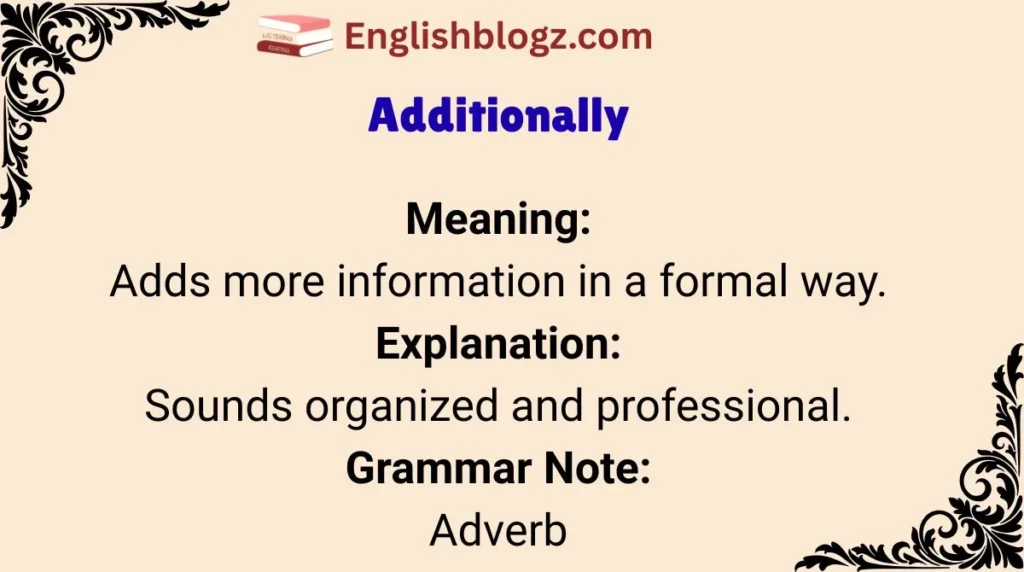
Meaning:
Adds more information in a formal way.
Explanation:
Sounds organized and professional.
Grammar Note:
Adverb
Example Sentence:
“Additionally, we need approval from management.”
Best Use:
Business, academic writing
Worst Use:
Casual conversation
Tone:
Formal
Level:
Intermediate
Similarity Score:
6/10
Replaceability Tip:
Choose this in reports or formal emails.
Incidentally
Meaning:
Mentions something slightly unrelated.
Explanation:
Elegant and natural in educated speech.
Grammar Note:
Adverb
Example Sentence:
“Incidentally, your idea was approved.”
Best Use:
Formal speech, writing
Worst Use:
Text messages
Tone:
Polite, refined
Level:
Advanced
Similarity Score:
8/10
Replaceability Tip:
Perfect when adding side information politely.
Just So You Know
Meaning:
Gives information for awareness.
Explanation:
Friendly but slightly informal.
Grammar Note:
Phrase
Example Sentence:
“Just so you know, the meeting starts early.”
Best Use:
Texts, friendly emails
Worst Use:
Academic or legal writing
Tone:
Friendly
Level:
Beginner
Similarity Score:
7/10
Replaceability Tip:
Use when informing, not announcing.
I Should Mention
Meaning:
Introduces something important but secondary.
Explanation:
Feels thoughtful and intentional.
Grammar Note:
Verb phrase
Example Sentence:
“I should mention that the deadline changed.”
Best Use:
Meetings, emails
Worst Use:
Very casual chats
Tone:
Professional
Level:
Intermediate
Similarity Score:
9/10
Replaceability Tip:
Great for polite professional updates.
As a Side Note
Meaning:
Adds extra detail without focus.
Explanation:
Organized and soft.
Grammar Note:
Phrase
Example Sentence:
“As a side note, parking is limited.”
Best Use:
Presentations, emails
Worst Use:
Fast conversation
Tone:
Neutral
Level:
Intermediate
Similarity Score:
8/10
On a Related Note
Meaning:
Connects information to the topic.
Explanation:
Sounds logical and smooth.
Grammar Note:
Phrase
Example Sentence:
“On a related note, we should review the budget.”
Best Use:
Meetings, writing
Worst Use:
Casual texting
Tone:
Professional
Level:
Intermediate
Similarity Score:
7/10
Before I Forget
Meaning:
Adds something remembered late.
Explanation:
Casual and honest.
Grammar Note:
Clause
Example Sentence:
“Before I forget, call the client.”
Best Use:
Spoken English
Worst Use:
Formal writing
Tone:
Friendly
Level:
Beginner
Similarity Score:
9/10
For Your Information
Meaning:
Shares information officially.
Explanation:
Firm and sometimes serious.
Grammar Note:
Fixed phrase
Example Sentence:
“For your information, the policy has changed.”
Best Use:
Workplace
Worst Use:
Casual chats
Tone:
Strong, professional
Level:
Intermediate
Similarity Score:
6/10
It’s Worth Noting
Meaning:
Highlights an important detail.
Explanation:
Common in formal English.
Grammar Note:
Phrase
Example Sentence:
“It’s worth noting that results vary.”
Best Use:
Reports, essays
Worst Use:
Texts
Tone:
Formal
Level:
Advanced
Similarity Score:
6/10
Moreover
Meaning:
Adds strong supporting information.
Explanation:
Structured and academic.
Grammar Note:
Adverb
Example Sentence:
“Moreover, costs have increased.”
Best Use:
Academic writing
Worst Use:
Conversation
Tone:
Formal
Level:
Advanced
Similarity Score:
5/10
Furthermore
Meaning:
Adds emphasis.
Explanation:
Very formal and logical.
Grammar Note:
Adverb
Example Sentence:
“Furthermore, the issue remains unresolved.”
Best Use:
Reports
Worst Use:
Casual speech
Tone:
Formal
Level:
Advanced
Similarity Score:
5/10
Another Thing
Meaning:
Adds an extra point casually.
Explanation:
Natural and spoken.
Grammar Note:
Phrase
Example Sentence:
“Another thing, don’t forget the charger.”
Best Use:
Conversation
Worst Use:
Professional writing
Tone:
Casual
Level:
Beginner
Similarity Score:
8/10
I’d Like to Add
Meaning:
Introduces extra information politely.
Explanation:
Clear and professional.
Grammar Note:
Verb phrase
Example Sentence:
“I’d like to add that training is required.”
Best Use:
Meetings, emails
Worst Use:
Fast chats
Tone:
Professional
Level:
Intermediate
Similarity Score:
9/10
By the Way → One More Thing
Meaning:
Adds final information.
Explanation:
Friendly and conversational.
Grammar Note:
Phrase
Example Sentence:
“One more thing, thanks for your help.”
Best Use:
Spoken English
Worst Use:
Formal writing
Tone:
Friendly
Level:
Beginner
Similarity Score:
9/10
Mini Dialogue Examples
Formal
“Before we conclude, I’d like to add that the schedule has changed.”
Informal
“Oh, by the way, I found your wallet.”
Business Email Style
“I should mention that the revised document is attached.”
Mistakes to Avoid
- Using “by the way” in academic essays
- Overusing it in one conversation
- Placing it mid-sentence incorrectly
- Using formal alternatives in casual chats
- Using strong phrases with friends
- Forgetting punctuation in writing
Cultural & Tone Tips
US English:
Very common and relaxed.
UK English:
Used often but slightly softer alternatives are preferred in writing.
Casual social English:
Perfectly natural.
Native speakers feel “by the way” is friendly but unplanned.
Comparison Table
| Phrase | Tone | Best Context | Professional Level | Example |
|---|---|---|---|---|
| I should mention | Professional | Emails | High | I should mention the update |
| Incidentally | Polite | Writing | High | Incidentally, we agreed |
| Just so you know | Friendly | Texts | Low | Just so you know |
| Additionally | Formal | Reports | Very high | Additionally, costs rose |
| One more thing | Casual | Speech | Low | One more thing |
FAQs
Is “by the way” rude?
No. It’s friendly but informal.
Is it okay in emails?
Yes, in casual emails only.
What is the most formal alternative?
“Additionally” or “Furthermore.”
What is the most polite alternative?
“I should mention.”
What should beginners use?
“Also” or “Another thing.”
Can I use it in meetings?
Yes, but limit it.
Conclusion
Words shape how people hear you.
Using only “by the way” limits your expression. When you learn alternatives, your English becomes clearer, stronger, and more professional.
Different situations need different tones. Friendly chats need soft phrases. Emails need structure. Reports need precision.
Practice these alternatives in real conversations. Try them in emails. Listen to how native speakers switch phrases.
Small changes create big fluency gains.

“Jacob Harper makes English learning simple and fun. He shares tips to help everyone improve confidently.”