“Best regards” is one of the most common ways to end a letter, email, or message. It signals politeness, respect, and a professional tone.
However, using the same phrase repeatedly can feel repetitive or even impersonal. Choosing the right alternative can make your message warmer, clearer, or more suitable for your audience.
For example, in a formal email to a client, “Best regards” works perfectly. But in a casual text to a coworker, “Cheers” might feel friendlier and more natural.
Understanding these subtle differences can improve your communication in business, social media, emails, and everyday conversation.
Using varied expressions also helps English learners sound more fluent and confident.
What Does “Best Regards” Mean?
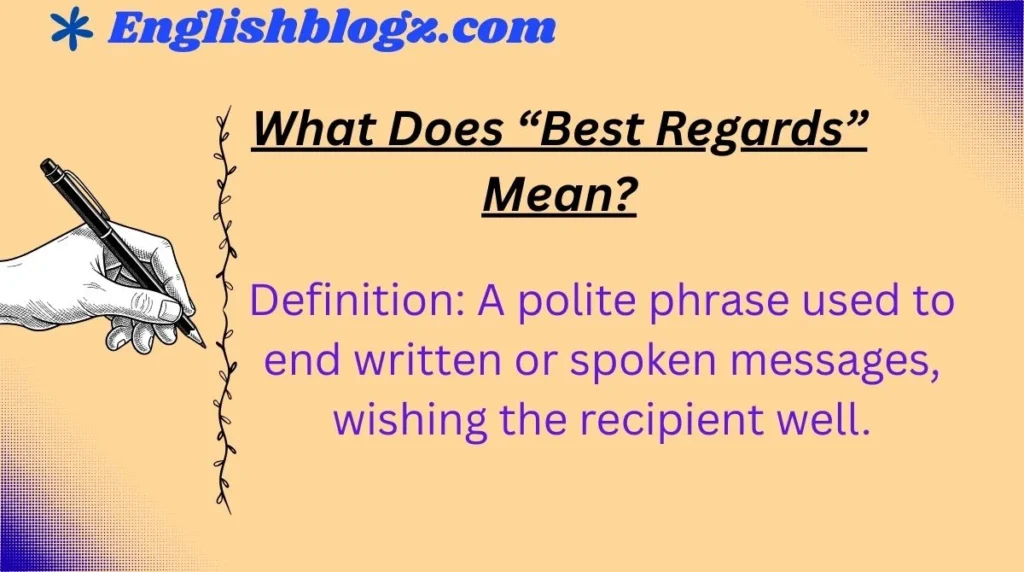
Definition: A polite phrase used to end written or spoken messages, wishing the recipient well.
Grammar Form: Noun phrase, often used as a closing in letters or emails.
Synonyms: Kind regards, Warm regards, Sincerely, Yours truly
Opposite Tone: Rude, casual, or abrupt endings like “Bye” or no closing at all
Example Sentences:
- I hope this email finds you well. Best regards,
- Thank you for your help with the project. Kind regards,
When to Use “Best Regards”
Spoken English: Rarely used, unless reading aloud or in formal speech.
Business English: Ideal for client emails, professional correspondence, and LinkedIn messages.
Emails / Messages: Standard for almost all professional and semi-formal emails.
Social Media: Less common; prefer informal alternatives like “Cheers” or “Thanks.”
Academic Writing: Use in emails to professors, researchers, or formal academic correspondence.
Professional Meetings: Can be used in written meeting follow-ups, not spoken.
Is “Best Regards” Polite or Professional?
Tone Levels:
- Polite: ✅ Shows respect
- Neutral: ✅ Standard, safe choice
- Strong: ⚠ Not assertive; neutral enough to avoid offense
- Soft: ✅ Friendly without being too casual
Formal vs Informal:
- More formal than “Cheers” or “Thanks.”
- Better for workplace emails than casual texts.
- Avoid using it in casual group chats with close friends.
Etiquette Tip: Always capitalize the first letter of both words. Never use it mid-sentence.
Pros & Cons of Using “Best Regards”
✔ Pros:
- Universally recognized in professional communication
- Polite and neutral
- Safe choice for most audiences
✘ Cons:
- Can feel repetitive if overused
- May seem impersonal in very casual emails
- Limited emotional nuance
Quick Alternatives List (One-Line Phrases Only)
- Kind regards
- Warm regards
- Regards
- Sincerely
- Yours truly
- Yours faithfully
- All the best
- Best wishes
- Cheers
- Many thanks
- Thanks again
- With appreciation
- Respectfully
- Cordially
- With best wishes
- Yours sincerely
- Take care
- Thank you
- Faithfully yours
- With gratitude
- Warmest regards
- With respect
- Fond regards
- Best
- Be well
- In appreciation
- Yours respectfully
- With thanks
- Stay well
- Appreciatively
- Peace
10 Alternatives to “Best Regards”
Kind Regards
Meaning: A polite, professional closing similar to “Best regards.”
Explanation: Slightly warmer than “Best regards,” appropriate for professional emails.
Grammar Note: Formal phrase
Example Sentence: Kind regards, Sarah
Best Use: Email, workplace
Worst Use: Informal texts with friends
Tone: Professional / Friendly
Level: Beginner
Similarity Score: 9/10
Replaceability Tip: Use when you want warmth but remain professional
Warm Regards
Meaning: Friendly, positive closing
Explanation: Conveys warmth without losing professionalism
Grammar Note: Formal phrase
Example Sentence: Warm regards, Tom
Best Use: Emails, letters
Worst Use: Very formal or legal documents
Tone: Friendly / Professional
Level: Intermediate
Similarity Score: 8/10
Replaceability Tip: Use for colleagues you know well
Regards
Meaning: Simple, neutral closing
Explanation: Shorter, minimalist alternative to “Best regards”
Grammar Note: Formal / neutral
Example Sentence: Regards, Alex
Best Use: Email, workplace
Worst Use: Close friends or informal chats
Tone: Neutral
Level: Beginner
Similarity Score: 8/10
Replaceability Tip: Use when you need brevity
Sincerely
Meaning: Expressing genuine or formal closing
Explanation: Strong formal tone; widely accepted in letters
Grammar Note: Formal phrase
Example Sentence: Sincerely, Jane Doe
Best Use: Formal letters, job applications
Worst Use: Casual messages
Tone: Formal / Professional
Level: Beginner
Similarity Score: 7/10
Replaceability Tip: Best for job-related emails
Yours Truly
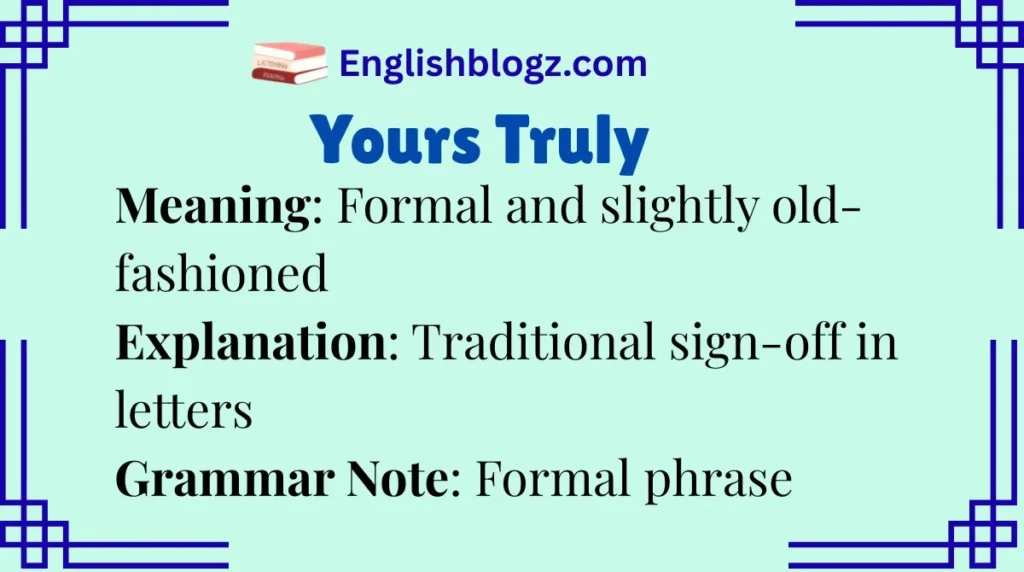
Meaning: Formal and slightly old-fashioned
Explanation: Traditional sign-off in letters
Grammar Note: Formal phrase
Example Sentence: Yours truly, Michael
Best Use: Letters, official correspondence
Worst Use: Emails to modern colleagues
Tone: Formal
Level: Intermediate
Similarity Score: 6/10
Replaceability Tip: Use in formal letters for a classic touch
Yours Faithfully
Meaning: Very formal
Explanation: Used when the recipient’s name is unknown
Grammar Note: Formal phrase
Example Sentence: Yours faithfully, John Smith
Best Use: Business letters
Worst Use: Informal or email communication
Tone: Formal
Level: Advanced
Similarity Score: 6/10
Replaceability Tip: Traditional British business letters
All the Best
Meaning: Friendly closing
Explanation: Less formal, casual, yet polite
Grammar Note: Informal phrase
Example Sentence: All the best, Emma
Best Use: Friendly emails, colleagues
Worst Use: Legal documents or highly formal contexts
Tone: Friendly / Soft
Level: Beginner
Similarity Score: 7/10
Replaceability Tip: Use for informal professional interactions
Best Wishes
Meaning: Warm, polite farewell
Explanation: Conveys care and positivity
Grammar Note: Formal / semi-formal phrase
Example Sentence: Best wishes, Martin
Best Use: Personal emails, farewell letters
Worst Use: Highly formal corporate emails
Tone: Friendly / Professional
Level: Beginner
Similarity Score: 7/10
Replaceability Tip: Suitable for friendly workplace emails
Cheers
Meaning: Casual, upbeat
Explanation: Very informal; friendly sign-off
Grammar Note: Slang / informal phrase
Example Sentence: Cheers, Liam
Best Use: Text messages, casual emails
Worst Use: Formal business emails
Tone: Friendly / Casual
Level: Beginner
Similarity Score: 5/10
Replaceability Tip: Use with peers or friends
Many Thanks
Meaning: Expressing gratitude
Explanation: Polite and friendly; emphasizes thankfulness
Grammar Note: Informal / semi-formal phrase
Example Sentence: Many thanks, Sophie
Best Use: Emails, messages
Worst Use: Highly formal letters
Tone: Friendly / Polite
Level: Beginner
Similarity Score: 7/10
Replaceability Tip: Use when thanking someone specifically
Mini Dialogue Examples
Formal Dialogue:
- A: I have sent the quarterly report.
- B: Thank you. Best regards,
- A: You’re welcome.
Informal Dialogue:
- A: Can you send me the meeting notes?
- B: Sure! Cheers,
- A: Thanks!
Business Email Example:
Dear Mr. Johnson,

Thank you for reviewing the proposal. Please find my comments attached.

Best regards,
Anna Smith
Mistakes to Avoid
- Using “Best regards” in casual group chats.
- Forgetting to capitalize the first letters.
- Using it mid-sentence instead of at the end.
- Overusing the same closing repeatedly in multiple emails.
- Confusing “Yours faithfully” with “Yours sincerely” in formal letters.
- Using informal phrases in highly formal emails.
- Mixing formal and casual tones in the same message.
Cultural & Tone Tips
- UK English: “Yours faithfully” for unknown recipients, “Yours sincerely” for known recipients.
- US English: “Sincerely” and “Best regards” are most common; casual closings like “Cheers” are informal.
- Casual Social English: Phrases like “Cheers,” “Take care,” or “All the best” feel natural.
Comparison Table of 7 Best Alternatives
| Phrase | Tone | Best Context | Professional Level | Example |
|---|---|---|---|---|
| Kind regards | Friendly | Email, workplace | Beginner | Kind regards, Sarah |
| Warm regards | Warm | Colleagues, clients | Intermediate | Warm regards, Tom |
| Regards | Neutral | Short emails | Beginner | Regards, Alex |
| Sincerely | Formal | Job applications | Beginner | Sincerely, Jane Doe |
| Yours truly | Formal | Letters | Intermediate | Yours truly, Michael |
| All the best | Friendly | Colleagues, friends | Beginner | All the best, Emma |
| Cheers | Casual | Peers, informal email | Beginner | Cheers, Liam |
FAQs
Is “Best regards” rude?
No, it is polite and professional.
Is it okay in emails?
Yes, it is standard for most professional emails.
What is the most formal alternative?
“Yours faithfully” or “Sincerely.”
What is the most polite alternative?
“Kind regards” or “Warm regards.”
What should beginners use?
“Best regards,” “Kind regards,” or “Sincerely.”
Can it be used in casual messages?
It’s safe but can feel stiff; informal alternatives like “Cheers” work better.
Conclusion
Using alternatives to “Best regards” improves clarity, tone, and professionalism. Word choice can make your messages sound friendlier, more formal, or more personal.
English learners and professionals can practice these phrases in emails, texts, and letters to build confidence.
Varying closings keeps communication fresh, natural, and context-appropriate, making you sound fluent and thoughtful.

“Jacob Harper makes English learning simple and fun. He shares tips to help everyone improve confidently.”